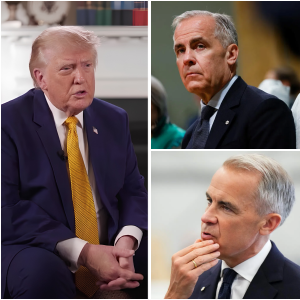
China just offered Canada something it NEVER offered the United States — and Mark Carney quietly accepted it while Washington was distracted by tariffs, headlines, and political drama.

What happened behind closed doors in Beijing may eventually become one of the biggest geopolitical turning points in modern North American history. While much of the world focused on Donald Trump’s escalating trade rhetoric and growing economic tensions with China, Canada appears to have been building a completely different strategy in silence.
According to reports circulating through diplomatic and trade circles, Chinese officials recently presented Canada with a rare earth and battery partnership framework unlike anything Beijing has ever formally offered Washington. The proposed agreement reportedly includes rare earth processing facilities in Canada, battery technology cooperation, and long-term critical mineral supply guarantees tied directly to the future electric vehicle economy.
And the part now shaking Washington the most is simple: China repeatedly refused to give the United States this level of access.
For years, American officials tried to reduce dependence on Chinese-controlled critical mineral processing and battery supply chains. Washington invested billions into alternative manufacturing networks, domestic mining projects, and North American industrial partnerships designed specifically to weaken Beijing’s leverage over future technologies.
But despite all of those efforts, China never opened the door fully for the United States.
Canada, however, appears to have received something completely different.
Reports suggest the framework would allow Canada to combine its enormous natural resource base with Chinese industrial expertise and advanced processing systems, potentially creating one of the most strategically important industrial partnerships outside direct American control.
That possibility alone is now sending shockwaves through geopolitical circles.
Rare earth minerals are not just another commodity buried underground. They are essential components for electric vehicles, advanced semiconductors, military electronics, aerospace manufacturing, renewable energy systems, battery storage technology, and next-generation industrial infrastructure.
Whoever controls those supply chains controls enormous influence over the future global economy.
Right now, China dominates much of that system.

Beijing controls a massive share of the world’s rare earth processing capacity and remains one of the dominant forces in advanced battery manufacturing technology. Mining raw materials is only part of the equation. The real strategic leverage comes from refining, processing, and integrating those materials into industrial supply chains that other countries still struggle to replicate independently.
That is why this reported agreement matters so much.
Instead of remaining primarily a supplier of raw resources exported abroad for processing elsewhere, Canada could eventually move much higher up the industrial value chain. Ottawa appears increasingly focused on transforming Canada from a commodity exporter into a major player in advanced manufacturing tied directly to EVs, clean energy systems, and next-generation industrial production.
That would represent a major economic transformation for Canada over the long term.
The timing is also becoming politically explosive.
Global competition over critical minerals is accelerating rapidly as countries race to secure supply chains for electric vehicles, defense systems, artificial intelligence infrastructure, and renewable energy technology. Governments increasingly understand that future economic power may depend heavily on controlling access to strategic industrial materials.
Canada possesses enormous untapped reserves of those materials.
And Beijing clearly knows it.
According to reports, Washington allegedly did not learn about the framework immediately through official diplomatic communication. Instead, American officials reportedly became aware of the discussions roughly 36 hours later through intelligence channels after major conversations had already taken place.
That detail intensified the controversy dramatically because it challenged one of the oldest assumptions inside the North American alliance system.
For decades, many policymakers in Washington assumed Canada would remain tightly aligned with American economic strategy regarding China. Ottawa was often viewed as deeply integrated into broader U.S.-led industrial planning and geopolitical positioning.
But Mark Carney increasingly appears willing to challenge that assumption carefully and strategically.
When American officials reportedly sought clarification from Ottawa, Canada’s response immediately grabbed international attention.
Canadian industrial decisions, officials allegedly stated, are “not subject to American veto.”
Those seven words may eventually become one of the defining geopolitical signals of Carney’s leadership.
The statement was not openly hostile toward the United States. Canada is not abandoning NATO, ending trade relations with America, or suddenly aligning itself completely with Beijing. But Ottawa increasingly appears determined to demonstrate that Canadian national strategy will ultimately be decided in Canada — not Washington.
That represents a major psychological shift in global politics.
Supporters of Carney argue Canada must diversify economically in a world becoming more unstable and unpredictable. They believe relying too heavily on a single dominant partner creates strategic vulnerability, especially during periods of growing protectionism and political instability inside the United States.
Critics, however, warn the risks are enormous.
Some fear China could gain dangerous influence over Canadian infrastructure and industrial systems. Others worry Ottawa may underestimate how aggressively future American administrations could respond if Canada moves too far outside Washington’s preferred economic framework.
That debate inside Canada is now intensifying rapidly.
But regardless of political opinion, one reality is becoming increasingly difficult to ignore: the old assumption that America automatically directs the economic decisions of its closest allies may no longer be as strong as it once was.
And if that assumption continues weakening, the global balance of power could slowly begin shifting in ways most people still do not fully understand.
Other countries are watching extremely closely.
Australia, Chile, Indonesia, and several European nations all control strategic resources Beijing desperately wants access to. If Canada can deepen economic cooperation with China without suffering devastating retaliation from Washington, many middle powers may begin reconsidering their own strategic options too.
That is why this story is far bigger than minerals or batteries alone.
It is about sovereignty.
It is about leverage.
It is about whether countries like Canada can increasingly balance relationships between competing superpowers instead of automatically following one side’s economic direction.
And perhaps the most important detail of all is how quietly this appears to have happened.
There were no dramatic speeches, no emotional press conferences, and no major political spectacle. Instead, the strategy appears calm, methodical, and highly calculated.
That is exactly how central bankers operate.
They rarely announce major transformations loudly. They signal them gradually, strategically, and often so subtly that most people do not fully understand the significance until much later.
If the reports are accurate, Canada may have just made one of the most consequential economic and geopolitical decisions in its modern history while much of the world was distracted by headlines and political theatre elsewhere.