A Fractured Commonwealth: The Legal and Ideological Battle Over Australia’s Far-Right Fringe
MELBOURNE — In a country long defined by its uneasy balancing act between its British colonial origins, its geographic reality in the Asia-Pacific, and a deeply entrenched multicultural policy, a volatile constitutional battle has spilled onto the steps of the High Court in Canberra. What began as a series of controversial legislative bans aimed at curbing violent extremism has metastasized into a high-stakes legal showdown that tests the limits of free speech, national identity, and the power of the state to suppress fringe political movements.
The catalyst for the current political storm is a formal High Court challenge launched by Thomas Sewell, a prominent and highly polarizing figure within Australia’s far-right ecosystem. Sewell has initiated legal proceedings against the ruling federal Labor government following its recent executive ban on the White Australia Party—a fringe ethno-nationalist group. Sewell publicly attacked the administration, declaring that “White Australians are now second-class citizens in their own country,” a phrase that has rapidly weaponized internet algorithms and ignited a fierce national debate.
For the center-left Labor government, led by Prime Minister Anthony Albanese, the prohibition of the group is framed not as an ideological purge, but as a long-overdue measure of national security and public safety. Federal authorities have argued that the organization’s rhetoric crosses the line from controversial political dissent into the incitement of racial hatred and the radicalization of individuals toward violence. In the government’s view, the state has a fundamental duty to protect its pluralistic society from groups that actively seek its violent subversion.
However, the legal architecture of Australia differs substantially from that of Western peers like the United States. Australia’s constitution lacks an explicit Bill of Rights or a sweeping equivalent to the First Amendment. Instead, the nation’s highest court recognizes an “implied freedom of political communication,” a delicate legal doctrine that protects the exchange of political ideas only to the extent necessary to maintain a functioning system of representative government. It is this specific constitutional loophole that Sewell’s legal team intends to exploit.

Legal scholars across the country are watching the case with a mixture of academic fascination and profound democratic anxiety. Constitutional experts point out that if the High Court rules in favor of the ban, it could significantly expand executive power to de-register and criminalize political organizations deemed “harmful” by the state. Conversely, a victory for Sewell would severely limit the government’s ability to combat hate speech and extremist organizing, establishing a precedent that could protect even more radical entities under the umbrella of political communication.
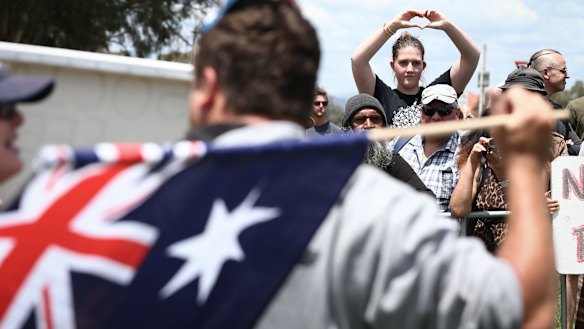
On the streets of Melbourne and Sydney, the rhetoric has translated into a visible and tense societal polarization. Over the weekend, counter-protesters advocating for minority rights and anti-fascist coalitions clashed with small but highly vocal groups of nationalist demonstrators outside state parliament buildings. Civil society organizations have expressed alarm over the mainstreaming of “Great Replacement” conspiracy theories, which have gained renewed traction among disenfranchised voters following the publicity surrounding the High Court filing.
The political opposition, led by the conservative Liberal-National Coalition, has found itself walking a treacherous tightrope. While mainstream conservative leaders have consistently distanced themselves from Sewell’s explicit white supremacist ideology, some factions within the right wing have used the opportunity to critique the Labor government’s broader approach to civil liberties. They argue that criminalizing fringe parties, rather than defeating their ideas through public debate, risks turning radical figures into political martyrs and driving dangerous movements further underground.
This domestic crisis unfolds against the backdrop of a sensitive regional geopolitical realignment. Australia has spent decades transforming its international image from a historical British outpost—symbolized by the notorious “White Australia” immigration policy dismantled in the late 20th century—into a trusted, diverse partner for its Asian neighbors. A high-profile legal battle centered on white ethno-nationalism threatens to damage Canberra’s diplomatic capital in Jakarta, Beijing, and New Delhi at a time when regional alliances are vital for economic stability.

Furthermore, digital intelligence analysts warn that the Australian legal battle is being heavily signal-boosted by international far-right networks, particularly those based in Europe and North America. Global extremist platforms have seized on Sewell’s “second-class citizens” narrative, using Australia as a case study to validate their broader claims that Western governments are actively engineering the erasure of their majority populations. The domestic legal challenge has effectively become a node in a transnational culture war.
Within Australia’s marginalized communities, the mood is one of vulnerability and frustration. Community leaders representing Asian, Middle Eastern, and Indigenous Australians have called on the government to strengthen federal anti-vilification laws rather than relying solely on high-profile political bans. They argue that the focus on macro-legal battles often obscures the daily realities of systemic discrimination and the psychological toll that public, racially charged political debates inflict on minority populations.
Sewell’s strategy, according to those familiar with his network’s operations, relies heavily on the oxygen of publicity. For fringe actors, a courtroom defeat can be as valuable as a victory; it serves as empirical “proof” of their narrative that the system is rigged against them. By forcing the High Court to rule on the legitimacy of a party explicitly defined by race, the far-right fringe has successfully injected its core grievances into the national judicial record and dominated the weekly news cycle.
Mainstream media outlets have also faced intense scrutiny regarding their coverage of the event. Editorial boards are grappling with the classic democratic dilemma: how to report on a significant constitutional challenge before the High Court without inadvertently providing a megaphone for hate speech and extremist propaganda. The sensationalist nature of the digital media ecosystem has frequently amplified the most inflammatory quotes, inadvertently deepening the societal divide.
As the High Court prepares to hear oral arguments in Canberra, the federal government remains firm in its legal positioning. The Attorney-General’s office has prepared a comprehensive brief detailing the links between extremist rhetoric and real-world domestic terror threats, asserting that the state’s intervention is both proportionate and necessary to preserve the “peace, order, and good government” of the Commonwealth.
Ultimately, the resolution of this case will do more than just decide the legal fate of a minor political party. It will serve as a defining marker for the character of modern Australian democracy. The court’s decision will signal whether the nation’s legal frameworks are resilient enough to suppress extremist movements without compromising the core tenet of free political expression, or whether the country will remain perpetually haunted by the ghosts of its exclusionary past.
The eyes of the nation now turn to the seven justices of the High Court. In a world where democratic norms are increasingly under strain from both ideological polarization and state overreach, Australia’s upcoming judicial ruling will resonate far beyond its own shores, offering a stark lesson in how a modern, multi-ethnic democracy chooses to defend—or redefine—its foundational values.






