For years, European leaders talked endlessly about “energy independence.”
But behind the speeches, summits, and climate pledges, Europe remained dangerously exposed.
Russian gas pipelines powered factories across Germany.
Chinese manufacturers dominated the supply chains for green technology.
American LNG increasingly filled emergency shortages at prices Europe could not control.
And every geopolitical crisis — from Ukraine to the Middle East — reminded Europe how vulnerable its economy truly was.
Now, something is changing.
A major new study released by Trinomics and DTU Wind has revealed numbers so large that they are forcing policymakers to rethink the entire economic logic of Europe’s energy future.
According to the analysis commissioned by WindEurope, every single euro invested in European wind energy infrastructure could generate seven euros in annual economic returns by 2040.
Not over decades.
Not in cumulative projections buried deep inside optimistic assumptions.
Annual returns.
The report estimates that a targeted €11.6 billion public investment strategy could add roughly €33 billion per year to the European economy while supporting an additional 180,000 jobs across manufacturing, construction, maintenance, logistics, and grid integration.
But the financial returns may actually be the least important part of the story.
Because this is no longer just about wind turbines.
It is about sovereignty.
The study arrives at a moment when Europe is confronting an uncomfortable reality: the continent may have underestimated how deeply modern geopolitics is controlled by energy systems, industrial supply chains, and infrastructure ownership.
The numbers inside the report expose the scale of that challenge.
Right now, European wind companies receive less than 2% of the budgets available across the twelve EU programs technically open to the sector. Funding remains fragmented, slow, bureaucratic, and spread across multiple competing priorities.
Meanwhile, China has been moving with extraordinary speed.
According to the study, Chinese turbine manufacturers have received between two and five times more state support than their European competitors in recent years. That aggressive industrial strategy allowed Chinese firms to scale production rapidly, cut prices, dominate supply chains, and increasingly challenge European companies in markets Europe itself originally pioneered.
In other words, Europe invented much of the modern wind industry…
…but China may be on track to own it.
That possibility is triggering alarm inside Brussels.
Because losing the wind industry would not simply mean losing green technology exports. It would mean surrendering control over one of the most strategically important industries of the twenty-first century.
And Europe now appears determined to stop that from happening.
The proposed European wind fund would consolidate fragmented financing into a single large-scale strategic instrument focused specifically on accelerating deployment across the entire value chain — from turbine production and rare earth processing to offshore installation and long-term maintenance infrastructure.
The economic implications are enormous.
The study estimates that up to 89% of the economic value generated by the investment could remain inside Europe if targeted support is implemented correctly.
Without that support, the retention rate collapses to only 47%.
That means more than half the economic value would effectively leak overseas, primarily to foreign manufacturers and suppliers — especially in China.
For European policymakers increasingly obsessed with “strategic autonomy,” those numbers are impossible to ignore.
But the energy security calculations may be even more dramatic.
According to the report, expanded wind infrastructure could displace approximately 70 billion cubic meters of imported natural gas every year by 2040.
That is the equivalent of roughly 700 LNG cargo shipments annually that Europe would no longer need to purchase from external suppliers.
And timing matters here.
Global energy markets remain unstable after years of geopolitical shocks. Russia’s invasion of Ukraine shattered Europe’s old pipeline model. Meanwhile, instability in the Middle East continues disrupting shipping routes and contributing to volatile LNG pricing across global markets.
Europe learned the hard way that energy dependence carries geopolitical consequences.
Now the continent is attempting something far more ambitious than a simple green transition.
It is building an entirely new strategic architecture.
And this is where Canada suddenly becomes critically important.
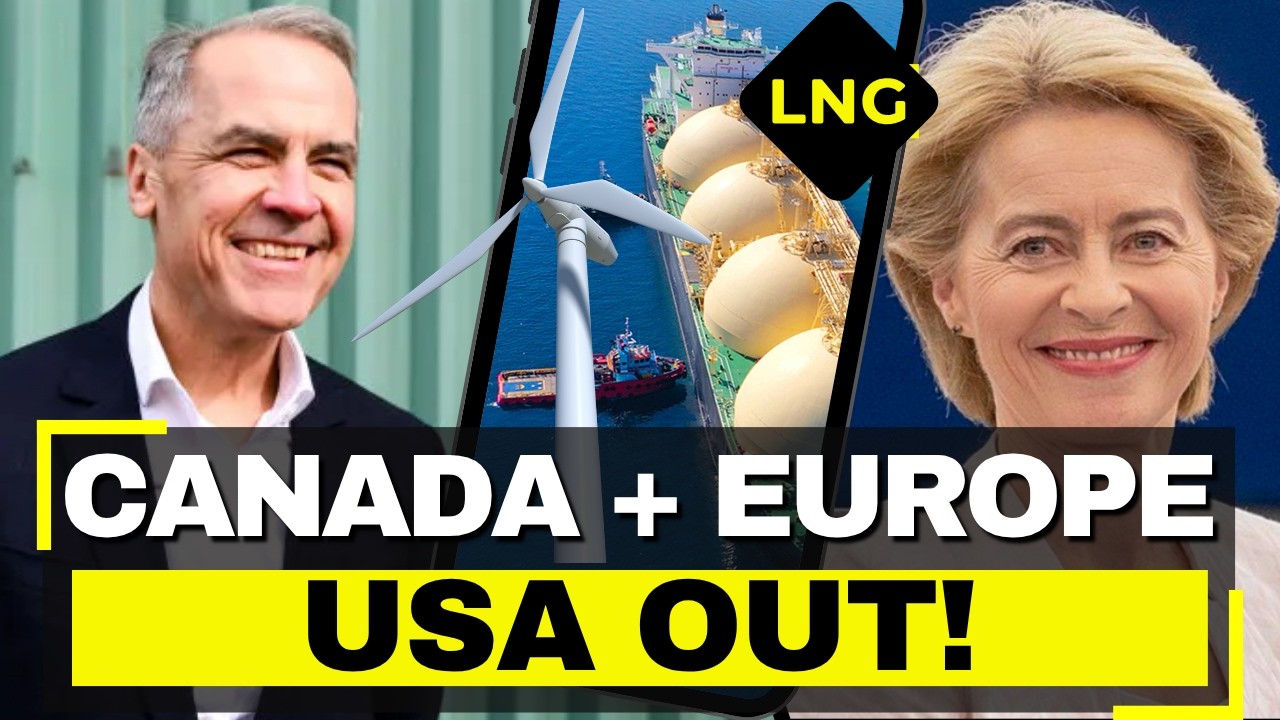
Over the past two years, Europe and Canada have quietly begun constructing what increasingly looks like a long-term transatlantic economic and energy alliance designed specifically to reduce dependence on authoritarian suppliers while building integrated democratic supply chains.
At first glance, the partnership appeared fragmented.
Critical minerals agreements.
LNG export discussions.
Hydrogen cooperation frameworks.
Battery supply investments.
But viewed together, they form a remarkably coherent strategy.
The foundation begins with critical minerals.
Modern energy systems require enormous quantities of lithium, copper, nickel, cobalt, and rare earth elements. Wind turbines, EV batteries, transmission grids, hydrogen systems, and defense technologies all depend on access to these materials.
And Europe has a problem.
Much of the global processing capacity for these minerals is currently dominated by China.
That dependence has become increasingly uncomfortable for European governments worried about future supply disruptions or geopolitical leverage.
Canada offers an alternative.
At the recent G7 summit in Alberta, Canada launched major new critical mineral partnerships aimed at expanding extraction, refining, and export capacity for democratic allies.
The scale is growing quickly.
More than 30 international partnerships have reportedly already been established, unlocking over $12 billion in mining-related investment capital.
Canadian firms are now supplying copper concentrate directly to German refineries. Lithium partnerships tied to renewable-powered processing facilities are expanding. Rare earth magnet supply agreements are being signed with European manufacturers.
These are not isolated business deals.
They are pieces of a much larger industrial puzzle.
Because Europe’s wind expansion requires massive quantities of exactly these materials.
And rather than relying on China for every critical component, Europe increasingly wants democratic supply chains anchored through Canada.
The second pillar is LNG.
For years, critics argued Europe replaced dependence on Russian gas with growing dependence on American LNG exports.
That substitution solved an immediate crisis but created new vulnerabilities.
American LNG pricing remains tied to domestic political pressures and global market volatility. Gulf shipping routes remain exposed to geopolitical instability. And European governments increasingly worry about relying too heavily on any single external supplier.
Canada changes the equation.
Prime Minister Mark Carney’s government has openly prioritized expanding energy infrastructure aimed at European markets, especially Germany.
Unlike previous Canadian governments that hesitated to back major LNG export infrastructure on the Atlantic Coast, Ottawa is now actively discussing financing mechanisms through the Canada Infrastructure Bank and the Canada Growth Fund.
The strategic logic is obvious.
Canadian LNG would provide Europe with a politically stable North Atlantic energy source supplied by a democratic ally under an existing free trade agreement framework.
No Russian pipelines.
No Strait of Hormuz chokepoints.
No dependence on unstable Gulf monarchies.
And no exposure to the same geopolitical risks currently disrupting global energy markets.
But LNG is only the transitional phase.
The third pillar is hydrogen.
Europe’s long-term decarbonization strategy requires enormous quantities of clean hydrogen for heavy industry, chemical manufacturing, steel production, and transportation systems that cannot easily electrify.
Germany especially faces urgent demand.
And Canada possesses something Europe desperately needs: abundant renewable energy resources capable of producing green hydrogen at scale.
Hydroelectric power from Quebec.
Offshore wind in Atlantic Canada.
Tidal energy potential in the Bay of Fundy.
Together, these resources could support one of the world’s largest green hydrogen export industries.
The Canada-Germany Hydrogen Alliance is already laying the groundwork for what officials envision as a transatlantic hydrogen trade corridor beginning deployment in the late 2020s.
If successful, the implications would be historic.
Canadian critical minerals would help manufacture European wind turbines.
European wind turbines would reduce fossil fuel demand across the continent.
Canadian LNG would stabilize the transition period.
And Canadian hydrogen would eventually replace much of the remaining fossil fuel use in heavy industry.
At every stage, the economic value remains largely inside a democratic transatlantic alliance rather than flowing toward geopolitical rivals.
That may ultimately be the real story behind the Trinomics study.
Not simply that wind investments generate strong returns.
But that infrastructure itself has become the central battlefield of modern geopolitics.
The contrast with the United States is becoming increasingly striking.
While Europe channels public investment toward long-term industrial infrastructure expected to generate compounding economic returns, America faces mounting fiscal pressure from rapidly rising debt-servicing costs.
The United States is now spending roughly a trillion dollars annually on interest payments alone.
Meanwhile, Europe is attempting to build infrastructure designed to permanently reduce energy import costs while strengthening industrial independence.
One model compounds liabilities.
The other compounds productive capacity.
That divergence may define the next decade of global economic competition.
And Europe appears increasingly convinced that energy sovereignty is no longer optional.
It is survival.
The proposed wind fund is expected to become part of the EU’s next major budget cycle, with large-scale funding potentially beginning around 2028.
By the mid-2030s, analysts believe European wind capacity could realistically displace the projected 70 billion cubic meters of imported gas identified in the study.
Canadian LNG exports to Europe may begin within five years.
Pilot hydrogen corridors could emerge before 2030.
Commercial hydrogen trade could scale by the early 2030s.
And the seven-to-one return identified in the study may eventually become the benchmark for evaluating future strategic infrastructure investments across the democratic world.
Because this is no longer merely an environmental story.
Or an energy story.
Or even an economic story.
It is a story about who controls the systems that power the modern world — and whether democracies can still build large-scale industrial strategies fast enough to compete with authoritarian states that subsidize entire industries as instruments of geopolitical power.
Europe appears to have made its decision.
And Canada is rapidly becoming one of the most important partners in that transformation.






