Canada’s Tariff Reckoning: How the US Supreme Court Rewrote Trump’s Trade War and Accelerated Carney’s Global Pivot
For more than a year, the economic confrontation between Canada and the United States was framed as a test of endurance. Washington imposed sweeping tariffs under emergency powers, financial markets braced for disruption, and Canadian industries prepared for what many feared would become a prolonged economic siege. Yet by early 2026, the centre of gravity in that conflict had shifted dramatically after the US Supreme Court ruled that the legal foundation underpinning Donald Trump’s tariff strategy had never existed in the first place.
The February ruling in Learning Resources versus Trump and VOS Selections versus United States immediately altered the trajectory of North American trade relations. In a 6–3 decision, the Supreme Court held that the International Emergency Economic Powers Act did not authorize unilateral presidential tariffs, effectively dismantling the legal architecture that had driven the most aggressive phase of the tariff campaign against Canadian exporters.
For Canadian policymakers and businesses, the judgment represented more than a courtroom defeat for the White House. It confirmed that the economic pressure campaign, which had dominated continental trade discussions since early 2025, was vulnerable from the outset to domestic constitutional scrutiny inside the United States itself.
What followed next was equally significant. Within days of the ruling, all tariffs imposed under IEEPA authority were terminated. American importers immediately began examining refund claims linked to duties collected over the previous year. According to estimates from the Penn Wharton Budget Model, US Customs and Border Protection had collected roughly $160 billion in tariff revenue between February 2025 and February 2026, costs that economists say were overwhelmingly absorbed by American businesses and consumers rather than foreign exporters.
That financial burden rippled across nearly every major consumer sector in the United States. Higher vehicle prices, increased construction costs, rising appliance expenses, and elevated grocery bills became part of a broader inflationary environment that many analysts linked directly to the tariff regime. The court’s decision now leaves lower courts to determine how refund claims may proceed and whether importers can recover substantial portions of those payments.
For Canada, the dispute exposed a long-standing structural vulnerability that successive governments had acknowledged for decades but struggled to address. Roughly 75 percent of Canadian merchandise exports continue to flow into the United States, making the Canadian economy uniquely exposed to shifts in American political and economic policy. The tariff conflict transformed that dependency from an abstract policy concern into an immediate national challenge.
In Ottawa, Prime Minister Mark Carney responded with an unusually aggressive diversification campaign that stretched well beyond conventional trade diplomacy. Over a twelve-month period, his government pursued new partnerships across Europe, Asia, and Latin America while simultaneously deepening Canada’s integration into emerging security and industrial alliances.
Midway through that diplomatic push, Carney travelled repeatedly between Brussels, Beijing, Mexico City, Davos, and several G20 capitals, presenting Canada not simply as a US trading partner, but as a middle power capable of operating across multiple economic blocs simultaneously. Canadian officials described the strategy as a structural reset rather than a temporary response to White House pressure.


One of the clearest indicators of the wider economic fallout emerged in the automotive sector. Industry estimates published through 2025 and early 2026 suggested global automakers absorbed roughly $35 billion in tariff-related costs. Detroit manufacturers including General Motors, Ford Motor Company, and Stellantis collectively reported billions in additional expenses tied to imported parts and cross-border manufacturing disruptions.
International firms faced similar pressure. Toyota projected billions in added annual costs, while companies including BMW, Honda, and Volkswagen also disclosed major tariff-related financial impacts. Analysts at the Center for Automotive Research had previously warned that broad 25 percent auto tariffs could add more than $100 billion in costs across the North American industry, projections that increasingly aligned with actual earnings reports.
The widening industrial impact appeared to reinforce Carney’s argument that Canada could no longer rely exclusively on a single export destination. At the World Economic Forum in Davos, he outlined an ambitious framework built around expanded trade agreements, critical mineral partnerships, defence manufacturing, and new economic corridors connecting Europe and the Indo-Pacific region.
Beyond trade negotiations, Canada’s integration with Europe accelerated at an unexpected pace. In June 2025, Ottawa signed a strategic defence and security partnership with the European Union, opening Canadian firms to participation in Europe’s massive rearmament procurement initiative. By February 2026, Canada had become the first non-European participant admitted into the EU Security Action for Europe program.
The strategic implications extended far beyond tariffs. Participation in European defence procurement positioned Canadian manufacturers inside a rapidly expanding industrial network linked to energy security, military modernization, and advanced technology production. Economists viewed the move as part of a broader effort to reduce exposure to unilateral US economic pressure.
At the same time, Carney’s government reopened diplomatic channels with China, including negotiations that eased tariffs on Canadian agricultural exports. Canada also intensified discussions with India, ASEAN economies, Mercosur states, and Pacific trading partners, seeking what officials described as a “multi-anchor” trade structure rather than dependence on a single continental market.
Critics inside Canada nevertheless argued that diversification remained incomplete and potentially overstated. Trade figures released in early 2026 still showed approximately three-quarters of Canadian merchandise exports going to the United States. Opposition leader Pierre Poilievre questioned whether the government had secured sufficient immediate relief for industries including steel, aluminum, forestry, and automotive manufacturing.
Some policy analysts also suggested Ottawa may have focused too heavily on Europe at the expense of faster-growing Asia-Pacific economies. Yet supporters of the government countered that diversification strategies unfold over years rather than months, and that the tariff crisis merely accelerated reforms Canada had postponed for decades.
The dispute also produced unintended consequences inside the United States itself. Consumer boycotts of American products gained traction across Canada following the first round of tariffs in 2025. Surveys indicated large numbers of Canadian households deliberately reduced purchases of US goods while international tourism into the United States also weakened significantly.
According to estimates cited by financial analysts, the combination of reduced foreign tourism and international consumer retaliation may have imposed tens of billions of dollars in drag on the American economy during 2025. Border states dependent on Canadian visitors reportedly experienced measurable declines in tourism spending, hospitality revenues, and cross-border retail activity.
Politically, the pressure appeared to consolidate rather than fracture domestic Canadian support around Carney’s government. Liberal victories in three federal by-elections during April 2026 strengthened the government’s position in the House of Commons, while national polling suggested growing approval for the prime minister’s economic management approach.
Even in Alberta, where separatist sentiment intensified amid economic frustrations and debates over federal policy, polling indicated a majority of residents still preferred remaining within Canada despite vocal regional dissatisfaction. Analysts observed that external economic pressure from Washington may have inadvertently reinforced national cohesion rather than weakening it.
Carney’s background as former governor of both the Bank of Canada and the Bank of England increasingly shaped interpretations of his response strategy. Supporters argued that his experience navigating both the 2008 financial crisis and Brexit provided a framework for managing prolonged economic instability while repositioning Canada internationally.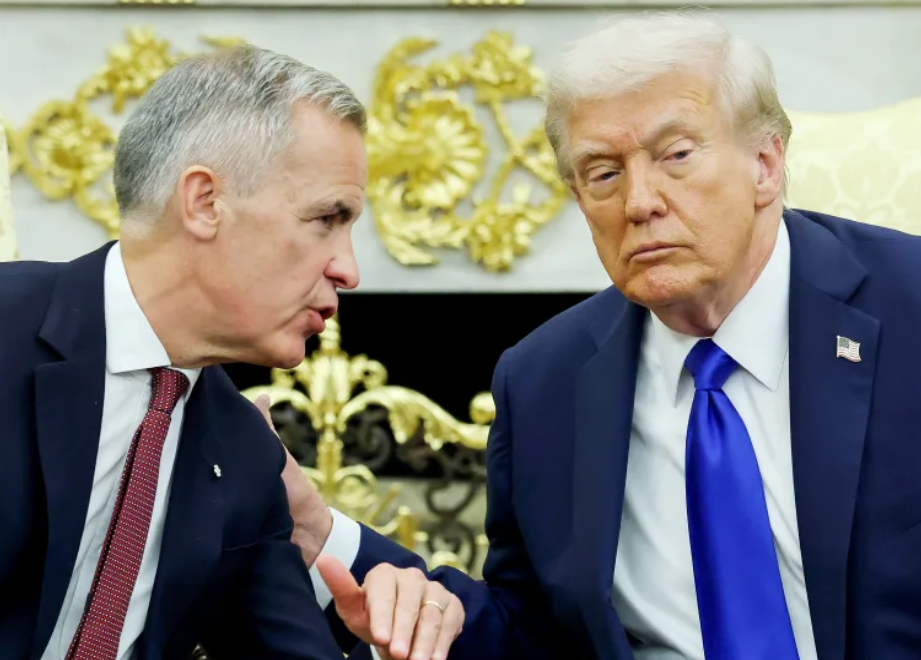
By early 2026, macroeconomic indicators offered cautious signs of stabilization. Inflation in Canada had returned within the Bank of Canada’s target range, interest rates were easing compared with earlier expectations, and federal debt metrics remained among the strongest in the G7. Growth projections still pointed to slower expansion than pre-crisis forecasts, but economists increasingly described the Canadian outlook as resilient rather than fragile.
The broader significance of the Supreme Court ruling now extends beyond tariffs themselves. The judgment placed clear constitutional limits on presidential trade authority while simultaneously exposing the risks of highly concentrated supply chains and single-market dependence. For Canada, the past year may ultimately be remembered less as a period of economic vulnerability than as the moment Ottawa accelerated a long-delayed strategic realignment.
Major disputes remain unresolved. Section 232 tariffs on steel, aluminum, automobiles, and heavy trucks continue to apply, and negotiations between Canadian and American officials remain ongoing. Refund litigation tied to the $160 billion collected under IEEPA tariffs is also expected to become one of the largest trade-related legal battles in recent American history.
Yet the political and economic landscape now looks markedly different from the assumptions that dominated the beginning of the tariff conflict. Twelve months ago, the central question was whether Canada could withstand sustained pressure from its largest trading partner. By mid-2026, the more consequential question may be whether the crisis ultimately forced Canada to build the diversified global relationships it had delayed pursuing for a generation.






