Australian Prime Minister Anthony Albanese is facing a wave of criticism after praising the Indian community’s role in “modern Australia” during an event celebrating 40 years of the Australia India Business Council.
What was meant to be a positive multicultural message quickly exploded into a much larger political debate — one touching immigration, national identity, cost of living pressures and the future direction of Australia ahead of the federal election.
The controversy began after Albanese shared several photos from the event on Facebook and Instagram. In the images, the Prime Minister could be seen giving a speech and shaking hands with members of the Indian business community.
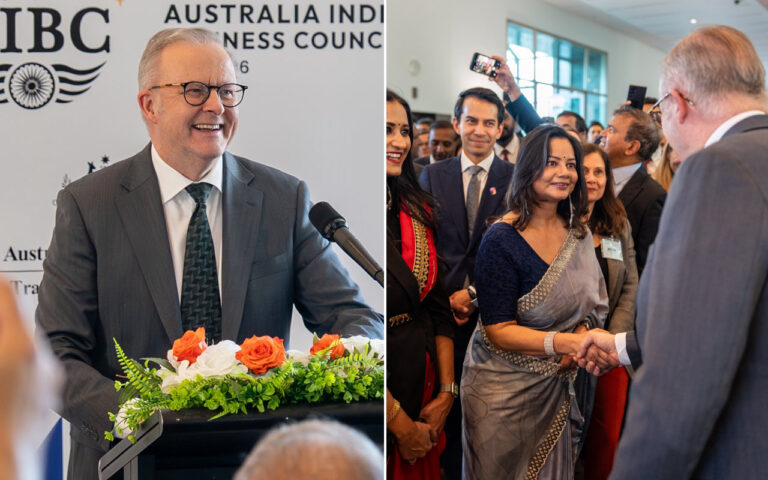
“It’s hard to imagine modern Australia without the contributions of our Indian community,” Albanese wrote.
“Creating jobs. Building businesses. Making our nation stronger and more vibrant.”
He also praised growing trade ties between Australia and India, calling the relationship increasingly important for the country’s economic future.
But instead of applause, the post triggered thousands of angry comments from Australians frustrated over immigration levels and rising pressure on housing, infrastructure and public services.
Many users accused the Prime Minister of being out of touch with growing public concerns.
One of the most-liked comments read:
“Albo with his people again. Never seen with an Aussie crowd.”
Another wrote:
“Counting the votes with every handshake.”
Others openly questioned whether Australia’s immigration program was benefiting ordinary citizens at all.
“What jobs do they create that weren’t already here?” one commenter asked.
Another sarcastically wrote:
“We’ve got the butter chicken recipe now, we don’t need them any more.”
Perhaps most surprising was that some criticism even came from Australians of Indian heritage themselves.
One commenter identifying as Indian-Australian admitted the timing of Albanese’s post was politically disastrous.
“As someone of Indian heritage myself, even I had to laugh at the timing of this post,” the comment read.
“When half the country is swinging toward Liberal and One Nation over immigration concerns, Anthony Albanese is posting about how immigration makes Australia stronger. Read the room.”
The backlash has become even more significant because it arrives during a period of intense political pressure over migration numbers.
Since Anthony Albanese became Prime Minister in May 2022, more than 2.5 million immigrants have arrived in Australia.
Net overseas migration during that period has reached roughly 1.5 million people, one of the highest migration surges in modern Australian history.
At the same time, housing affordability has collapsed in many major cities, rental vacancies remain critically low and infrastructure systems are struggling to keep pace with population growth.
For many Australians, these economic pressures are now directly linked in their minds to immigration policy.
The numbers involving the Indian-born population have also become central to the debate.
According to official data cited in the discussion, Indians became Australia’s largest foreign-born group last year for the first time ever, overtaking those born in England.
As of June 30 last year, Australia’s Indian-born population had reached 971,020 people.
That figure represents an increase of 522,000 people since 2015.
Even more dramatically, the Indian-born population has increased by roughly 884,000 people since 2000, when there were only 97,085 Indian-born residents living in Australia.
The demographic shift has been enormous within just one generation.
And the numbers grow even larger when ancestry statistics are included.
According to 2024 estimates, there are also 200,971 Australian-born people with Indian ancestry, as well as another 113,947 residents born in other countries who also identify with Indian ancestry.
Together, those figures illustrate how rapidly the Indian community has expanded across Australia economically, culturally and politically.
Supporters of multiculturalism argue this transformation has strengthened the country.
Indian-Australians are heavily represented in sectors including medicine, IT, engineering, education and small business.
Many economists also argue that migration has helped Australia avoid labor shortages and maintain economic growth during difficult global conditions.
But critics increasingly say the pace of change has become too fast.
That tension is now spilling directly into federal politics.
Several recent opinion polls reportedly show One Nation either ahead of Labor or only slightly behind in certain voter groups, driven largely by frustration over immigration and cost-of-living pressures.
Immigration — once considered politically untouchable — is rapidly becoming one of the defining issues of the next election.
That explains why Albanese’s social media post created such an explosive reaction.
To supporters, the Prime Minister was simply acknowledging the success of one of Australia’s most visible migrant communities.
To critics, however, the message symbolized a political class refusing to acknowledge growing public anxiety.
Some users also noticed that Albanese shared the post on Facebook and Instagram — but not on X, where multiculturalism-related posts often attract even harsher criticism.
That detail alone sparked another round of speculation online.
Critics accused the government of carefully choosing platforms where backlash could be more controlled.
Others argued the Prime Minister underestimated how frustrated ordinary Australians have become.
The debate has now moved beyond one social media post.
It has evolved into a wider national conversation about identity, integration and whether Australia’s immigration system is sustainable at current levels.
For decades, Australia proudly promoted itself as one of the world’s most successful multicultural societies.
But rising living costs, housing shortages and economic insecurity are clearly reshaping the political mood.
And increasingly, voters are connecting those frustrations to migration policy — fairly or unfairly.
The situation is especially delicate because Australia also depends heavily on immigration for economic growth.
Business groups continue warning that labor shortages could worsen without strong migration intake.
Universities, technology companies and healthcare providers all rely heavily on skilled migrants, particularly from India.
That creates a difficult balancing act for Albanese.
Reducing migration too aggressively could damage economic growth and anger industries dependent on foreign workers.
But ignoring public frustration could become politically catastrophic ahead of the election.
For now, the Prime Minister has shown no sign of backing away from his support for multiculturalism.
Yet the intensity of the reaction to a single Facebook post suggests something much deeper is happening inside Australian politics.
This is no longer just a debate about immigration numbers.
It is becoming a debate about national identity itself.
And judging by the public response, many Australians believe the country is approaching a political turning point that leaders in Canberra can no longer avoid.






