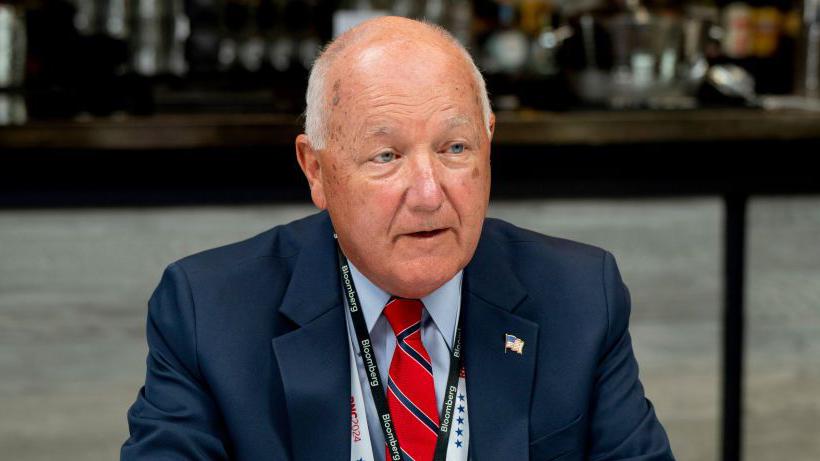
The relationship between Canada and the United States has entered a dangerous new phase after a stunning remark from Pete Hoekstra, Donald Trump’s ambassador to Canada, triggered outrage across the country and reopened deep tensions between Ottawa and Washington.
What began as a routine political exchange quickly exploded into an international controversy after Hoekstra openly suggested that Canada should be “more like Mexico” when dealing with the United States.
For many Canadians, the comment was not just insulting — it was humiliating.
And what happened afterward only made the backlash worse.
When journalists later asked Hoekstra whether he understood why Canadians were angry and frustrated by the remark, his response was blunt:
“Absolutely no.”
Those two words instantly spread across Canadian media and social networks, fueling accusations that Washington no longer sees Canada as an equal partner, but as a country expected to fall in line.
Political commentators described the exchange as one of the most openly dismissive moments in recent Canada-US relations.
Because for Canadians, this was never only about trade.
It became about dignity.
The controversy arrives at an already fragile moment between the two neighboring countries.
For more than a year, tensions have been growing over tariffs, economic pressure and Donald Trump’s increasingly aggressive rhetoric toward allies.
Trump allies have repeatedly criticized Canada over trade imbalances, energy policy and military spending, while Canadian officials have quietly warned that the tone coming from parts of Washington is becoming openly hostile.
But Hoekstra’s “Mexico” remark appeared to cross a psychological line.
Across Canadian television panels, radio shows and online forums, the reaction was immediate and emotional.
Many Canadians interpreted the statement as an attempt to reduce Canada’s status to that of a subordinate state expected to obey Washington’s demands.
Others argued the comparison revealed how some figures close to Trump view international relationships entirely through leverage and pressure.
The symbolism of Mexico also carried enormous political weight.
For years, Trump used Mexico as a political target during campaigns focused on border control, trade disputes and immigration fears.
So when Canada was suddenly told to behave “more like Mexico,” many saw it as a deliberate attempt to send a message:
Stop resisting.
Stop pushing back.
Comply.
But instead of calming tensions, the comment appears to have hardened Canadian attitudes even further.
Over recent months, Canadians have increasingly embraced economic nationalism in response to pressure from the United States.
Local campaigns encouraging consumers to “buy Canadian” have gained momentum.
Domestic tourism has surged as many Canadians intentionally choose to spend money inside the country rather than travel to the US.
Small business owners have openly promoted Canadian-made alternatives to American products.
And political analysts say something unusual is now happening across the ideological spectrum:
Canadians who disagree on almost everything else are suddenly uniting around one idea — resisting outside pressure.
That growing national mood may explain why Hoekstra’s remarks detonated so quickly online.
Canadians were already frustrated.
The comment simply gave that frustration a target.
One viral post read:
“We’re allies, not a branch office.”
Another said:
“If Washington thinks insults will make Canada surrender, they’ve misunderstood the country completely.”
Even some moderate commentators who usually support closer ties with the United States expressed shock at the tone coming from Trump’s orbit.
Several warned that the language risks permanently damaging trust between the two nations.
And behind the scenes, officials in Ottawa reportedly viewed the situation with increasing concern.
Canadian diplomats have spent decades carefully maintaining the image of the Canada-US relationship as one built on mutual respect, shared values and strategic partnership.
But critics now say that image is cracking.
Some political analysts believe the incident also reflects a much broader shift taking place inside American politics.
Under Trump-style nationalism, allies are increasingly treated less as partners and more as competitors expected to prove loyalty.
That approach may work domestically with Trump’s political base.
But internationally, it is creating growing resentment — especially in countries like Canada that historically viewed themselves as America’s closest friend.
What makes the situation even more explosive is timing.
The remarks arrive during a period of heightened Canadian sensitivity over sovereignty and independence.
Economic pressure from the US, concerns over trade dependence and fears of political interference have all intensified public debate about how vulnerable Canada really is next to its much larger neighbor.
In that climate, even symbolic comments can trigger massive reactions.
And Hoekstra’s refusal to back down only added fuel to the fire.
Critics say his “Absolutely no” response sounded less like diplomacy and more like contempt.
Some Canadian commentators accused Washington figures of confusing patience with weakness.
Others argued the US political establishment underestimated how deeply Canadians value sovereignty and international respect.
Meanwhile, supporters of Trump dismissed the backlash as overreaction.
Conservative American commentators argued Hoekstra was simply emphasizing economic pragmatism and stronger alignment with US interests.
But that defense did little to calm the outrage north of the border.
Instead, the controversy has transformed into something much larger than one sentence from one diplomat.
It has become a symbol of a changing relationship.
For decades, Canada and the United States promoted one of the closest alliances in the world — economically integrated, militarily aligned and culturally intertwined.
Now, however, many Canadians fear the relationship is entering a colder and more transactional era.
And ironically, the harder pressure from Washington becomes, the more determined many Canadians appear to resist it.
That resistance is no longer happening only at the political level.
It is happening socially, economically and emotionally.
Canadian flags have become more visible at local events.
Support for domestic industries has intensified.
Even conversations around national identity have shifted, with many Canadians openly discussing the importance of protecting independence from American political influence.
In other words, the strategy may be backfiring.
Because if the goal was to pressure Canada into greater compliance, the public response suggests the opposite is happening.
Canadians are becoming more defiant, not less.
And that may explain why some observers believe Washington is now growing nervous.
For years, America operated with the assumption that Canada would always remain quietly aligned no matter the disagreement.
But this moment suggests something different.
Canada may still value the alliance deeply.
But it also appears increasingly willing to say no.
And that changes the entire dynamic.
Whether Hoekstra intended it or not, his remark may now be remembered as the moment many Canadians realized the relationship with Washington was no longer guaranteed to feel respectful by default.
Because in the end, the issue was never really about Mexico.
It was about whether Canada should bow under pressure — or stand its ground even when facing its most powerful ally.
And judging by the reaction across the country, millions of Canadians believe they already made their choice.






