By XAMXAM
WASHINGTON — The language has changed.
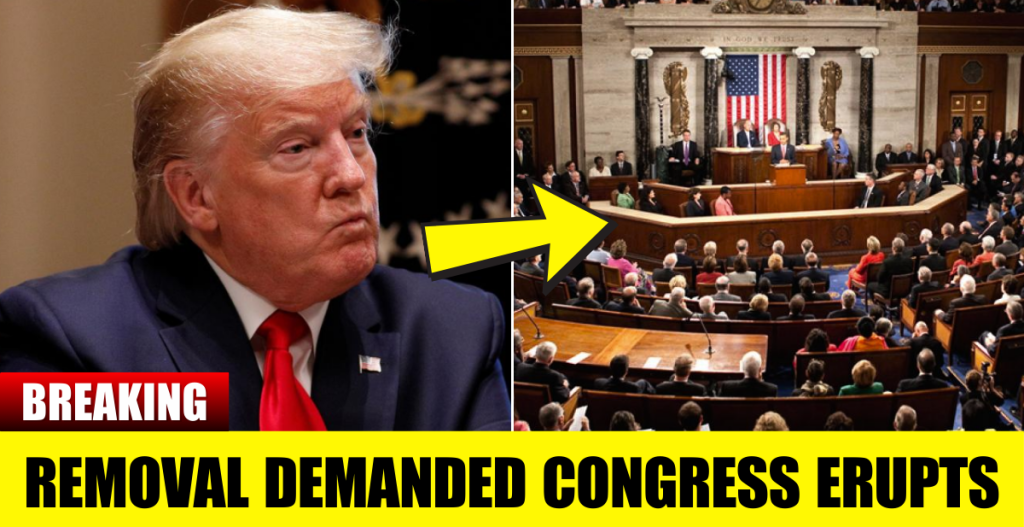
For months, criticism of President Donald J. Trump’s second-term conduct followed a familiar script: investigations, oversight hearings, sternly worded statements about norms and guardrails. Now, members of Congress are saying something far more direct, and far more destabilizing to the political system.
They are calling for him to resign.
The shift did not come from a single event, but from an accumulation of actions that have unsettled lawmakers across party lines — unauthorized military force abroad, open threats against allies, and a pattern of governance that critics say treats constitutional limits as inconveniences rather than obligations. What once would have been whispered in closed-door meetings is now being said out loud, on cable news, in floor statements, and in formal impeachment resolutions.
The immediate spark was Venezuela.
In a move that stunned diplomats and lawmakers alike, Mr. Trump ordered a military operation that resulted in the capture of Venezuelan President Nicolás Maduro and his wife, announcing that the United States would oversee a transitional authority in the country. The operation occurred without congressional authorization, without a declaration of war, and without the kind of legal justification traditionally required before committing American forces to hostilities.
Democrats were swift and unequivocal. Senator Scott Wiener of California described the action as an “illegal invasion and coup,” calling for impeachment, conviction and removal. Representative Dan Goldman, a former federal prosecutor who played a central role in Mr. Trump’s first impeachment, labeled the operation an impeachable abuse of power and warned that the president had become “a danger to the Constitution.”
Those statements alone would not be remarkable in a polarized era. What made this moment different was what followed.
Mr. Trump did not retreat. He escalated.
He defended the Venezuela operation as an assertion of executive authority and refused to concede any need for congressional approval. He then turned his attention north and east, reviving and intensifying a long-standing fixation on Greenland — a territory of Denmark, a NATO ally. He threatened economic retaliation against Copenhagen and declined to rule out the use of military force to seize the territory if negotiations failed.
That was the moment when Republican unease moved from private to public.
Representative Don Bacon of Nebraska, a mainstream Republican and former Air Force general, said he would lean toward impeachment if the president pursued military annexation of Greenland, warning that such a move could “mark the end” of Mr. Trump’s presidency. Other Republicans, speaking anonymously, described the Greenland strategy as politically suicidal ahead of the 2026 midterms.
The implications were hard to overstate. A United States president openly contemplating the use of force against a NATO ally to acquire territory would represent a rupture with postwar American foreign policy — and with the alliance system that has underpinned global stability for nearly eight decades.
As concern mounted, so did the constitutional conversation.
Impeachment is no longer theoretical. Multiple resolutions have already been filed in the House. One, House Resolution 353, lays out seven articles, including abuse of war powers directly tied to Venezuela. Another expands the scope of alleged misconduct. These resolutions have not yet advanced, but they establish a formal record — a blueprint that can be activated if political conditions shift.
More striking still is the reemergence of the 25th Amendment in serious discussion. Legal scholars and some lawmakers have begun openly debating whether Mr. Trump’s conduct could meet the threshold under Section 4, which allows the vice president and a majority of the cabinet to declare the president unable to discharge his duties. The amendment has never been used to remove a president. That it is being mentioned at all reflects the depth of alarm among some observers.
Mr. Trump’s response has followed a familiar pattern: attack, pressure, deflect.
He has labeled critics weak and disloyal. He has warned Republicans that any loss of congressional control in 2026 would lead directly to his impeachment. In one striking admission, he told House Republicans bluntly that if they lose the midterms, “I will get impeached — they will find the reason.”
The statement was revealing. The president was acknowledging that his political survival now depends less on the merits of his actions than on the balance of power in Congress. Protection, not persuasion, has become the organizing principle.
For now, that protection holds.
Democrats are united in their opposition but do not control the House. Most Republicans, though increasingly uneasy, remain aligned with the president — constrained by fear of his base, by primary threats, and by the calculation that breaking ranks still carries greater risk than defending him. The calls for resignation, while real and growing, have not reached the critical mass needed to force action.
Yet their significance lies not only in immediate outcomes.
Resignation demands serve as pressure, not just on the president, but on his party. They force Republicans to choose: defend actions that alarm allies and legal experts, or begin distancing themselves from a president who may become an electoral liability. They create a public record — a ledger of who spoke and who stayed silent — that will matter if events escalate.
They also signal a refusal to normalize behavior that many lawmakers believe crosses fundamental lines.
Mr. Trump has shown repeatedly that he does not respond to pressure as conventional politicians do. He does not apologize. He does not step back. He reframes conflict as persecution and doubles down. Voluntary resignation, the path taken by Richard Nixon when conviction became inevitable, runs counter to everything Mr. Trump’s political career represents.
For resignation to become plausible, Republican leaders would need to conclude that remaining tied to him is more dangerous than severing the relationship — and convey that judgment privately and unmistakably. That threshold has not been reached. But it is no longer unthinkable.
The midterm elections loom over every calculation. If Democrats retake the House in 2026, impeachment becomes almost certain. Mr. Trump knows this. His critics know this. His allies know this. The resignation calls that seem quixotic today could become overwhelming pressure tomorrow if voters shift and Republican unity fractures.
In the meantime, the fury emanating from the White House tells its own story. Secure presidents do not warn their parties that their own survival depends on electoral outcomes. They do not lash out at dissenters with such intensity. They do not frame constitutional accountability as a personal vendetta.
Mr. Trump projects defiance. But his behavior suggests anxiety.
The United States has been here before, though rarely in quite this form. Moments when institutions — Congress, the courts, the electorate — must decide whether norms are flexible or binding, whether power excuses conduct or constrains it. The fact that serious lawmakers are openly calling on a sitting president to resign is itself a measure of how far the system has been stretched.
Whether those calls succeed remains uncertain. What is no longer uncertain is that the conversation has changed — and that the presidency has entered a phase defined less by policy debates than by a fundamental question of fitness, authority and constitutional limits.
In Washington, that is the sound of pressure building.







