For years, Washington believed tariffs would force the world to negotiate on American terms.
Instead, something very different may now be happening.
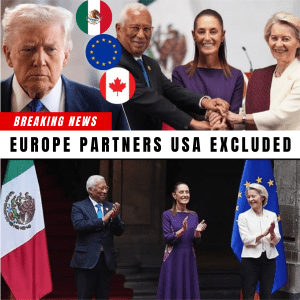
Across Europe, Latin America, and North America, governments are accelerating major trade agreements, resource partnerships, and strategic supply-chain alliances at a pace that is beginning to alarm economic analysts. While the United States continues battling over tariffs, industrial protectionism, and trade restrictions tied to Donald Trump’s economic strategy, many of America’s traditional partners appear to be quietly building a new commercial architecture that increasingly excludes Washington from the center of the conversation.
And the implications could be enormous.
In Brussels, officials have spent months pushing forward agreements designed to secure long-term access to critical minerals, energy resources, agricultural supply chains, and manufacturing partnerships. What once looked like slow-moving diplomatic paperwork is suddenly being viewed as part of a much larger geopolitical transformation.
The European Union is deepening economic ties not only with Canada and Mexico, but also with Mercosur — the South American trade bloc that includes Brazil, Argentina, Paraguay, and Uruguay.
For years, negotiations with Mercosur stalled over environmental concerns, agricultural protections, and political disagreements. But now, with global trade tensions intensifying and fears growing over economic fragmentation, momentum behind the deal has returned with surprising force.
Many analysts believe Europe sees a rare opportunity.
If the United States continues prioritizing tariffs and economic confrontation, the EU may position itself as the world’s most reliable large-scale trading partner at precisely the moment countries are searching for stability.
That possibility is now reshaping diplomatic strategy across multiple continents.
The timing is impossible to ignore.
As Washington escalates trade disputes and threatens new tariffs on allies and rivals alike, governments around the world are increasingly looking for ways to reduce dependence on American markets and political unpredictability.
Canada has accelerated efforts to diversify exports beyond the United States.
Mexico has quietly expanded conversations with European and Asian partners while simultaneously trying to protect its crucial economic relationship with Washington.
Meanwhile, Mercosur nations — long frustrated by Western trade barriers — suddenly find themselves in a stronger bargaining position as Europe races to secure access to food production, lithium reserves, rare earth materials, and industrial commodities.
Behind closed doors, some diplomats reportedly describe the situation in remarkably blunt terms:
The world is reorganizing itself around resilience.
And many no longer believe the United States offers enough predictability to remain the unquestioned center of global commerce.
One of the biggest concerns driving this shift is the growing battle over critical minerals.
Lithium, copper, nickel, cobalt, and rare earth elements have become central to the future of electric vehicles, defense systems, semiconductors, battery manufacturing, renewable energy infrastructure, and artificial intelligence technology.
Countries now understand that whoever controls these supply chains could dominate the next era of industrial power.
South America possesses some of the world’s most valuable lithium reserves.
Canada controls enormous strategic mineral resources.
Europe has manufacturing capacity but lacks sufficient domestic raw materials.
The result is a rapidly emerging network of economic cooperation that many analysts say is designed specifically to reduce vulnerability to geopolitical shocks — including shocks originating from Washington.
And that is where Trump’s tariff strategy enters the conversation.
Supporters of Trump argue that tariffs are necessary to rebuild American manufacturing, protect domestic workers, and counter unfair trade practices from rivals like China.
Critics, however, increasingly warn that aggressive tariff policies may be producing unintended consequences.
Rather than forcing countries to depend more heavily on the United States, they may actually be encouraging nations to build alternative systems that permanently bypass American influence.
Some economists now fear the U.S. could be accelerating the exact type of global realignment it hoped to prevent.
Instead of isolating rivals, Washington may be isolating itself.
That concern has become especially visible in Europe.
European leaders have spent years warning that the continent depends too heavily on external powers for energy, defense technology, industrial supply chains, and digital infrastructure.
Russia’s invasion of Ukraine intensified those fears dramatically.
Now, Trump’s increasingly confrontational trade rhetoric is adding a second layer of anxiety.
If future American administrations can rapidly impose tariffs even on allies, many European policymakers believe the EU must become more strategically autonomous — economically as well as militarily.
That mindset is now driving a wave of new agreements, industrial policies, and resource partnerships.
To some observers, it resembles the early foundations of a new economic order.
One where Europe acts less like a junior partner to Washington and more like an independent global power center.
Canada’s role in this transformation is also becoming increasingly important.
For decades, Canada’s economy has remained deeply tied to the United States through geography, manufacturing integration, and energy exports.
But recent political tensions, tariff threats, and uncertainty surrounding future U.S. trade policy have pushed Ottawa to strengthen relationships elsewhere.
Canadian officials have intensified trade engagement with Europe under the Comprehensive Economic and Trade Agreement framework while simultaneously exploring broader Indo-Pacific partnerships.
And now, with Europe aggressively seeking secure supplies of critical minerals and clean-energy resources, Canada suddenly finds itself in an exceptionally valuable strategic position.
Some analysts believe Ottawa may emerge as one of the biggest long-term beneficiaries of the global supply-chain restructuring now underway.
Mexico faces an even more complicated balancing act.
Its economy remains heavily integrated with the United States through manufacturing and cross-border production networks.
At the same time, Mexico cannot ignore the risks of overdependence on a politically volatile relationship.
That reality is pushing Mexican policymakers to diversify trade relationships where possible without provoking a direct economic confrontation with Washington.
The challenge is delicate.
But it reflects a broader international trend:
Countries increasingly want options.
And many are building those options through agreements that no longer place the United States at the center.
Perhaps the most symbolic element of this transformation is psychological rather than economic.
For decades, the assumption underlying global trade was relatively simple: access to the American market was the ultimate strategic prize.
Now, for the first time in generations, some governments appear to be asking a different question:
What if future stability depends on reducing exposure to American political turbulence?
That question would have sounded almost unimaginable not long ago.
Today, it is quietly influencing trade negotiations across the globe.
Critics of Trump’s strategy argue that the United States risks repeating a historical mistake seen in previous great powers: assuming economic dominance alone guarantees long-term loyalty from allies.
History suggests otherwise.
Alliances survive not only through strength, but through predictability, trust, and shared strategic interests.
If allies begin feeling economically vulnerable to sudden tariff shocks or political pressure, they naturally start searching for alternatives.
And alternatives are exactly what Europe, Canada, Mexico, and Mercosur now appear to be building together.
None of this means the United States is collapsing economically.
America remains the world’s largest economy, a technological superpower, and an unmatched consumer market.
But global influence is rarely lost overnight.
More often, it erodes gradually as other systems emerge alongside it.
That is what makes current developments so significant.
The concern among some analysts is not that the U.S. disappears from global trade.
It is that Washington may slowly stop being indispensable.
And once that process begins, reversing it can become extraordinarily difficult.
For now, negotiations continue behind closed doors.
Trade ministers are meeting.
Supply-chain agreements are expanding.
Critical mineral partnerships are accelerating.
And across multiple continents, governments are quietly preparing for a future where economic survival depends less on one dominant power and more on diversified networks of cooperation.
Whether this becomes a temporary adjustment or the beginning of a historic geopolitical realignment remains unclear.
But one thing is becoming harder to ignore:
While Washington focuses on tariffs and confrontation, much of the rest of the world may already be building the next global trade system without it.






