A geopolitical transformation that once sounded impossible is now unfolding in plain sight.
While much of the world remains distracted by election drama, tariff battles, and political chaos in Washington, Europe appears to be executing one of the most sophisticated economic realignments of the modern era — and Mexico may have just become one of its most important strategic partners.
In a move already sending shockwaves through financial and diplomatic circles, European leaders traveled to Mexico City and finalized a sweeping trade agreement that both sides openly framed as something far bigger than economics alone.
This was not just about exports.
Not just about tariffs.
And not simply another routine international deal.
According to analysts following the negotiations, the agreement represents part of a much larger global shift:
a growing effort by major economies to reduce dependence on the United States itself.
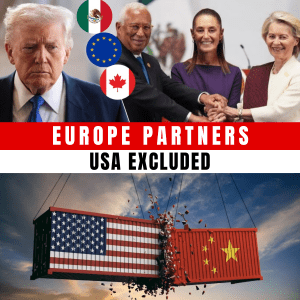
That realization is now triggering growing concern inside Washington.
Because the pattern becoming visible across the world is increasingly difficult to ignore.
Canada deepens ties with Europe.
Mexico expands strategic cooperation with the EU.
Mercosur strengthens negotiations.
Japan accelerates coordination.
South Korea signs new frameworks.
India broadens industrial partnerships.
Even the United Kingdom — historically America’s closest strategic ally — continues expanding economic alignment with Europe.
One by one, major global economies appear to be diversifying away from overwhelming dependence on the U.S. market.
And many experts now believe Europe is quietly building something unprecedented:
A global economic network surrounding the United States itself.
For decades, Washington occupied the uncontested center of the Western economic order. Access to American markets, American finance, American technology, and American consumers formed the backbone of global trade strategy.
But recent years changed the calculation.
Aggressive tariff policies.
Trade wars.
Political instability.
Growing unpredictability in U.S. foreign policy.
And rising fears among allies that dependence on Washington may carry greater long-term risk than previously imagined.
Now the consequences may finally be materializing.
According to reports surrounding the new EU-Mexico agreement, the deal goes far beyond traditional trade cooperation.
It reportedly opens major channels involving:
• Critical mineral supply chains
• Semiconductor cooperation
• Digital trade integration
• Government procurement access
• Industrial investment coordination
• Battery production networks
• Future energy infrastructure
• Strategic manufacturing partnerships
• Artificial intelligence development frameworks
In other words:
this is not just a trade agreement.

It is infrastructure for an entirely new economic architecture.
And the implications could reshape global power for decades.
Mexico’s role in this transformation is especially significant.
For generations, Mexico’s economy remained deeply intertwined with the United States through geography, manufacturing integration, and cross-border supply chains.
But dependence can also create vulnerability.
Recent tensions involving tariffs, migration disputes, and economic pressure reportedly pushed Mexican policymakers to accelerate efforts toward diversification.
Europe saw opportunity.
The result is a partnership many analysts now describe as deeply strategic rather than merely commercial.
Some experts believe the EU is positioning itself as the stabilizing center of a new global trade ecosystem precisely as Washington becomes increasingly inward-focused.
One European analyst summarized the strategy bluntly:
“Europe is trying to become the world’s safe economic partner while America becomes unpredictable.”
That perception may explain why so many countries now appear eager to strengthen ties with Brussels simultaneously.
Particularly because Europe is also redirecting enormous amounts of capital toward its own industrial future.
According to multiple economic projections, the European Union could redirect nearly €2 trillion annually into strategic sectors tied to industrial sovereignty, defense production, energy security, AI development, and supply-chain independence.
The scale of that transformation is enormous.
And unlike previous decades, Europe no longer appears content simply following Washington’s economic lead.
Instead, it increasingly wants its own global network.
Its own industrial strategy.
Its own defense capability.
Its own technological regulations.
Its own financial systems.
And increasingly:
its own geopolitical influence.
The timing of the EU-Mexico agreement is therefore impossible to separate from the broader global context.
Because behind closed doors, many policymakers now openly fear that the world is entering an era of fragmentation where countries must build resilient partnerships capable of surviving geopolitical shocks.

The pandemic exposed supply-chain weaknesses.
The Ukraine war exposed energy vulnerabilities.
Sanctions battles exposed financial dependence.
Trade wars exposed industrial risks.
Together, these crises changed global thinking.
Countries no longer assume the existing order will remain stable forever.
And Europe appears to be responding faster than many expected.
Meanwhile, critics inside the United States argue that aggressive tariff strategies may have accelerated the exact scenario Washington long feared:
allies building alternative systems that gradually reduce American leverage.
For years, U.S. policymakers assumed major partners had little choice but to remain economically tied to Washington at the center of global commerce.
But diversification changes everything.
If Europe succeeds in building parallel trade networks strong enough to function independently from U.S. economic pressure, the geopolitical consequences could be historic.
Not because America suddenly collapses.
But because the world no longer revolves around a single indispensable center.
That possibility now dominates conversations among global strategists.
Some experts compare the current moment to the early stages of major historical realignments that only became obvious years later.
At first, individual agreements seemed isolated.
A trade pact here.
An industrial deal there.
A supply-chain partnership elsewhere.
But eventually the pattern became undeniable.
And that pattern now appears to be emerging around Europe.
The EU-Mexico agreement also carries another major strategic dimension:
critical minerals.
As the world races toward electric vehicles, AI systems, advanced semiconductors, battery production, and next-generation defense technologies, access to minerals like lithium, rare earths, copper, and nickel becomes increasingly essential.
Mexico possesses enormous strategic value in that competition.
Europe knows it.
China knows it.
And Washington certainly knows it.
Control over future supply chains may ultimately determine which economic blocs dominate the coming decades.
That is why this agreement is being viewed so seriously inside diplomatic and industrial circles.
Because it signals that Europe is no longer thinking only about present trade flows.
It is positioning itself for the next industrial age.
Social media reactions to the deal have been explosive.
Across X, TikTok, Reddit, and YouTube, users are describing the agreement as:
“Europe’s silent economic revolution,”
“a ring forming around America,”
and:
“the biggest geopolitical trade shift nobody noticed happening.”

Others warn that such interpretations may exaggerate the situation.
After all, the United States remains the world’s largest economy, dominant military power, and central force in global finance and technology.
But even skeptical analysts acknowledge one reality:
Europe is becoming far more strategically ambitious.
And that ambition is changing global calculations.
Perhaps the most remarkable part of this transformation is how quietly it is unfolding.
No dramatic declarations.
No public collapse of alliances.
No official anti-American coalition.
Instead:
careful diversification.
Layer by layer.
Agreement by agreement.
Partnership by partnership.
Until suddenly the world wakes up and realizes the center of gravity may already be shifting.
Now one question is spreading rapidly through economic and political circles worldwide:
Did Europe just execute the most sophisticated geopolitical trade strategy of the 21st century while America was distracted by tariff wars and internal division?






