

In the marble corridors of Brussels, a quiet but seismic decision was made this week that will ripple across the planet’s orbital infrastructure for decades to come. The European Commission has effectively slammed the door on Elon Musk’s Starlink expansion into Europe. On Wednesday, Brussels is set to formally reserve one of the most strategically critical radio frequency bands on the continent — the 2 GHz band — exclusively for European satellite operators. Starlink is out. Amazon’s Project Kuiper is out. Every non-European satellite company is now locked out of the only harmonized satellite frequency band that covers all 27 EU member states in one single stroke.
This is not a minor regulatory tweak. This is Europe drawing a hard line in the sky. The invisible infrastructure that decides who can beam internet directly into your pocket from orbit now belongs to Europe alone. Washington is already furious. The head of the US Federal Communications Commission has issued an explicit warning of retaliation, stating that if Europe insists on this path of satellite sovereignty, the United States “will have to take that into account” when it comes to reciprocal treatment for European companies operating in America. Diplomatic language for “we will hit back.”
To understand why this single frequency band has triggered such fury, you have to understand what radio spectrum actually is. Think of it as invisible lanes on an orbital motorway. There are only so many lanes, and once a government allocates one, it is locked. No one else can use it without causing interference that crashes the entire system. The 2 GHz band is the only satellite frequency harmonized at the EU level — a single decision in Brussels applies uniformly across the continent. Since 2009 it has been used in a limited way by two European operators, mostly for emergency calls when your phone has no mobile signal. But technology has now advanced to the point where satellites in low Earth orbit can connect directly to ordinary smartphones in your pocket — no towers, no cables, no middlemen. Whoever controls that 2 GHz band controls whether European citizens connect through European satellites under European law or through American ones under American jurisdiction.
Starlink currently operates over 10,000 low-orbit satellites — roughly two-thirds of every active satellite circling the planet. It dominates global satellite internet. Amazon’s Kuiper is scaling fast behind it. Both desperately wanted access to Europe’s 2 GHz band because it would let them offer seamless direct-to-device service that bypasses European telecom infrastructure entirely. Data would flow straight from American satellites to European phones, routed through American systems and subject to American legal demands, including the controversial CLOUD Act. European mobile operators would lose customers. European governments would lose sovereign control over a critical communications layer. The Commission’s decision kills that scenario dead. The 2 GHz band stays European. Any direct-to-device service in Europe will now be provided by companies bound by European data protection rules, European security standards, and European oversight.
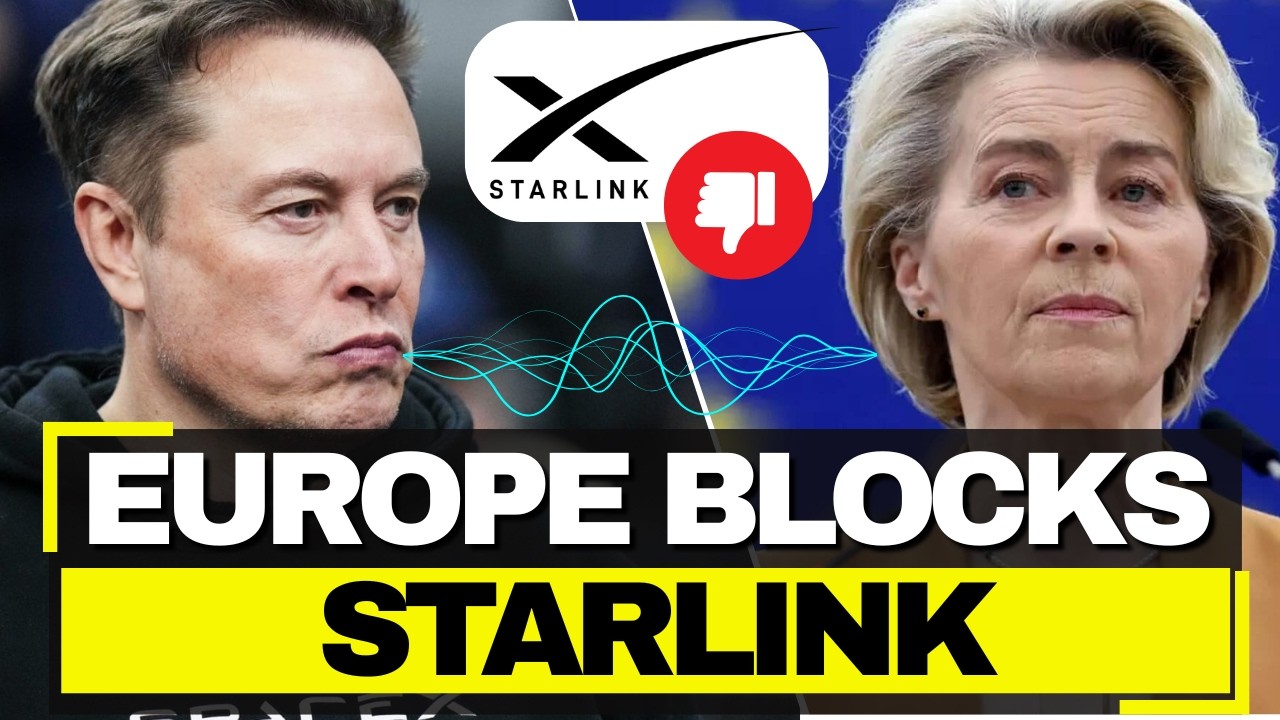
Thomas Regier, the Commission spokesperson for tech sovereignty, put it bluntly: “Satellite connectivity is a key piece of our technological sovereignty, our security, and our defense. In the changing geopolitical situation, EU-wide satellite connectivity becomes synonymous with resilience, security, and capability.” This is the latest chapter in Europe’s accelerating push for digital independence — the radio-spectrum layer of a much larger strategy that already includes the Iris² sovereign satellite constellation, the upcoming tech sovereignty package restricting American cloud providers from sensitive government data, and a broader architecture designed to stop critical infrastructure from falling under foreign legal control.
The timing is surgical. The spectrum decision lands just one day before the Commission presents its full tech sovereignty package. The two moves together send a crystal-clear message: whether data travels through undersea cables or through radio waves from space, Europe is closing its digital borders to systems that operate outside European legal jurisdiction. Iris² — the 290-satellite EU-owned constellation already under construction with Norway and Iceland as the first non-EU partners — is the hardware. Wednesday’s spectrum reservation is the software layer that guarantees those European satellites will have dedicated, interference-free lanes in European skies. Without it, even Iris² would have to fight Starlink for bandwidth over its own continent. With it, Europe’s satellites get a protected motorway that no American operator can enter.
Inside the Commission the battle was intense. EU digital chief Henna Virkkunen, aligned with European telecom interests, had to balance commercial demands against military ones. Defense Commissioner Andrius Kubilius pushed hard for a dedicated slice of the 2 GHz band for encrypted military applications within Iris². Spectrum is finite — every megahertz given to commercial broadband is a megahertz not available for secure government or defense use. The final compromise keeps the entire band European while still allowing internal negotiations on how it will be split between civilian and military needs. The foundational principle, however, is now locked in: this critical resource stays in European hands.
The American reaction was swift and sharp. At the Mobile World Congress in Barcelona earlier this year, FCC Chairman Brendan Carr delivered a direct warning. Europe has national champion satellite providers that do substantial business in the US, he noted, and “we have all benefited from a fair and even-handed approach.” Then came the threat: if Europe goes down the path of satellite sovereignty that excludes non-continent providers, the US “will have to take that into account with respect to the reciprocal treatment that we provide.” In diplomatic speak, that is a promise of retaliation — potential restrictions on European satellite companies operating inside the American market.
Yet insiders in Brussels believe immediate escalation is unlikely. The Transatlantic Trade and Technology Council agreement has only just been approved, and neither side wants to rip open that fragile truce right now. Starlink will continue operating in Europe on its existing frequencies, but it is permanently locked out of the 2 GHz direct-to-device band. European operators, backed by Iris², the EU Space Act, and the full sovereignty stack, are now positioned to build their own direct-to-device services — European phones connecting to European satellites under European law.
This fight is about far more than internet speed or phone coverage. It is about who controls the invisible infrastructure that increasingly decides national resilience in an era of hybrid threats. In a crisis — whether cyber attack, conventional conflict, or simple geopolitical pressure — the ability to keep citizens connected without relying on foreign satellites becomes a matter of survival. Europe watched too many critical systems fall under American jurisdiction and is now systematically taking them back. Radio spectrum is simply the latest — and one of the most strategic — pieces of that puzzle.
For Elon Musk, the decision is a rare public setback. Starlink’s global dominance is built on speed and scale, but Europe has just reminded the world that even the man who owns two-thirds of all satellites in orbit cannot simply fly over sovereign borders and claim new frequency lanes. For ordinary Europeans, the decision means future satellite-to-phone service will be provided by companies answerable to European courts, not Washington. For the United States, it is a clear signal that the era of unchallenged technological dominance in Europe is ending.
The next chapter is already written in the stars. Iris² satellites are moving toward launch. Local European production lines for secure hardware are being funded. Regulatory frameworks are being tightened. And the 2 GHz band — that precious slice of orbital real estate — now belongs exclusively to Europe. The invisible lanes in the sky have been painted with European colors, and no amount of American pressure is likely to erase them anytime soon.
While governments argue over trade and technology, the real war is being fought in frequencies most people will never see. Europe has just claimed one of the most important ones. The United States is furious. And the rest of the world is watching to see whether this bold assertion of digital sovereignty holds — or whether the transatlantic space war that has been quietly brewing finally breaks into the open.
The decision drops Wednesday. The retaliation threats are already in the air. And the satellites circling overhead will soon discover exactly who controls the lanes they are allowed to use when they pass over Europe.






