A new geopolitical confrontation is quietly emerging on Europe’s eastern frontier, and many analysts now believe it could become one of the Kremlin’s most difficult strategic challenges since the beginning of the Ukraine conflict. At the center of the growing tension lies Transnistria, a narrow separatist region located between Moldova and Ukraine that has long remained one of the most fragile unresolved disputes in post-Soviet Europe.
For decades, Transnistria existed in a political gray zone. Although internationally recognized as part of Moldova, the region has operated as a de facto separate entity since the early 1990s, maintaining close ties with Moscow and hosting a contingent of Russian troops despite repeated objections from both Moldova and Western governments.
What makes the situation particularly significant today is the growing fear among European security officials that Transnistria could become another flashpoint in the broader struggle between Russia and the West.
Many observers point to a pattern that has appeared repeatedly throughout recent Russian foreign policy. Moscow has often justified involvement in neighboring regions by emphasizing the protection of Russian-speaking populations or Russian passport holders living outside the Russian Federation.
Supporters of the Kremlin argue that protecting compatriots abroad is a legitimate national responsibility. Critics, however, believe the policy creates a framework that can later be used to justify political intervention, military pressure, or territorial influence.
That debate has become increasingly relevant in Transnistria.
Over the years, large numbers of residents in the region acquired Russian citizenship and passports. This has strengthened Moscow’s influence politically, culturally, and economically while simultaneously increasing concern among neighboring governments about the region’s long-term future.
Yet many analysts believe the strategic environment today looks dramatically different from the conditions that existed during earlier regional crises.
The most important difference is geography.
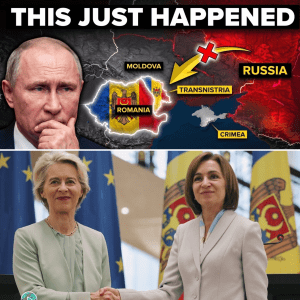
Unlike Crimea in 2014, Transnistria is effectively isolated from direct Russian military support. The region sits between Moldova and Ukraine without any direct land connection to Russia itself. Since the outbreak of the Ukraine war, access routes that might have been available previously have become largely inaccessible.
Ukraine’s role has become especially critical.
Since 2022, Kyiv has transformed much of its southwestern frontier into a heavily fortified defensive zone. Ukrainian military planners view the Transnistria region not merely as a Moldovan issue but as a potential security vulnerability that could affect the broader war effort.
As a result, significant defensive infrastructure has reportedly been established along key border sectors near the region.
Military analysts note that any attempt to reinforce Russian forces in Transnistria would face extraordinary logistical difficulties under current conditions.
Land access is effectively blocked.
Air access would face enormous risks due to Ukrainian air defense systems and regional surveillance networks.
Sea access presents its own challenges because Russia’s ability to project power in the western Black Sea has become far more constrained than before.
This logistical reality has fundamentally altered the strategic equation.
While Russian troops remain present inside Transnistria, many experts argue that their ability to conduct large-scale operations independently is limited without substantial reinforcement. That creates a situation very different from other theaters where Moscow possesses more direct access and support capabilities.
At the same time, Moldova itself has become increasingly assertive.
For many years, Chisinau pursued a cautious approach toward Transnistria, seeking stability while avoiding direct confrontation. However, the broader security environment created by the Ukraine conflict has encouraged Moldovan leaders to strengthen cooperation with European institutions and expand security coordination with Western partners.
This shift has not gone unnoticed in Moscow.
Russian officials frequently criticize what they describe as Western efforts to pull Moldova away from its traditional sphere of influence. Meanwhile, Moldovan leaders argue that closer cooperation with Europe is essential for national sovereignty and long-term security.
The result is a rapidly intensifying geopolitical competition.
NATO’s indirect influence further complicates the picture.
Although Moldova is not a NATO member, neighboring Romania is one of the alliance’s most important eastern flank states. Increased NATO activity throughout Eastern Europe has significantly expanded intelligence gathering, surveillance capabilities, and military readiness across the broader region.
From Moscow’s perspective, this creates additional strategic pressure.
From the perspective of NATO members, however, these measures are viewed as necessary deterrence against further instability.
Energy politics also play a major role in the current confrontation.
For years, Russia maintained significant leverage over Moldova through energy supplies and economic relationships. Yet efforts by European governments to diversify regional energy networks have gradually reduced some of that dependence, limiting Moscow’s ability to use economic pressure as effectively as in previous decades.
This changing landscape has left Transnistria in an increasingly uncertain position.
The region remains politically aligned with Russia but geographically disconnected from it. Its future depends not only on local dynamics but also on broader developments involving Ukraine, NATO, the European Union, and Russia itself.
Some analysts now argue that Transnistria may actually represent a strategic liability rather than an opportunity for Moscow.
Maintaining influence in an isolated enclave surrounded by increasingly hostile territory requires resources, attention, and political capital. As long as the Ukraine war continues, those resources remain stretched across multiple fronts simultaneously.
Others caution against underestimating Russia’s long-term patience.
Historically, Moscow has often pursued strategic objectives over decades rather than years, waiting for favorable political conditions to emerge. From this perspective, temporary obstacles do not necessarily mean permanent defeat.
Still, even those analysts acknowledge that current conditions are unusually difficult.
The combination of Ukrainian defenses, Moldovan resistance, NATO vigilance, and geographic isolation has created a set of constraints unlike anything Moscow faced in Crimea more than a decade ago.
That reality is forcing policymakers throughout Europe to reassess assumptions about the region’s future.
Rather than becoming another rapid geopolitical victory, Transnistria increasingly looks like a complex strategic puzzle with no easy solutions for any side involved.
As tensions continue rising across Eastern Europe, the region may become one of the most important tests of how power, geography, and political influence interact in a new era of great-power competition.
Whether Moscow ultimately succeeds in preserving its influence there remains uncertain.
What is becoming increasingly clear, however, is that the path forward appears far more complicated than many observers once expected.






