A heated online debate has erupted across Australia and the United States after a social media post about Australia’s National Sorry Day unexpectedly went viral, exposing millions of Americans to a tradition many said they had never heard of before.
What began as a single frustrated post from an Australian mother quickly exploded into a much larger international argument about national identity, historical guilt, indigenous reconciliation, schools, politics, and the cultural direction of modern Australia.
Within hours, conservative commentators, political influencers, journalists, and ordinary social media users from both countries were fiercely debating whether National Sorry Day represents compassion and historical recognition — or whether it has become a symbol of what critics describe as “national self-hatred.”

The controversy intensified after several prominent American conservatives reacted with visible disbelief upon learning that Australia dedicates an official national day to acknowledging the suffering of Indigenous Australians affected by past government policies.
The online firestorm began after an Australian woman named Lauren posted on X that she had decided to keep her son home from school during National Sorry Day activities.
“We have nothing to be sorry for and I am sick to death of my White sons being guilt tripped,” she wrote.
The comment immediately triggered thousands of reactions, shares, and arguments.
Some users praised her for “standing up against political indoctrination,” while others accused her of completely misunderstanding the purpose of the day and disrespecting Indigenous Australians and survivors of the Stolen Generations.
But the debate moved far beyond Australia once prominent American commentator Matt Walsh responded publicly.
“This popped up in my feed for some reason,” Walsh wrote.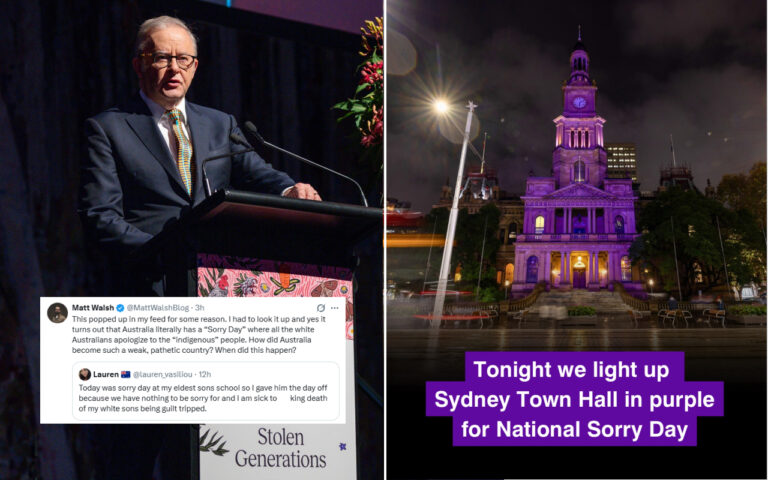
“I had to look it up and yes it turns out that Australia literally has a ‘Sorry Day’ where all the White Australians apologise to the indigenous people. How did Australia become such a weak, pathetic country? When did this happen?”
His comments rapidly spread across conservative social media communities in the United States, where many users reacted with confusion and shock.
For many Americans unfamiliar with Australian history, the idea of an annual national event centered around apology and historical reflection appeared deeply unusual.
Walsh continued by mocking common international stereotypes about Australians.
“I used to think Australians were a bunch of tough old bastards living down there with crocodiles and spiders the size of dinner plates,” he wrote.
“Turns out they’re just warm weather Canadians.”
That remark alone generated enormous online engagement, with thousands of Australians responding angrily, defensively, or humorously.
Some accused American conservatives of completely misunderstanding Australia’s history.
Others agreed with Walsh and argued that Australia had become increasingly dominated by progressive identity politics and cultural guilt.
National Sorry Day has existed since 1998 and is observed every year on May 26.
The day commemorates the Stolen Generations — Indigenous Australian children who were forcibly removed from their families under historical government policies that lasted for decades.
For many Indigenous Australians and supporters of reconciliation, the day is intended to acknowledge trauma, recognize survivors, and promote healing.
Schools, councils, institutions, and governments across Australia often organize ceremonies, educational programs, speeches, and commemorative events.
This year, Sydney Town Hall was illuminated in purple as part of the observance.
Prime Minister Anthony Albanese also released a public statement describing the Stolen Generations as “one of the darkest chapters in our nation’s history.”
He praised the “courage of survivors” and said Australia must continue the work of reconciliation and healing.
“On National Sorry Day we acknowledge their pain, we honour their strength and we renew our national commitment to the work of healing,” Albanese wrote.
Supporters of the day argue that acknowledging historical injustice is necessary for national maturity and reconciliation.
They insist National Sorry Day is not about blaming modern Australians personally for historical actions, but rather about recognizing real suffering experienced by Indigenous communities.
However, critics increasingly argue that the day has evolved into something more politically and culturally divisive.
Several online commenters claimed Australian children are now being raised with constant messages of inherited guilt.
Independent journalist Drew Pavlou became one of the most widely shared Australian voices in the debate.
“Australia has held 29 National Sorry Days since 1998,” he wrote.
“Longer than I’ve been alive. I wonder when the apology will be accepted.”
In another post, Pavlou claimed that many progressive cultural trends affecting Europe and North America are also becoming deeply embedded in Australia.
“It’s so much worse than people understand,” he wrote.
“On the current trajectory European Australians will be a minority within 15-20 years.”
His comments generated fierce backlash from critics who accused him of fearmongering and promoting racial anxiety.
But supporters argued he was voicing concerns that many Australians privately share but rarely express publicly.
Another viral comment came from Australian mother Celine Baumgarten, who described hearing children perform a “Welcome to Country” acknowledgment over a school loudspeaker every day.
“Australian children are being told daily that they are on stolen land,” she wrote.
“We are truly the land down under — upside down.”
That phrase spread rapidly across social media platforms, becoming one of the most repeated lines associated with the controversy.
The emotional intensity of the debate reflects much broader tensions that have been building inside Australian society for years.
Questions surrounding Indigenous recognition, immigration, national identity, colonial history, and cultural change have increasingly become emotionally charged political issues.
The failed Indigenous Voice referendum in 2023 already revealed deep divisions across the country about reconciliation and constitutional recognition.
Many Australians felt exhausted by identity-focused political debates.
Others believed the referendum’s defeat demonstrated how much work still remained in addressing Indigenous disadvantage and national unity.
The National Sorry Day controversy appears to have reopened many of those same wounds.
For progressive Australians, criticism of National Sorry Day feels like an attempt to erase painful historical realities.
For conservative Australians, the growing emphasis on apology, historical guilt, and symbolic politics represents a country losing confidence in itself.
The involvement of American commentators added another layer to the debate.
Some Australians reacted angrily to what they viewed as Americans interfering in Australian cultural discussions without understanding local history.
Others welcomed the attention, arguing that outsiders were finally noticing dramatic political and cultural changes taking place in Australia.
Several political analysts noted that social media increasingly transforms national debates into international ideological battlegrounds almost instantly.
What might once have remained a domestic disagreement now becomes global within hours.
That dynamic helps explain why a single mother’s school complaint quickly evolved into an international political argument involving commentators, journalists, activists, and politicians from multiple countries.
The emotional reactions also reveal how deeply symbolic issues surrounding identity and history have become in modern democracies.
For supporters of National Sorry Day, the observance represents empathy, recognition, and moral responsibility.
For critics, it represents national weakness, cultural guilt, and political messaging aimed at children.
Those two interpretations are now colliding more openly than ever before.
Behind the viral headlines and angry online arguments lies a deeper question many Australians are now asking themselves:
What kind of country does Australia want to become?
That debate is no longer happening quietly in classrooms or political institutions alone.
It is unfolding publicly across social media feeds, television panels, schools, workplaces, and dinner tables — with growing intensity every year.
And after millions of Americans suddenly discovered National Sorry Day for the first time, that conversation is no longer staying inside Australia either.






