A Viral Clip Recasts an Old Feud Over Credentials Into a Lesson About Political Theater
By Staff Writer
WASHINGTON — For more than a decade, Donald Trump and Barack Obama have occupied opposite poles of American political identity. One has favored provocation, spectacle, and personal mockery; the other has leaned on restraint, institutional language, and appeals to norms. Last week, those contrasting styles collided again — this time in the form of a viral video that ricocheted across social media under the headline: Trump mocked Obama’s grades. Obama read Trump’s transcript. The crowd roared.
The clip, which amassed millions of views within hours, purports to show a nationally televised education forum in which Mr. Trump derides Mr. Obama’s academic record, only to be met with a devastating reversal. In the video, Mr. Obama calmly produces what is described as Mr. Trump’s transcript and reads out scores that appear to undercut Mr. Trump’s long-standing claims of intellectual superiority. The audience erupts. Mr. Trump looks stunned. The moment ends in what viewers online quickly labeled an “unrecoverable collapse.”
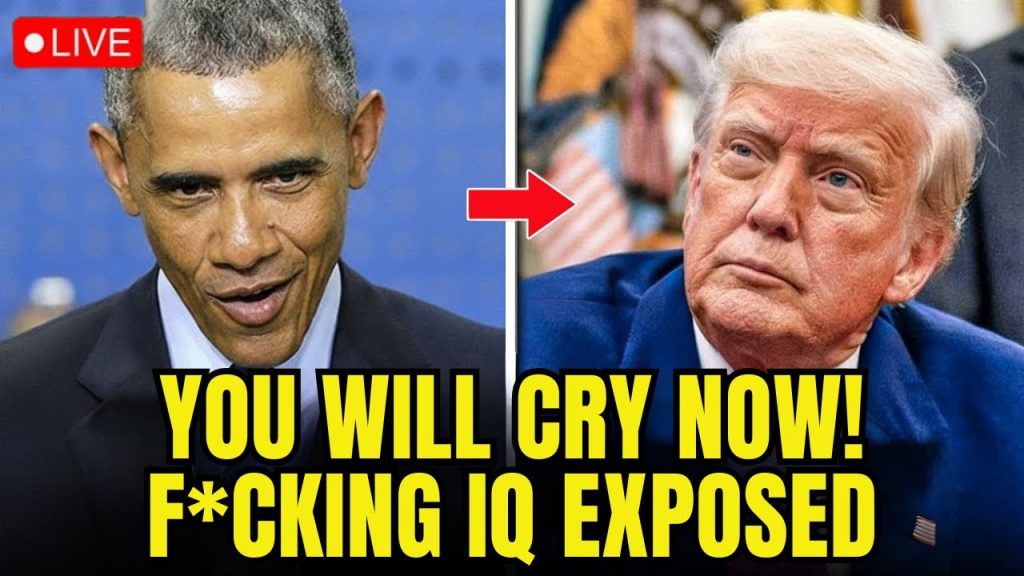
The problem is that none of this has been independently verified.
The Power of a Familiar Story
No public record exists of Mr. Obama revealing Mr. Trump’s academic transcript on live television. Mr. Trump’s standardized test scores have never been officially released, nor has any credible outlet reported that such documents were “unsealed.” Both men’s representatives declined to comment directly on the video, though Trump allies dismissed it as fabricated, and Obama allies noted that the former president has consistently avoided personal humiliation as a political tactic.
Yet the video’s reach says less about its factual accuracy than about the appetite it tapped.
“This clip works because it completes a narrative people already recognize,” said a media analyst who studies political virality. “Trump attacks credentials. Obama responds with calm authority. Paper beats bravado.”
In that sense, the video functions as political fan fiction — not unlike other viral moments in recent years that blend real personalities, familiar conflicts, and imagined resolutions into emotionally satisfying arcs.
Credential Warfare, Revisited
Mr. Trump has long used academic pedigree as a rhetorical weapon. He has mocked rivals’ intelligence, questioned their grades, and cited his own education at Wharton as shorthand for competence. Mr. Obama, conversely, has often been the target of credential-based attacks, from false claims about his birthplace to insinuations that his success was unearned.
The viral clip exaggerates this dynamic into a symbolic confrontation: the mocker confronted with documentation; the loud voice silenced by a page.
What resonated with viewers was not the alleged numbers, but the structure of the exchange. Mr. Obama does not insult. He does not raise his voice. He produces a document and lets the crowd respond.
“It’s the fantasy of accountability,” said a political communications professor. “Not yelling back, but holding up the receipt.”
The Illusion of Evidence
The visual language of the clip is key to its credibility. A single sheet of paper. Reading glasses. A pause before the number is spoken. These cues signal verification, even when the underlying source is fictional or unconfirmed.
In reality, transcripts and test scores are rarely decisive in political life. Voters do not choose leaders based on percentiles. But the idea of a transcript carries symbolic weight. It represents permanence — something written down that cannot be argued with on volume alone.
That symbolism has become increasingly potent in an era of disinformation and performance politics. As claims proliferate faster than they can be checked, the image of a document read aloud feels like a return to older rules: facts over flair, records over rhetoric.
Reaction and Aftermath
Online, the response split predictably. Critics of Mr. Trump shared the clip as catharsis, often acknowledging that its veracity was secondary to its message. Supporters dismissed it as propaganda, pointing out the lack of sourcing and the implausibility of the scenario.
Mr. Trump himself responded obliquely on social media, reiterating his academic achievements and accusing unnamed opponents of spreading “fake garbage.” He did not address the specific claims in the video.
What lingered was not outrage, but a kind of quiet satisfaction among those who shared it. The clip offered a vision of a political culture many feel is missing: one in which mockery backfires, restraint prevails, and credibility is not self-declared but tested.
Why It Matters Anyway
Even as a fabrication, the episode reveals something real about the current media environment. Viral political content no longer needs to be true to be meaningful. It needs to feel true — to align with established character arcs and collective frustrations.
For Mr. Obama, the clip reinforces an image cultivated during and after his presidency: the leader who does not descend into insult, who lets others exhaust themselves, and who trusts that composure reads as strength. For Mr. Trump, it amplifies a vulnerability he has always denied: that his authority rests on repetition rather than proof.
The transcript, in the end, is beside the point. The roar of the crowd — real or imagined — is the message. It reflects a public hunger for moments when noise gives way to quiet, and bravado meets something it cannot simply talk over.

In a political era defined by spectacle, the viral fantasy of a single sheet of paper ending an argument may be unrealistic. But its popularity suggests how deeply many Americans wish it were possible.






