On a bright spring morning in Stockholm Harbor, Sweden’s Prime Minister and Defense Minister stood aboard a Swedish Navy corvette and delivered news that instantly rippled through defense ministries across Europe and across the Atlantic.
They announced their country’s largest single defense investment since formally joining NATO just 18 months earlier — a sweeping $4 billion package spanning next-generation warships, fighter aircraft upgrades, anti-drone systems, advanced radars, and electronic warfare capabilities. The scale was historic. The detail that hit hardest for many observers was even more striking: not one dollar of that $4 billion would flow to any American defense contractor.
The centerpiece of the announcement was a major order for five French-designed FDI frigates from Naval Group. The deal, potentially worth up to $4.2 billion on its own, was selected primarily because France could deliver the warships on the fastest timeline. Swedish officials made clear that operational urgency, not political favoritism or industrial offsets, drove the choice.
Sweden needed capable surface combatants quickly, and the French production line was already running at full speed for both the French and Greek navies. In one stroke, Sweden had placed one of its biggest naval bets in decades squarely inside the European defense ecosystem.
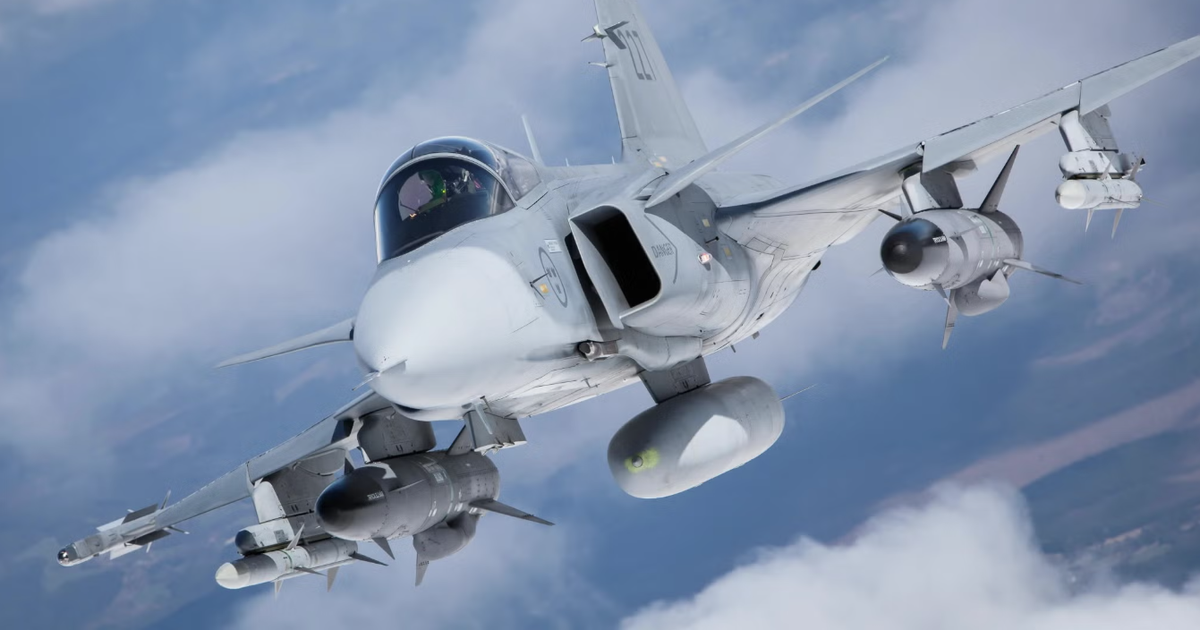
At the same time, the package included continued heavy investment in Saab’s Gripen fighter program, next-generation counter-drone systems, radar platforms, and electronic warfare tools. Saab’s stock jumped 5.3 percent by mid-morning. Shares in Germany’s Rheinmetall and other major European defense names rose between 5 and 8 percent.
The broader European defense sector index, already up 57 percent in 2025, added another surge as investors recognized the signal: Europe was no longer waiting for American permission or American hardware. It was writing its own checks to its own companies.
What made the Swedish decision especially powerful was its context. Sweden had spent two centuries as a militarily non-aligned nation. Its accession to NATO in March 2024 was a direct response to Russia’s full-scale invasion of Ukraine. Yet even as a brand-new NATO member with no historical grudge against American equipment, Sweden chose European suppliers on the basis of capability, speed, and long-term strategic alignment.
Procurement officials in Berlin, Warsaw, Rome, and Helsinki took note. When Sweden — pragmatic, technologically advanced, and anchored by one of Europe’s most respected defense firms in Saab — turns to France for warships, the message travels fast.
The relationship is already running in both directions. In December, France ordered two of Saab’s GlobalEye airborne early warning and control aircraft, with an option for two more. France is buying Swedish surveillance planes while Sweden buys French warships.
The industrial and technological ties between Paris and Stockholm have deepened more in the last six months than in the previous six decades. Neither country asked Washington for approval. Neither consulted American officials before signing. This is sovereignty in action — quiet, deliberate, and accelerating.
Sweden’s broader defense trajectory tells the same story in numbers. Military spending is projected to reach 2.8 percent of GDP in 2026 and climb toward 3.5 percent by 2030 — nearly double the old NATO 2 percent guideline that many European nations struggled to meet just three years ago.
In April, Stockholm announced a separate 8.7 billion kronor (roughly $916 million) investment focused on air defense and anti-drone systems, including Saab’s battle-tested counter-drone platforms. Swedish officials emphasized that these systems had already proven effective in Ukraine against Iranian-made Shahed drones. Sweden is not buying theoretical capability from glossy brochures. It is buying equipment validated in real combat and built by European hands.
This pattern is no longer isolated. Across the continent, European defense expenditure has risen from approximately €240 billion in 2022 to an estimated €360 billion in 2025 — a 50 percent jump in just three years. The EU as a whole crossed the 2 percent of GDP threshold for the first time in decades. Poland is spending at 4.5 percent.
The Baltic states and Finland sit comfortably above 3 percent. Germany is on track to field 460,000 troops and build Europe’s strongest conventional military by the mid-2030s. France has extended its nuclear deterrence framework to eight European partners. The EU’s Readiness 2030 package aims to mobilize €800 billion by the end of the decade, and the overwhelming majority of that procurement pipeline is staying inside Europe.
Corporate results mirror the government spending almost exactly. The six largest European defense companies — Rheinmetall, Leonardo, BAE Systems, Thales, Hensoldt, and Saab — saw average revenue growth of 57 percent between 2021 and 2025. Order intake grew even faster. Rheinmetall’s backlog surged 323 percent over the same period.
The company told investors it expects total sales to grow 40 to 45 percent in 2026 alone. Analysts upgraded the stock specifically because of Germany’s rapidly expanding budget and the rest of Europe’s even faster trajectory. Europe’s defense sector index has delivered eye-popping returns while the old reliance on American prime contractors quietly erodes. Only 8 percent of Germany’s 154 major planned military purchases now go to American suppliers.
The architecture taking shape is self-reinforcing. France builds warships for Sweden. Sweden builds surveillance aircraft for France. Germany supplies ammunition and armored vehicles across the continent. Finland provides infantry mobility platforms to neighbors.
Every contract signed between European companies makes the next European contract more likely, more efficient, and more strategically logical. It also makes the next American contract less necessary. Analysts now predict that European defense procurement from European suppliers will exceed 70 percent of total military spending by 2028, up from roughly 55 percent today.
Sweden’s choice accelerates that trajectory precisely because it carries no ideological baggage. This is not France or Germany pushing an anti-American agenda. This is a pragmatic, newly aligned NATO member choosing the fastest, most capable, and most interoperable European options available. When other capitals see that even Stockholm is prioritizing European speed and European sovereignty, the old default of defaulting to American platforms weakens further.
Hardware is only part of the story. European officials are also moving to ensure the software, command systems, and data architectures that connect this new equipment remain under European control. The same logic that drove Sweden to French frigates is driving decisions about battle-management systems, satellite communications, and autonomous platforms. The goal is a continental defense industrial base that can stand on its own if political winds in Washington shift again.
The defense super-cycle that analysts first described in 2022 is no longer a forecast. It is line items on national budgets, percentage points on GDP, surging order backlogs, and rising stock prices that lifted every major European defense company on a single morning in May 2026.
Sweden’s announcement is simply the latest, clearest data point in a continental rearmament that is deliberately building mutual dependencies inside Europe rather than across the Atlantic.
For American defense contractors, the message is unambiguous. Europe is no longer content to be a passive customer. It is becoming a self-supplying strategic actor. The ships, the fighters, the radars, the drones, and the networks that will define European security for the next generation are increasingly being designed, built, and paid for inside Europe. Sweden’s $4 billion decision, made without American participation and without American veto, is not an insult. It is a statement of intent. Europe has decided that its security must ultimately rest on European foundations.
The question now is how fast the rest of the continent follows the same logic — and how Washington chooses to respond. One thing is already clear: the old post-Cold War assumption that European NATO members would automatically turn to American weapons is fading into history. A new European defense ecosystem is rising, contract by contract, frigate by frigate, and it is doing so on its own terms. Sweden just wrote one of the clearest chapters yet.






