For decades, Canada’s Arctic strategy rested on a delicate balance of geography, diplomacy, and cooperation with allies. That balance is now changing faster than many analysts predicted.

In a sweeping announcement that could redefine the future of North America, Prime Minister Mark Carney unveiled a historic investment package exceeding $40 billion aimed at strengthening Canada’s presence across the Arctic. The message was unmistakable: Canada intends to secure, develop, and defend its North on its own terms.
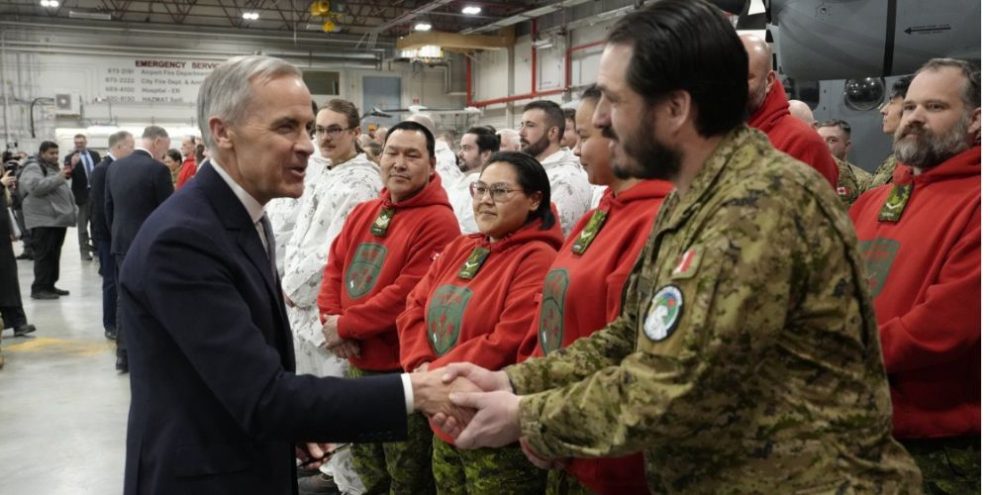
Standing before members of the Canadian Armed Forces in Yellowknife, Carney delivered a statement that immediately captured attention across international capitals. Canada, he said, could no longer depend on other nations for its security and prosperity in the Arctic.
The declaration represented far more than political rhetoric. It signaled a fundamental shift in Canada’s strategic thinking at a moment when the Arctic is becoming one of the most contested regions on Earth.
Climate change has transformed the region faster than almost any other place on the planet. Arctic temperatures are rising at nearly three times the global average, accelerating the retreat of sea ice and opening waterways that were once inaccessible for much of the year.
At the center of this transformation lies the Northwest Passage, a vast network of Arctic channels weaving through Canada’s northern archipelago. For centuries, the route was largely frozen and unusable for commercial navigation.

Today, however, shipping experts increasingly view the passage as a potential game-changing trade corridor connecting Asia and Europe. If fully navigable, vessels could save thousands of kilometres compared with routes through the Panama Canal or the Suez Canal.
With economic opportunity comes geopolitical competition.
For decades, Canada and the United States have maintained differing interpretations of the Northwest Passage. Ottawa insists the route passes through internal Canadian waters, while Washington has traditionally argued that it constitutes an international strait.
As Arctic navigation becomes more practical, this long-standing legal disagreement is no longer merely theoretical. It is evolving into a strategic issue with enormous implications for trade, security, and sovereignty.
The Carney government appears determined to ensure that Canada possesses the infrastructure and capabilities required to enforce its position.
A central component of the plan involves approximately $32 billion in military investments focused on key Arctic operating locations including Yellowknife, Inuvik, Iqaluit, and Goose Bay.
These installations are not new military bases. Instead, they are existing facilities that will undergo extensive modernization to support expanded surveillance operations, rapid response capabilities, and year-round Arctic presence.

Defence planners argue that maintaining sovereignty over such a vast territory requires more than symbolic declarations. Canada’s Arctic spans approximately 4.4 million square kilometres of land and sea, making it one of the largest and most challenging regions on Earth to monitor.
The government’s strategy therefore emphasizes persistent presence rather than occasional patrols. Officials believe sovereignty is strengthened when a nation demonstrates continuous operational capability across its territory.
Beyond military upgrades, Canada is investing heavily in surveillance technologies.
A new Arctic maritime awareness hub in Iqaluit will gather and analyze intelligence on vessel movements throughout the region. Additional reconnaissance equipment will be deployed, while new long-range radar systems are planned along key Arctic waterways.
The radar network is particularly significant. Positioned near critical sections of the Northwest Passage, these systems would provide real-time monitoring of maritime traffic and enhance Canada’s ability to track activities throughout the region.
New drone capabilities are also being incorporated into the strategy. These platforms are expected to operate in the air, on the surface, and even underwater, dramatically expanding Canada’s ability to observe remote areas.
Yet the government’s vision extends well beyond defence.
Officials repeatedly emphasize that long-term sovereignty depends on economic activity and thriving communities. Security, they argue, cannot be separated from development.
That philosophy is evident in the proposed Grays Bay Road and Port project, one of the most ambitious Arctic infrastructure initiatives in recent Canadian history.
The project would establish a deep-water port on Canada’s northern coast and connect it to valuable mineral deposits through a 230-kilometre all-season road. The development could unlock significant reserves of zinc, copper, and other strategic resources.
Supporters view the initiative as a transformative economic opportunity. By creating permanent commercial activity in the Arctic, Canada would strengthen its practical control over territory and waterways that are increasingly attracting international attention.
The project also highlights the growing role of Indigenous leadership in Arctic development. Inuit organizations are expected to play a central role in shaping and operating critical infrastructure projects.
Meanwhile, plans for the broader Canadian Arctic Economic and Security Corridor seek to extend transportation networks deeper into the North, creating links between resource-rich regions and emerging infrastructure hubs.
Energy investments form another key pillar of the strategy.
Federal plans include major hydroelectric expansion projects designed to increase power generation capacity in the Northwest Territories. Reliable energy supplies are considered essential for sustaining future industrial and community growth.
Military exercises conducted in recent months have reinforced the government’s message.
Canadian Rangers and Armed Forces personnel completed a remarkable snowmobile patrol exceeding 5,000 kilometres across some of the harshest terrain on Earth. The operation demonstrated the unique capabilities developed by northern communities and Indigenous reservists.
Temperatures reportedly plunged below minus 60 degrees Celsius during portions of the exercise, underscoring the extraordinary challenges associated with Arctic operations.
The Rangers remain one of Canada’s most effective tools for maintaining a year-round presence in remote regions where conventional military deployments are difficult and expensive.
Taken together, the defence spending, infrastructure construction, surveillance systems, transportation corridors, and energy projects reveal a coherent national strategy rather than a collection of isolated initiatives.
The timing is equally important.
As global powers increasingly focus on Arctic resources, shipping routes, and strategic positioning, Canada appears determined to secure its interests before competition intensifies further.
For many Canadians, the announcement represents a long-overdue recognition of the North’s importance to the nation’s future. For others, it signals the beginning of a new era in Arctic geopolitics.
What is clear is that the Arctic is no longer a distant frontier discussed only by specialists and policymakers. It has become a central arena where economics, climate change, security, and sovereignty intersect.
The coming decade will reveal whether Canada’s unprecedented investment can successfully transform the North into a region that is not only defended, but fully integrated into the country’s economic and strategic future.
One thing is certain: Ottawa has made its choice. Canada is building an Arctic fortress—not merely to protect territory, but to shape the future of the North on Canadian terms.






