EUROPE’S NEW NATO RISES: France’s Nuclear Umbrella Now Shields 9 Nations as USA Pulls Out Submarines & Jets – Historic Shift!
The Dawn of Europe’s Independent Defense Era: As America Withdraws, France’s Nuclear Umbrella Expands to Nine Nations
In a stunning 48-hour sequence that marks a historic turning point in global security, the United States delivered a bombshell announcement to its NATO allies, followed almost immediately by a bold move that signals Europe’s determination to forge its own path. On Tuesday, behind closed doors in Brussels, Pentagon officials informed NATO defense policy directors of drastic reductions in American military commitments to the alliance. The very next day, Norwegian Prime Minister Jonas Gahr Støre flew to Paris and signed the Narvik Agreement with French President Emmanuel Macron, formally placing Norway under France’s nuclear protection.
This is not mere coincidence. It is cause and effect playing out in real time – the clearest evidence yet that Europe is rapidly building its own version of NATO as American reliability fades.
The U.S. announcement was stark and sweeping. America will cut the number of fighter jets available to NATO by approximately one-third. Strategic bombers will see significant reductions. The U.S. Navy will provide fewer destroyers for European operations. Armed and reconnaissance drones will be scaled back dramatically, with Europe expected to fill the gap independently. Most shocking of all: the United States will no longer provide any submarines to NATO – zero. The alliance that has depended for 77 years on American nuclear submarines as its ultimate survivable deterrent has just been told that this cornerstone capability is gone.
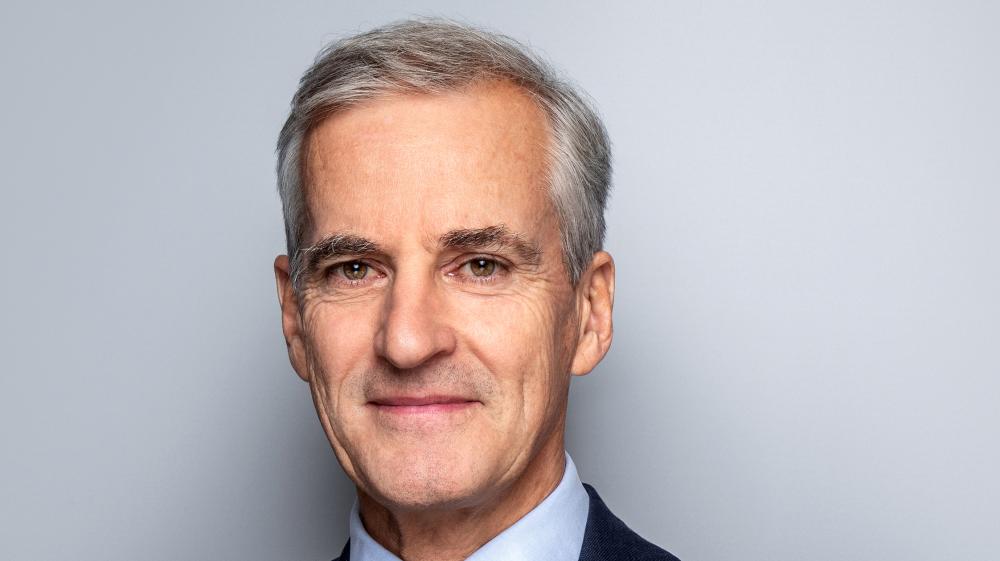
A Pentagon adviser delivered the message in the closed-door session, and spokesman Shawn Parnell later confirmed the changes publicly. The reductions were framed as an opportunity for European allies to finally “step up,” echoing President Trump’s repeated calls for them to take primary responsibility for their own defense. A NATO spokeswoman acknowledged an “over-reliance” on U.S. forces and stated that European members must now close the resulting capability gaps. Further details are expected at a formal force generation conference in early June.
The timing could not have been more dramatic. Within 24 hours of hearing that America was pulling back its submarines, bombers, and a third of its fighter jets, one of NATO’s original 12 founding members – Norway – took a decisive step toward European strategic autonomy. At the Élysée Palace, Prime Minister Støre and President Macron signed the Narvik Agreement, making Norway the ninth country to join France’s forward nuclear deterrence framework.
No nuclear weapons will be stationed on Norwegian soil in peacetime, but the principle of mutual defense assistance is now locked in. Støre described the current security environment as “the most serious since the Second World War,” citing Russia’s massive nuclear rearmament and growing doubts about long-term U.S. security commitments as the driving factors.
France’s nuclear umbrella now extends over Norway, Sweden, Finland, Denmark, the Netherlands, Belgium, Poland, Estonia, and Greece. What began as a limited offer from Macron in 2020 has exploded into a major independent European deterrence architecture in just 18 months. Each new U.S. withdrawal announcement seems to trigger another European nation signing onto French protection.
This shift represents far more than bureaucratic adjustments. Militarily, the implications are profound. Losing a third of NATO’s fighter jets weakens air superiority, close air support, and precision strike capabilities across any potential European conflict scenario. The complete removal of American submarines eliminates the alliance’s most stealthy second-strike nuclear option and its premier underwater intelligence platform in the European theater. Reduced destroyers mean thinner naval air defense and ballistic missile protection over vast stretches of the North Atlantic and Mediterranean. The drone drawdown forces Europe to rapidly develop its own unmanned aerial capabilities – a gap that dozens of European defense startups are now racing to fill.
The pattern is unmistakable. Russia’s invasion of Ukraine exposed vulnerabilities. Trump’s return to the White House accelerated doubts. The U.S. involvement in the Iran conflict, without full allied support, further strained trust. Threats to leave NATO entirely, troop withdrawals from Germany, cancellation of key missile deployments, and now this week’s explicit force reductions have all pushed Europe toward the same conclusion: they must prepare to defend themselves without counting on Washington showing up.
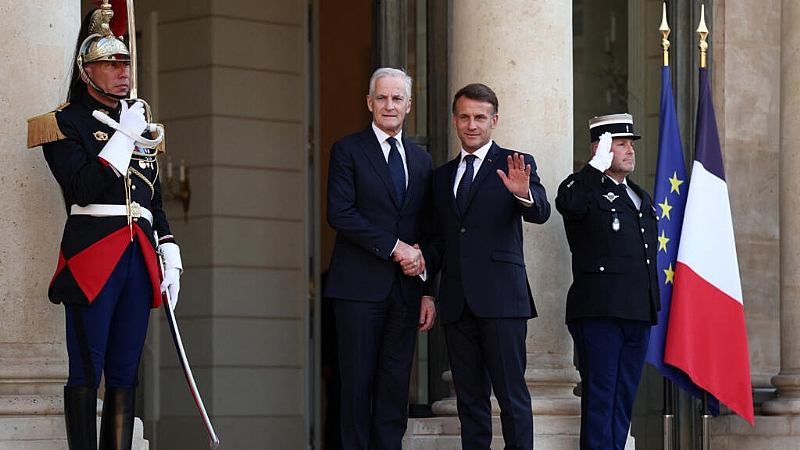
President Macron hailed the Narvik Agreement as a milestone for Europe’s strategic autonomy. Prime Minister Støre was more blunt, directly linking the pact to declining confidence in American guarantees. A NATO founding member publicly hedging against U.S. unreliability by placing itself under a European nuclear umbrella is a seismic diplomatic signal. It was announced not in secret cables but openly, in front of the world’s press at the Élysée Palace.
This development fits into a broader European defense awakening. The E3 format, E5 initiatives, minilateral command clusters, joint procurement programs like IRIS-T, and the push for “Made in Europe” defense production are all accelerating. Countries are increasingly buying from each other rather than from the departing superpower. Recent examples, such as Canada rejecting Boeing in favor of a Swedish surveillance aircraft built on a Canadian platform with zero American content, illustrate the new procurement reality.
The United States is not destroying European security. Paradoxically, its withdrawals are catalyzing a stronger, more self-reliant European defense identity. By making American protection feel increasingly unreliable, Washington is forcing Europe to build credible alternatives. France’s nuclear umbrella stands as the most visible symbol of this transformation – an independent European deterrent outside traditional NATO nuclear sharing arrangements.

Looking ahead, France’s nuclear framework is predicted to expand further. Italy and Portugal are seen as the most likely next candidates by the end of 2026, given their strong bilateral ties with France and exposure to Mediterranean and Atlantic threats. The U.S. reductions announced this week will almost certainly be formalized in June and are unlikely to be reversed under the current administration, regardless of European lobbying.
European nations are already accelerating their own submarine programs, drone manufacturing, and fighter jet production. Contracts are flowing to European companies, creating jobs, technology, and strategic independence. This is NATO 3.0 in action – not the collapse of European defense, but its rebirth as a more autonomous, capable system.
Critics may warn that reducing U.S. involvement weakens the alliance against Russia and China. Supporters of European sovereignty argue the opposite: a Europe that can stand on its own two feet creates a stronger partner for America in the long term, particularly as the U.S. pivots toward the Indo-Pacific. The old model of total dependence is ending. A new era of shared but independent responsibility is beginning.
For Norway, a nation with a long Atlanticist tradition, this decision was not taken lightly. It reflects hard calculations about geography, energy security, Arctic threats, and the reality of Russian nuclear modernization. By linking itself to French nuclear deterrence, Norway gains strategic depth while contributing to a broader European security web.
The speed of this transformation is remarkable. Just four years ago, Macron’s nuclear dialogue offer found few takers. Today, nine nations stand under the French umbrella, and the number is likely to grow. Each American cutback has produced another European signature. The cause-and-effect relationship is now impossible to deny.
This week’s events encapsulate a deeper truth about geopolitics: power abhors a vacuum. As the U.S. steps back from its traditional role as Europe’s primary security provider, Europe is stepping forward. Not in anger, but in necessity. Not in opposition to America, but in adaptation to new realities.
The implications extend far beyond military hardware. This is about strategic culture, industrial policy, technological sovereignty, and political will. Europe is investing heavily in its own defense industry. Joint projects are multiplying. Political leaders are speaking openly about strategic autonomy in ways that would have been taboo a decade ago.
As the June force generation conference approaches, European capitals will be finalizing plans to fill the gaps left by departing American assets. The question is no longer whether Europe will build its own defense architecture. The question is how quickly and how effectively it can do so.
The Narvik Agreement and the U.S. withdrawal announcements together represent more than policy tweaks. They mark the beginning of a new chapter in transatlantic relations and European history. A chapter where Europe no longer waits for Washington’s lead but charts its own course while remaining ready to cooperate when interests align.
The United States has told Europe to handle its own defense. In the space of one dramatic week, Europe has begun to answer that call – with French nuclear guarantees, accelerated European procurement, and a growing determination to never again be wholly dependent on any single external power.
The old NATO is evolving. Europe’s own defense identity is emerging stronger, more self-assured, and increasingly capable. Whether this leads to a healthier alliance or a more fragmented security landscape remains to be seen. What is certain is that the era of unquestioned American dominance in European defense is fading, and a new multipolar reality within the West is taking shape.
The events of this week will be studied for years as the moment when Europe decisively turned toward strategic autonomy. The submarines may be leaving. The jets may be fewer. But in their place, a new European defense architecture is rising – one with French nuclear weapons at its core and nine nations already standing together under its protection.






