Canada is entering what many analysts now describe as one of the most consequential geopolitical turning points in its modern history. For decades, the country balanced its economy, security, and diplomatic priorities around close cooperation with the United States. But after years of growing global instability, rising protectionism, trade tensions, and unpredictable shifts in American foreign policy, Ottawa is beginning to signal something very different:
Canada wants more control over its own future.
And according to many political observers, Foreign Affairs Minister Mélanie Joly just delivered one of the clearest messages yet.
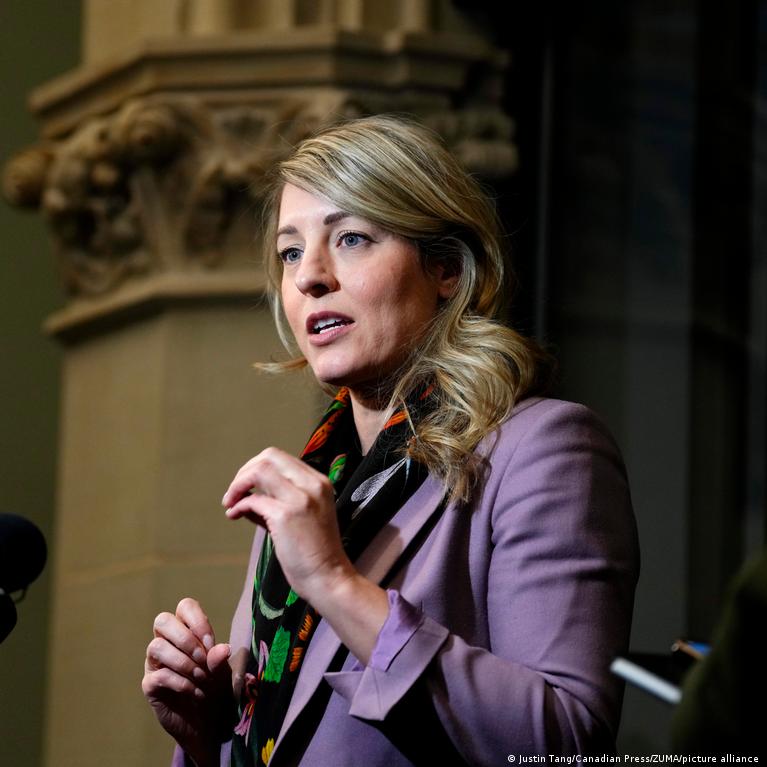
During a speech that quickly sparked reactions across Canadian political circles and international media, Joly outlined a vision for Canada built around sovereignty, industrial independence, and national resilience. While she never directly attacked Donald Trump by name for most of the address, the implications were difficult to ignore.
The speech came at a time when tensions between Canada and sections of the American political establishment have quietly intensified. Trump’s repeated criticism of allies, his aggressive tariff rhetoric, and his “America First” economic philosophy have left many governments—including Canada’s—questioning how reliable Washington may be in the years ahead.
Joly’s message appeared carefully designed to answer that uncertainty.
“This is a moment for Canada to build, invest, and protect its own future,” she said before a packed audience in Ottawa. “Economic security is national security.”
The line immediately began circulating online.
Commentators noted that the statement reflected a dramatic shift in tone from the more cooperative language that traditionally defines Canada-U.S. relations. Rather than emphasizing dependency on American markets or military support, Joly emphasized domestic manufacturing, Canadian supply chains, critical mineral development, advanced technologies, and sovereign defense capabilities.
In other words: Canada is preparing for a world where it cannot assume the United States will always act as a stable partner.
That idea alone is likely to irritate Donald Trump and many figures aligned with his movement.
Trump has long argued that allies benefit disproportionately from American economic and military power. Throughout his presidency, he repeatedly pressured NATO members to increase defense spending and criticized trading partners—including Canada—for what he considered unfair arrangements.
But Joly’s speech flipped the narrative entirely.
Instead of appearing dependent, Canada presented itself as a country preparing to stand more firmly on its own.
And that may be exactly what frustrates Trump most.
Political analysts say the speech reflects growing concern inside Ottawa about the future direction of the United States itself. With another tense American election cycle approaching and polarization continuing to deepen south of the border, Canadian officials increasingly appear focused on insulating the country from external political shocks.
The strategy goes far beyond defense spending.
Canada is now investing heavily in domestic semiconductor production, artificial intelligence infrastructure, clean energy supply chains, and critical minerals essential for electric vehicles and military technology. The federal government has also expanded partnerships with European and Indo-Pacific allies in an effort to diversify trade relationships and reduce overreliance on the American market.
“This is about resilience,” one senior policy advisor reportedly said following the speech. “The global economy is fragmenting. Countries that cannot produce strategically important goods at home will be vulnerable.”
That vulnerability became painfully clear during recent years of global disruption.
The COVID-19 pandemic exposed weaknesses in international supply chains. Wars and geopolitical tensions disrupted energy and food markets. Rising competition between the United States and China forced middle powers like Canada to reconsider where they stand in an increasingly divided world.
Joly’s speech acknowledged that reality directly.
“Canada must never again find itself unable to secure the tools, technologies, and industries essential to its own stability,” she declared.
The audience reportedly responded with sustained applause.
But not everyone reacted positively.
Critics from conservative circles accused the government of using nationalism as political branding while failing to address affordability concerns at home. Others argued that attempting to distance Canada economically from the United States would be unrealistic given the enormous integration between the two economies.
Still, supporters saw something larger in Joly’s remarks.
To them, the speech symbolized a country redefining itself during an era of uncertainty.
For decades, Canada’s geopolitical identity often revolved around moderation, diplomacy, and partnership-building. But the tone emerging now feels more assertive. Canadian officials increasingly speak about “strategic autonomy,” “industrial sovereignty,” and “national capacity”—language more commonly associated with larger global powers.
That rhetorical shift has not gone unnoticed internationally.
European observers have praised Canada’s efforts to strengthen democratic alliances while reducing economic vulnerabilities. Indo-Pacific partners view Ottawa as increasingly active in regional security discussions. And defense industry leaders see massive opportunities as Canada seeks to expand domestic production capabilities.
Meanwhile, Trump allies have already begun criticizing what they describe as “anti-American economic positioning” from parts of the Canadian government.
One American commentator close to Trump’s political orbit dismissed the speech as “globalist rebranding wrapped in nationalist language.” Another accused Canada of benefiting from U.S. security protections while pretending to move toward independence.
But supporters of Joly argue those criticisms only reinforce why Canada feels the need to adapt.
“The world has changed,” one former diplomat explained during a television panel discussion after the speech aired. “Countries can no longer assume stability will simply continue forever. Canada is trying to prepare for that reality before it becomes a crisis.”
The speech also carried political symbolism beyond economics.
Many viewers noticed that Joly repeatedly emphasized Canadian identity, democratic institutions, and decision-making “in the interests of Canadians alone.” The framing appeared intentional: a subtle but unmistakable rejection of the populist pressure tactics and aggressive transactional politics associated with Trump-era diplomacy.
Social media reactions exploded within hours.
Supporters praised the speech as “strong,” “strategic,” and “finally independent.” Clips of Joly’s remarks circulated rapidly across TikTok, X, and YouTube, with users describing the address as one of the clearest signs yet that Canada is entering a new political era.
Critics, however, accused the government of overstating external threats to justify industrial spending and political messaging.
But regardless of political perspective, one conclusion seemed impossible to avoid:
Canada is changing its posture on the world stage.
And if Donald Trump returns to power in Washington, that shift could become even more significant.
For years, Canada carefully positioned itself as America’s closest ally and most reliable partner. But now, Ottawa appears increasingly focused on ensuring the country can withstand instability—even if that instability originates from the United States itself.
That may be the most important takeaway from Mélanie Joly’s speech.
This is no longer just about trade agreements or defense budgets.
It is about a country quietly preparing for a future where global alliances feel less predictable, economic nationalism is rising everywhere, and middle powers can no longer afford complacency.
For supporters, it represents realism and strength.
For critics, it risks unnecessary confrontation.
But either way, one thing became clear after Joly stepped away from the podium:
Canada is no longer speaking like a country waiting for direction from someone else.
It is beginning to speak like a country determined to shape its own future.






