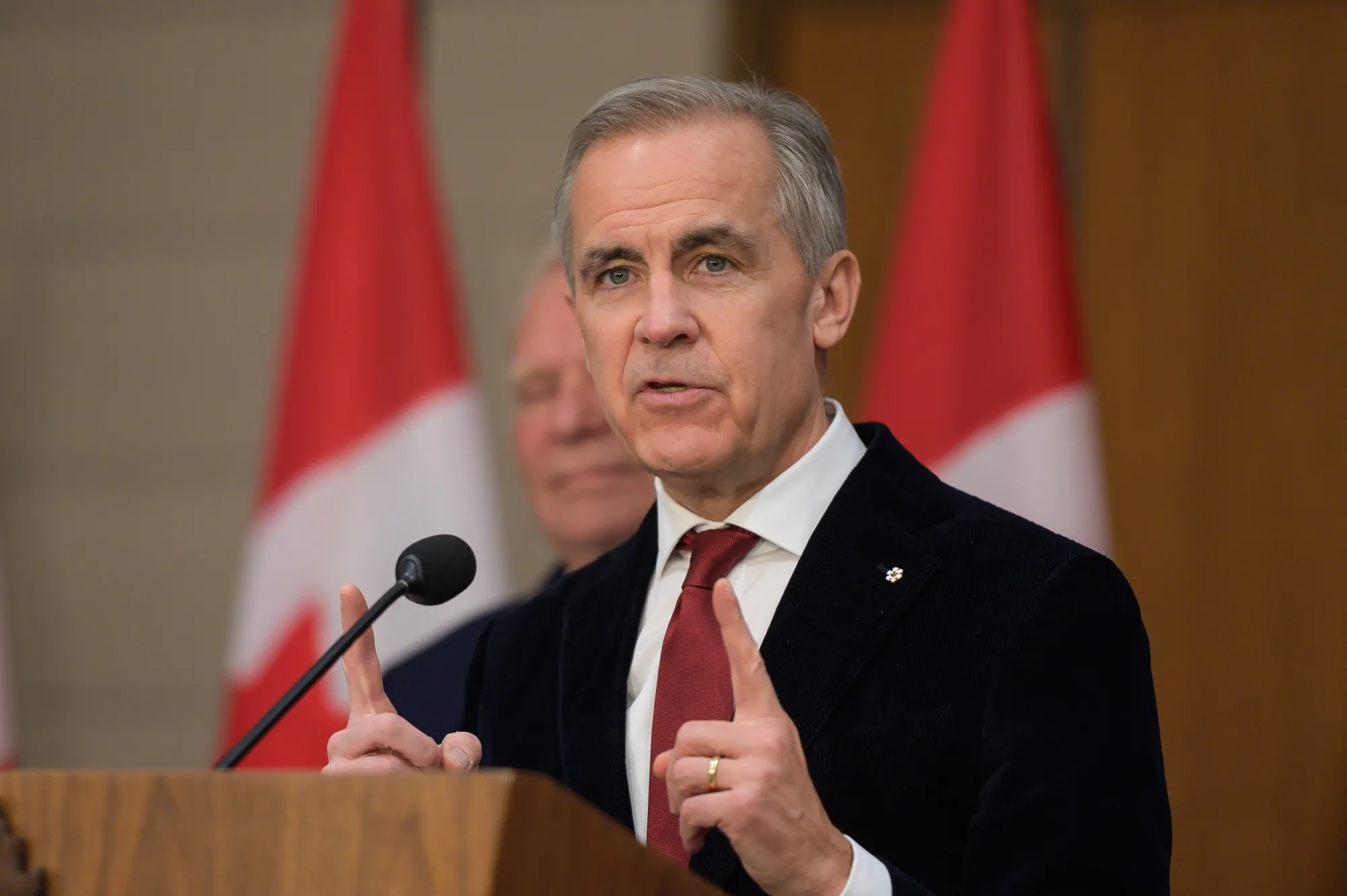
Standing before business leaders in Vancouver, Mark Carney delivered one of the clearest signals yet that Ottawa intends to push forward with a major new energy corridor, even if negotiations with David Eby remain difficult. With only weeks remaining before key trade and infrastructure deadlines, Carney framed the discussion not as a theoretical debate about pipelines, but as a defining economic decision for Western Canada.
The prime minister argued that Canada is operating in the middle of a global energy crisis and that the country has an opportunity to strengthen both its economy and its international leverage through expanded energy exports. Speaking to the Greater Vancouver Board of Trade, Carney said the project would proceed only if three major conditions were satisfied, each tied to environmental commitments, provincial benefits, and Indigenous consultation.
At the center of Carney’s proposal was the requirement that the Pathways Alliance carbon capture initiative move forward alongside any future pipeline development. The project, backed by six of Canada’s largest oil sands producers, is designed to capture and store up to 22 million tonnes of carbon emissions annually by the end of the decade. By tying pipeline approval to emissions management, Carney attempted to position the project as both an economic and climate strategy.
The Pathways Alliance includes major firms such as Suncor Energy, Cenovus Energy, Canadian Natural Resources, Imperial Oil, MEG Energy, and ConocoPhillips. Together, the consortium represents the overwhelming majority of oil sands production in Alberta, giving the proposal significant industrial backing even as financing and timing questions remain unresolved.
Another major demand from Ottawa focused on British Columbia’s role in the economic structure of the project. Carney emphasized that BC would not merely function as a transit corridor for Alberta crude, but would also receive direct economic participation through infrastructure investment, long-term employment opportunities, and industrial contracts connected to ports and transportation networks.
That condition appeared to directly address concerns previously raised by Eby, who earlier argued that British Columbia had been largely excluded from the broader national energy discussion. The premier had recently presented a list of proposed development projects worth tens of billions of dollars and pushed for greater federal recognition of BC’s economic priorities.
Carney’s third condition focused on Indigenous consultation under Section 35 of the Constitution Act. He described meaningful consultation with First Nations as non-negotiable, signaling that no federal approval process could move forward without direct engagement with Indigenous communities whose territories would be affected by construction routes.

The political significance of that condition became immediately apparent because previous energy infrastructure disputes in Western Canada have repeatedly stalled over Indigenous opposition and legal challenges. The transcript referenced the experience surrounding the Coastal GasLink project and concerns raised by the Wet’suwet’en Nation, both of which remain influential examples in Canada’s resource development debates.
During the same Vancouver appearance, Carney issued what many observers interpreted as a direct warning to British Columbia. He stated that if discussions become stalled, Ottawa would spend more time investing elsewhere in the country. Though delivered in measured language, the comment carried the tone of a federal ultimatum aimed at accelerating provincial cooperation.
The message reflected growing pressure tied to the approaching July 1 deadline connected to broader trade and infrastructure negotiations. According to the discussion, Alberta is expected to submit a formal pipeline proposal to the federal major projects office at roughly the same time Canada and the United States continue negotiations connected to the future of the CUSMA trade framework.
For provincial leaders, the timing creates substantial political and economic pressure. A stalled pipeline discussion could weaken Canada’s attempt to present itself internationally as a credible alternative energy supplier capable of reducing dependence on the American market while strengthening trade relationships in Asia and other global regions.
Eby’s response, however, suggested a noticeable shift in tone compared with his earlier public criticism of the proposal. Rather than rejecting the idea outright, the premier described the federal-provincial relationship as one built on honest discussions and acknowledged that economic growth and environmental protection must be addressed simultaneously.
The premier also raised concerns about the federal oil tanker moratorium on British Columbia’s north coast, legislation that currently limits the movement of large crude carriers through parts of the region. By referencing the moratorium publicly, Eby appeared to signal that British Columbia was beginning to engage with practical questions surrounding possible pipeline logistics rather than focusing solely on political resistance.
Behind the negotiations lies a massive economic calculation. The transcript repeatedly referenced estimates suggesting that a pipeline carrying roughly one million barrels of oil per day could generate approximately $37 billion annually in economic activity, royalties, and tax revenue under current global oil price conditions.
Supporters of the proposal argue that such revenues could transform Western Canadian infrastructure investment and strengthen federal finances at a time of economic uncertainty. Critics, however, continue to question the environmental consequences, financing structure, and long-term viability of large fossil fuel projects during a global transition toward lower-carbon energy systems.
One of the largest unresolved issues remains the tanker moratorium itself. Any northern export route connected to Prince Rupert would likely require either legislative exemptions or revised regulatory arrangements from Ottawa. Such measures would involve parliamentary debate and could significantly complicate the government’s desired timeline.
Another major uncertainty involves the Pathways carbon capture initiative. Although politically useful as a climate commitment, the project itself has faced delays and funding concerns. Linking pipeline approval to the simultaneous advancement of another multibillion-dollar infrastructure initiative creates an additional layer of complexity for both governments and industry leaders.
Perhaps the biggest obstacle is that no private-sector company has yet formally committed to building and operating the proposed pipeline. Without a confirmed project proponent, discussions about construction timelines remain largely aspirational rather than operational, despite increasing political momentum.
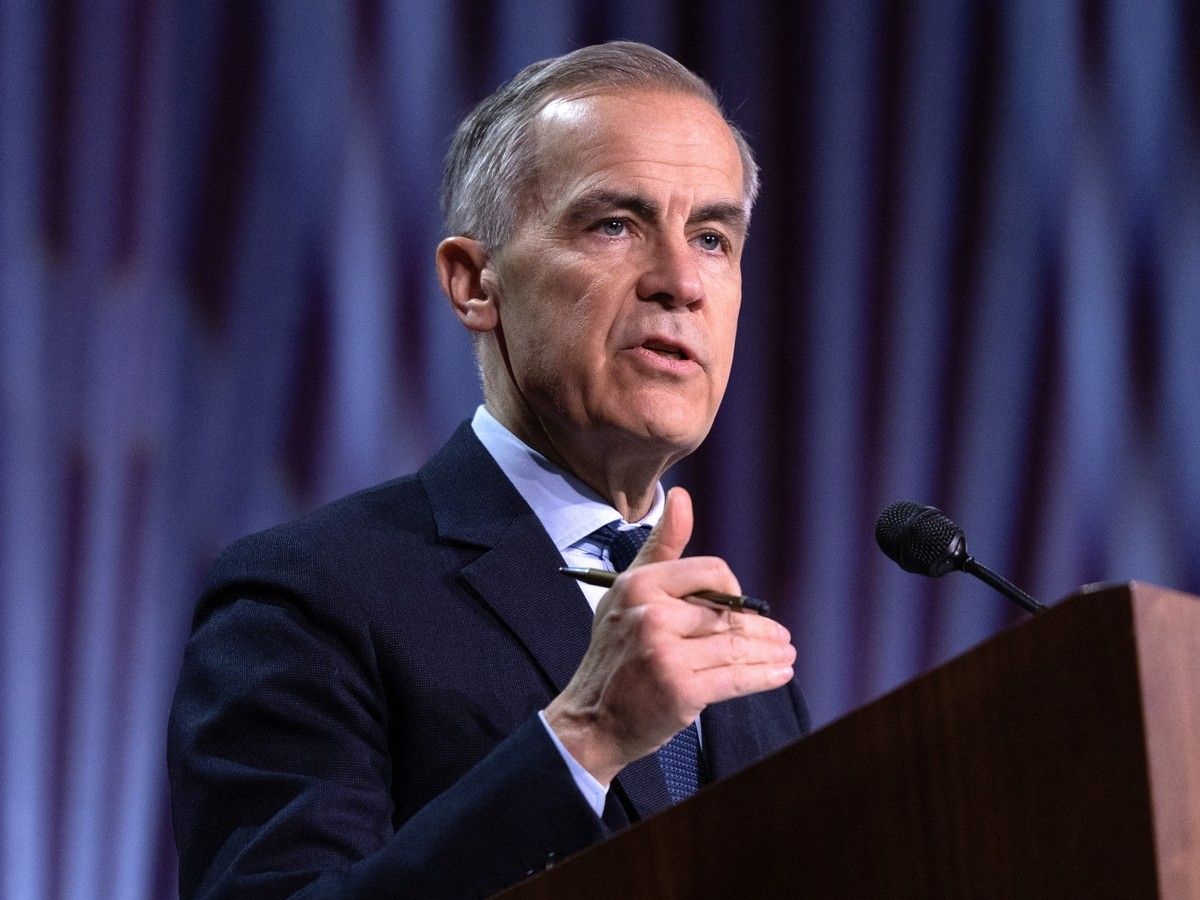
Even so, the Vancouver meeting marked an important turning point in the broader conversation. For the first time in months, both Ottawa and British Columbia appeared publicly willing to negotiate the conditions under which a major energy corridor could proceed rather than simply exchanging criticism through the media.
Whether those negotiations ultimately produce a formal agreement remains uncertain. Environmental groups, Indigenous communities, industry executives, and provincial governments still hold competing priorities that could reshape or delay the proposal in the months ahead.
For now, however, Carney’s message was unmistakable. Ottawa intends to move aggressively on national energy infrastructure, and British Columbia faces a strategic decision about whether it wants to participate directly in that transformation or risk being bypassed as Canada attempts to redefine its economic future beyond dependence on the United States.






