For decades, Canada has occupied a unique position in the Western world — geographically tied to North America, economically intertwined with the United States, and culturally connected to Europe. Yet a remarkable political signal emerging from Northern Europe suggests Canada may now be entering a new chapter in its international identity.
The comment sounded casual at first.
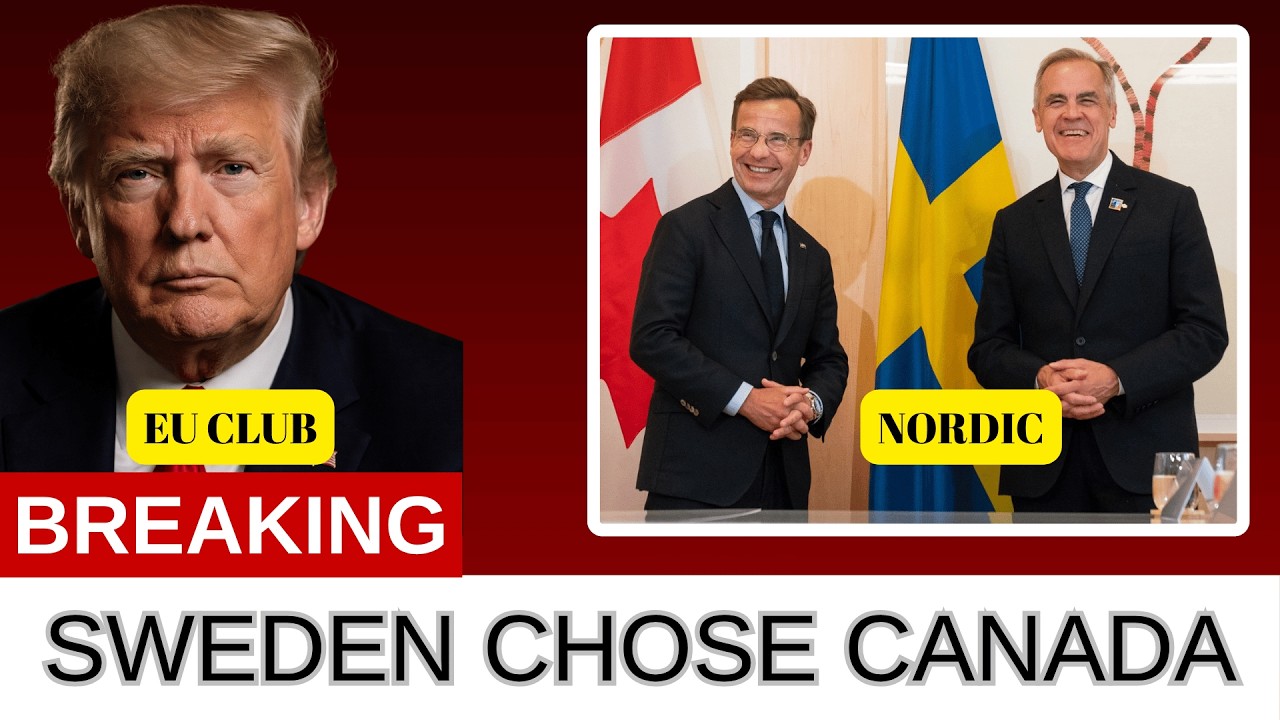
During a televised interview, Swedish Prime Minister Ulf Kristersson was asked about the increasingly discussed idea of Canada one day becoming closer to the European Union. His answer began with a smile and a joke about geography. But what followed was anything but a joke.
Kristersson described the European Union as a community built not only on geography but also on values. Then came the statement that immediately captured attention across political circles.
Canada, he said, is often referred to in Sweden as “the most Nordic country outside the Nordics.”
The remark may appear symbolic, but symbols often reveal deeper political realities.

At a time when alliances are being reshaped by war, economic uncertainty, and strategic competition, the language used by world leaders matters. Kristersson was not discussing tourism, culture, or hockey. He was talking about political trust.
His comments suggested that Canada is increasingly viewed by Nordic governments as a natural strategic partner sharing common democratic principles, institutional stability, and a commitment to the rules-based international order.
What makes the statement particularly significant is that it did not emerge in isolation.
Only weeks earlier, Finnish President Alexander Stubb publicly emphasized the importance of strengthening ties between Canada and Europe. He argued that Canada fits naturally alongside European democracies because of shared values and common interests.
When two leaders from different Nordic capitals deliver similar messages within a short period, political observers begin paying attention.
Patterns matter more than individual remarks.
And the pattern emerging today points toward a Canada that is becoming increasingly integrated into a Northern European strategic vision.
This growing relationship extends far beyond diplomacy.

While political leaders exchanged warm words, governments and industries were already building concrete partnerships behind the scenes.
The clearest example is Canada’s interest in acquiring Sweden’s GlobalEye airborne surveillance system.
Developed by Saab and integrated onto Bombardier aircraft, the platform represents more than a military purchase. It symbolizes industrial cooperation between two countries that increasingly see one another as long-term partners.
The aircraft serves as a sophisticated flying command center capable of monitoring airspace, maritime activity, and ground movements across enormous distances.
For Canada, such capabilities have special significance.
The Arctic is rapidly becoming one of the most strategically important regions on Earth.
Climate change is opening new shipping routes. Competition among major powers is intensifying. Russian military activity remains a persistent concern. Meanwhile, Canada’s vast northern territory presents extraordinary monitoring challenges.
For generations, Canada has spoken about Arctic sovereignty.
Today, it is investing in the tools required to enforce it.
The GlobalEye program may therefore represent something larger than modernization. It may mark the beginning of a new era in which Canada assumes greater responsibility for protecting its own northern frontier.
Perhaps even more important is where the aircraft could be built.

Canadian officials have suggested that domestic production opportunities could allow Canada not only to operate these systems but potentially export them to allied nations.
That possibility changes the conversation entirely.
Historically, Canada has often been a buyer of advanced military technology developed elsewhere.
The emerging vision suggests Canada could increasingly become a producer and exporter of sophisticated defence systems.
Such a transformation would generate economic benefits extending far beyond military procurement.
It would support high-skilled jobs, strengthen domestic manufacturing, and deepen Canada’s role within allied supply chains.
The economic implications could be substantial.
At the centre of this discussion stands Saab, the Swedish defence company that continues expanding its footprint in Canadian strategic conversations.
The company is not only associated with GlobalEye.
It also remains one of the leading contenders in Canada’s ongoing fighter aircraft debate through its Gripen platform.
That competition has evolved into a broader discussion about sovereignty, industrial benefits, and strategic independence.
Supporters argue that Saab’s proposals offer Canada greater control over sensitive data and domestic industrial participation.
Critics, however, caution that any defence procurement program must ultimately be judged by delivery, affordability, and operational effectiveness.
Those concerns have been amplified by Conservative leader Pierre Poilievre.
Poilievre has warned against allowing procurement strategies to become exercises in bureaucracy rather than practical improvements for Canadian Armed Forces personnel.
His criticism reflects a long-standing concern among Canadians.
Major defence projects often promise economic benefits and strategic advantages but can struggle with delays, cost overruns, and implementation challenges.
The real test of any new partnership will therefore be execution.
Can aircraft be delivered on time?
Will promised jobs actually materialize?
Can exports generate sustainable economic growth?
These questions remain unanswered.
Yet even as domestic political debates continue, the broader geopolitical trend appears increasingly clear.
Canada is strengthening relationships with countries that share its outlook on democracy, international law, and collective security.
This alignment became particularly visible during recent meetings between Prime Minister Mark Carney and Nordic leaders.
Representatives from Sweden, Finland, Norway, Denmark, and Iceland gathered alongside Canada to discuss common challenges facing Arctic nations and middle powers.
The symbolism was powerful.
Five Nordic countries and Canada sitting at the same table discussing the future of security, trade, and international cooperation.
Not as distant partners.
As strategic equals.

The significance of these developments extends beyond Europe.
They also reflect a changing global environment in which countries are reassessing dependencies and diversifying partnerships.
For Canada, this does not mean abandoning the United States.
The Canada-U.S. relationship remains foundational.
However, it does suggest a growing interest in expanding strategic options.
The objective is resilience.
A nation with multiple trusted partners enjoys greater flexibility than one dependent on a single source of technology, investment, or security cooperation.
That reality is increasingly shaping Canadian policy.
The phrase “the most Nordic country outside the Nordics” may therefore become more than a compliment.
It could become a political description of Canada’s evolving place in the world.
A country anchored in North America.
A nation deeply connected to Europe.
An Arctic power with expanding responsibilities.
And perhaps, increasingly, a central member of an emerging network of like-minded democracies stretching across the North Atlantic.
Whether this transformation ultimately reshapes global alliances remains uncertain.
But one fact is becoming difficult to ignore.
Some of Europe’s most trusted democracies are openly signalling that Canada belongs inside their circle of confidence.
And in international politics, such invitations are rarely extended without reason.
The Nordic moment may only be beginning.
But its implications could define Canada’s strategic future for decades to come.






