Öxit alarm and patriotic alliances: Is the European Union facing its historic collapse?
A political storm of unprecedented proportions is brewing across the European continent. A storm with the potential to shake the entrenched structures of the European Union (EU) to their very foundations and completely redraw the political map of Europe. The epicenter of this impending quake lies in our neighboring country, Austria.
There, a tremendous unrest is stirring among the population, and the signals emanating from Vienna to Brussels are leaving the European elites, above all Commission President Ursula von der Leyen, in a state that appears to be teetering between incredulous disbelief and sheer panic. What is currently unfolding in the Alpine republic is far more than just an ordinary political protest.
It is the powerful awakening of a people who feel abandoned by their leaders and are loudly demanding their fundamental right to national sovereignty. Is Austria truly on the verge of leaving the EU? The signs are mounting, and the consequences for all of Europe, especially for Germany, would be enormous.
These days, the streets of Vienna resemble, at times, an unmissable sea of blue FPÖ flags. Tens of thousands, perhaps even far more, are taking to the streets. And it is crucial to understand who these people are. They are not, as some mainstream media outlets reflexively suggest, extremist fringe groups.
They are ordinary citizens from the heart of society. They are mothers who are seriously worried about the safety and future of their children. They are fathers who have to fight for their livelihoods in an increasingly strained job market, while competition from uncontrolled migration steadily grows.
They are hard-working people and pensioners who no longer want to accept that billions of their tax dollars are flowing abroad while inflation is eroding domestic savings and the cost of living is skyrocketing.
They are all united by the feeling that a completely out-of-touch three-party coalition of the ÖVP, SPÖ, and NEOS is governing directly against the interests of their own people.
According to polls, over 80 percent of Austrians are deeply dissatisfied with the current government. In a functioning democracy, such figures represent an unmistakable vote of no confidence.
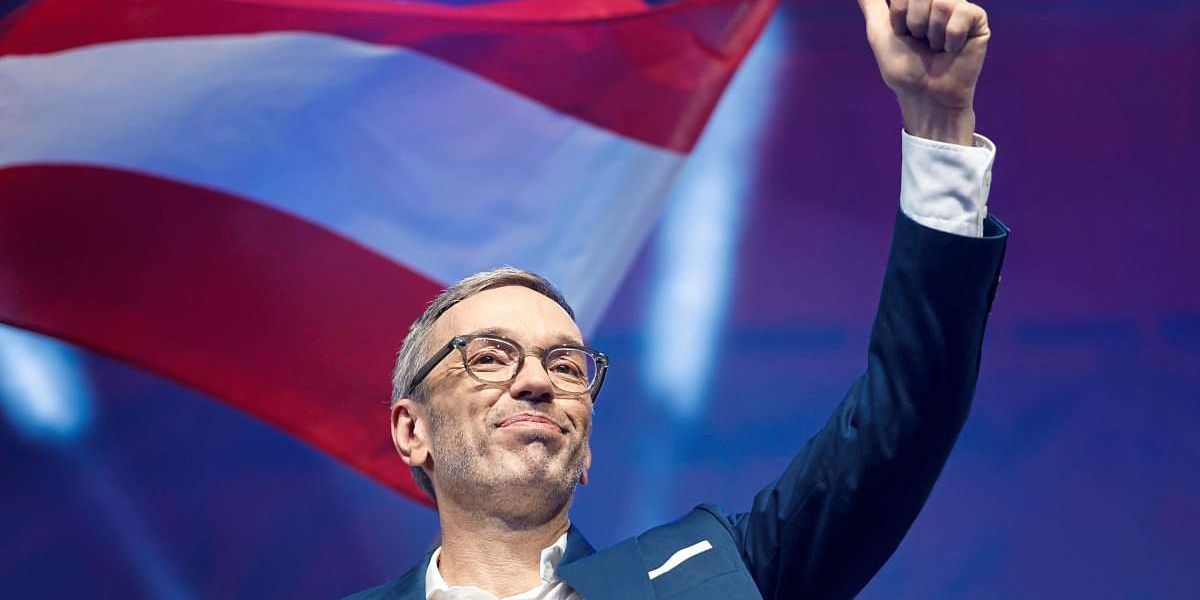
In this volatile situation, Herbert Kickl, the charismatic and combative leader of the FPÖ (Freedom Party of Austria), emerges as the man of the hour. Kickl’s uncompromising analyses resonate with the spirit of the times. His scathing criticism of European migration policy, in particular, finds massive support.
He doesn’t shy away from stating the obvious: the EU, according to Kickl, often functions not as a problem solver, but rather as a problem creator. He categorically rejects the forced distribution of migrants being pushed by Brussels. Instead, he points to successful, sovereign models like that of Denmark, where a consistent and restrictive asylum policy protects the local population.
Kickl’s accusation is serious: he effectively describes the EU’s resettlement program as state-sponsored human trafficking. The absurd reality, in which member states like Hungary are hit with draconian fines of millions simply for applying existing law and effectively protecting their EU external borders, exposes the ideological blindness in Brussels. The consequence for Kickl is crystal clear: Austria must finally go its own sovereign way.
This call for sovereignty is growing ever louder. It is no longer just a vague feeling, but a concrete political demand. Many Austrians look with envy to countries like Norway and Switzerland. These proud nations prove anew every day that it is possible to act politically freely and prosper economically outside the tight confines of the EU.
They decide for themselves on their immigration, their tax policies, and their economic relationships, without having to submit to bureaucratic dictates from Brussels. The idea of freeing oneself from the rampant EU bureaucracy, the massive financial transfers, and the often ideologically driven regulations is rapidly gaining appeal in Austria.
But this yearning for freedom is not a purely Austrian phenomenon. It is part of a large, pan-European patriotic movement. It is precisely at this point that the close, strategic alliance between the FPÖ (Freedom Party of Austria) and the Alternative for Germany (AfD) becomes so immensely important.
Both parties share a clear, unambiguous vision: They view the current form of the European Union as a failed, centralist project that erodes national sovereignty, devours vast sums of taxpayers’ money, and massively disadvantages strong economies like Germany and Austria in particular.
The answer to this flawed development is: A Europe of Fatherlands. A loose, pragmatic community of sovereign nations based on free trade and peaceful cooperation, without an anonymous bureaucracy in Brussels interfering in the internal affairs of nation-states. Alice Weidel tirelessly emphasizes the importance of this partnership. Together, they believe, they can overcome the dictates of Brussels and pave the way for a better future.
The oft-invoked fear of economic collapse in the event of a UK exit – the infamous “Brexit chaos” – quickly loses its terror upon closer examination.
The reality in Great Britain paints a more nuanced picture: The country has regained valuable room for maneuver, independently concludes new trade agreements worldwide, and is gradually freeing itself from burdensome European regulations. An “Öxit” or even a “Dexit” could mean the urgently needed liberation for Austria and Germany from the unfair transfer union.
The inexorable economic decline, driven by exploding energy prices, advancing deindustrialization, and an ideologically driven “Green Deal,” is largely a product of misguided EU policies.
As if this internal political dynamic weren’t already volatile enough, reports are now circulating about alleged US foreign policy strategies that have the potential to bring the entire system crashing down. A leaked draft of a possible new security strategy under a future US administration led by Donald Trump is causing fury in European capital circles.
According to reports, Trump plans to actively strengthen patriotic and sovereignty-minded forces in Europe. The goal: to deliberately weaken the EU by supporting key states like Austria, Hungary, Italy, and Poland in their pursuit of independence. Trump seems to view Europe as being in a similar state of civilizational danger as many conservative forces in Germany.
The answer, here too, is a return to national strength and an end to the paternalism of supranational organizations. The alleged strategy for Germany is particularly noteworthy. A direct German exit is not the primary objective, but rather a political upheaval from within, possibly led by a resurgent AfD (Alternative for Germany), which would reshape the European power structure from the center.

These geopolitical prospects are clearly unsettling politicians like Friedrich Merz. The panic within the establishment is palpable. The logic of the domino effect is undeniable: if Austria, as a country of such economic and cultural importance, actually dares to leave, who or what will hold Italy, Poland, or Hungary together? And if these pillars crumble, the entire European construct faces final collapse.
The often-used rhetorical weapons employed to discredit patriotic movements have long since lost their power. The citizens have exposed the transparent game played by the media and political elites. We stand on the threshold of a true turning point.
If the firewall in Germany finally falls and the patriotic forces in Europe realize their vision of sovereign nation-states, the political history of our continent will open a completely new chapter. Let us remain vigilant and sovereign – the decisive days are just around the corner.






