We Should Not Underestimate…’: Mark Carney Takes On Trump In America
NEW YORK — Prime Minister Mark Carney of Canada delivered a pointed address in New York this week, outlining his government’s vision for economic resilience and strategic autonomy at a moment of deepening tensions with the United States.
Speaking at the Economic Club of New York, Mr. Carney emphasized Canada’s determination to strengthen its economy at home while diversifying partnerships abroad amid what he described as a global “rupture” led by technological change and shifting American commercial policies.

A Message of Self-Reliance
Mr. Carney began by acknowledging the profound shifts underway in the international order. He argued that Canada had recognized these changes earlier than most and responded with a clear strategy: building strength domestically and forging new relationships overseas.
“In a world where integration has been weaponized,” he said, “a country that can’t feed, fuel or defend itself is not truly sovereign.”
Tax Cuts and Investment Push
The prime minister highlighted recent policy moves designed to attract capital. His government has cut taxes on income, capital gains and new business investments, while introducing a “productivity super deduction” that he said gives Canada the most competitive tax rate for new investment in the Group of 7.
Canada is aiming to catalyze $1 trillion in investment over the next five years in energy, transportation, data centers and defense. Regulatory reforms are being accelerated to fast-track major infrastructure projects.
Energy Superpower Ambitions
Mr. Carney positioned Canada as an emerging energy superpower. By the end of the decade, the country expects to export nearly 50 million tons of liquefied natural gas annually, doubling that capacity in the following decade.
He pointed to plans for a new pipeline to carry at least one million barrels per day of low-emission Alberta oil to Asian markets, alongside large-scale carbon capture initiatives. Canada is also advancing small modular reactors and expanding uranium production.
Critical Minerals and Diversification
In the past year, Canada has signed 56 critical minerals agreements with more than 10 countries, unlocking over $18 billion in capital. The government is doubling its electricity grid capacity, adding more than 160 gigawatts of new power.
Mr. Carney stressed the importance of strategic autonomy, noting new economic and security deals across five continents. Canada has joined the European Union’s SAFE defense procurement initiative as its only non-European member.
Commitment to Allies and Values
While pursuing greater independence, Mr. Carney reaffirmed Canada’s commitment to its allies. The country is on track to meet NATO spending targets, reaching 4 percent of GDP in total defense spending by the end of the decade.
Canada continues to support Ukraine and is enhancing Arctic security through partnerships with Nordic countries, Germany and Britain. He also proposed a new multilateral “Defense Security and Resilience Bank” to finance resilient infrastructure across NATO allies.

Fiscal Discipline Claims
Mr. Carney defended his government’s fiscal record, noting efforts to cut 10 percent of the federal civil service and 20 percent of spending on consultants. He projected Canada would have the second-fastest growth in the G7 this year and already possesses the strongest fiscal position in the group.
Non-U.S. exports are rising sharply, he said, with foreign direct investment running at twice the rate of Canada’s nearest G7 peer.
A Stronger Ally for America
Addressing his American audience directly, Mr. Carney argued that a stronger, more confident Canada would benefit the United States. He reminded listeners that Canada remains America’s largest customer, buying more goods than China, Japan and Germany combined.
Integrated supply chains, energy exports and critical minerals were presented as foundations of mutual strength. “Canada strong will help make America great again,” he said.
Call for Renewed Partnership
Mr. Carney proposed reimagining cooperation in key sectors facing global competition, including aluminum, automobiles and critical minerals. He urged both countries to focus on shared interests rather than differences.
Drawing on the words of Finnish President Alexander Stubb, he cautioned against underestimating the future. In times of crisis, he said, fortune favors the bold.
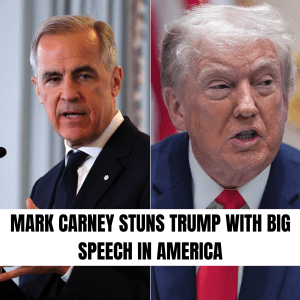
Context of Bilateral Tensions
The speech came against the backdrop of ongoing U.S. tariffs on Canadian goods and public friction between the two governments. Mr. Carney’s emphasis on diversification and autonomy reflected Ottawa’s response to perceived unreliability in the bilateral relationship.
Reception and Implications
The address was well-received by the business audience, many of whom represent major institutional investors and pension funds. Mr. Carney’s message blended optimism about Canada’s potential with a pragmatic recognition of global challenges.
For U.S. policymakers and business leaders, the speech served as both an invitation for renewed partnership and a subtle reminder that Canada is actively preparing for a less dependent future.
Broader Strategic Shift
Mr. Carney’s New York appearance fits into a pattern of assertive Canadian diplomacy. By highlighting investment momentum, energy capacity and new international alliances, he sought to reframe the narrative around Canada’s role in North America and the world.
Whether this vision translates into tangible results amid ongoing trade tensions will be closely watched in both Ottawa and Washington in the months ahead.






