Canada’s New Defense Deal May Signal a Much Bigger Strategic Shift
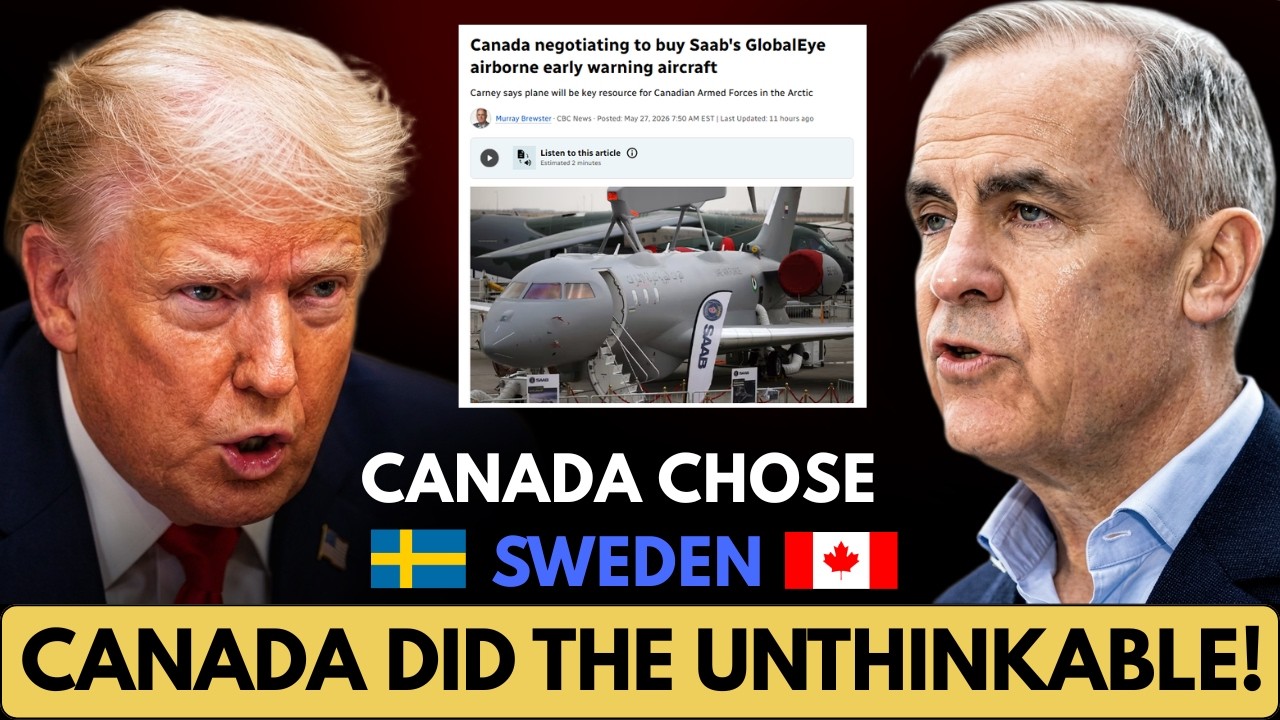
Nobody expected a routine defense announcement to generate this much attention.
What appeared at first to be a standard military procurement update quickly evolved into something far more significant. Standing beside executives from Saab, Prime Minister Mark Carney unveiled negotiations for Canada’s acquisition of the GlobalEye airborne surveillance system.
At face value, the project seems straightforward. Canada wants advanced radar aircraft capable of monitoring vast stretches of territory, particularly in the Arctic. Few would argue against that need.
But as the announcement continued, something unusual happened.
Carney repeatedly returned to words rarely emphasized so heavily in previous Canadian defense speeches: sovereignty, independence, resilience, and strategic autonomy.
The aircraft suddenly felt like only part of the story.
For years, Canada’s security architecture has been deeply connected to the United States. From intelligence sharing to aerospace defense, the two countries have operated within one of the closest military relationships in the world.
That relationship still exists.
Yet the tone coming from Ottawa appears to be changing.
Rather than focusing exclusively on traditional North American defense partnerships, Carney highlighted cooperation with Sweden, Canadian industrial capabilities, and the importance of maintaining greater control over critical defense technologies.
Analysts immediately noticed the shift.

Modern defense contracts are no longer simply about purchasing equipment. They determine where technology is developed, where jobs are created, and who controls supply chains during future crises.
In that context, Saab’s proposal offers something Canada increasingly values: options.
The GlobalEye platform combines advanced surveillance capabilities across air, sea, and land domains. In a region as vast and strategically important as the Arctic, that capability carries enormous value.
And the Arctic is becoming more important every year.
Russia continues expanding its northern military infrastructure. China has shown growing interest in Arctic shipping routes and resource access. NATO activity across the region has also increased significantly.
Canada finds itself responsible for defending one of the world’s largest and most challenging geographic areas.
That reality is forcing policymakers to think differently.
The discussion is no longer limited to today’s threats. It is increasingly focused on what the security environment might look like ten or twenty years from now.
And that future appears less predictable than the past.
What makes this announcement particularly interesting is the industrial dimension attached to it. The GlobalEye platform is based on aircraft produced by Bombardier, one of Canada’s flagship aerospace companies.
That detail may prove just as important as the radar systems themselves.
Every major defense project creates long-term economic relationships. Governments increasingly view military spending as a tool for strengthening domestic industrial capacity.
Canada appears to be following the same path.
Rather than simply purchasing foreign equipment, Ottawa seems interested in building a larger ecosystem involving Canadian manufacturing, maintenance, and technological expertise.
That approach mirrors trends emerging across much of the Western world.
European governments are discussing strategic independence. Supply chains are being diversified. Critical industries are being brought closer to home.
The lesson learned from recent geopolitical disruptions is simple: dependence can become vulnerability.
Canada appears determined to reduce that vulnerability wherever possible.
That does not mean abandoning alliances.
In fact, strategic autonomy often works best inside strong alliances. The objective is not isolation. The objective is flexibility.
Countries want multiple partners, multiple suppliers, and multiple options available when circumstances change unexpectedly.
And circumstances have been changing rapidly.
Trade disputes, political tensions, supply chain disruptions, and rising great-power competition have forced governments to reconsider assumptions that seemed permanent only a decade ago.
Canada is not alone in making these calculations.
But what surprised many observers was how openly those calculations appeared in this particular announcement.
The conversation quickly expanded beyond surveillance aircraft.
Questions emerged about future procurement decisions, including whether Canada may eventually seek broader defense partnerships with European suppliers.
Attention immediately turned toward Saab’s Gripen fighter aircraft and Canada’s long-running F-35 debate.
No official policy changes were announced.
Yet Carney’s careful avoidance of direct answers fueled further speculation.
In politics, silence can sometimes be as revealing as a statement.
What seems increasingly clear is that Canada wants more strategic room to maneuver in an uncertain world.
That objective explains the emphasis on sovereignty.
It explains the focus on domestic capability.
And it explains why a defense procurement announcement suddenly sounded like a broader national strategy.
The real significance of this deal may not be measured by the number of aircraft purchased.
It may be measured by what the announcement reveals about how Canada’s leaders view the future.
A future where Arctic competition intensifies.
A future where supply chains become strategic assets.
And a future where nations that prepare early enjoy greater freedom of action when the next crisis arrives.
The GlobalEye negotiations may be about radar aircraft today.
But beneath the surface, they may represent the first visible sign of a much larger transformation already underway inside Canada’s defense and foreign policy thinking.






