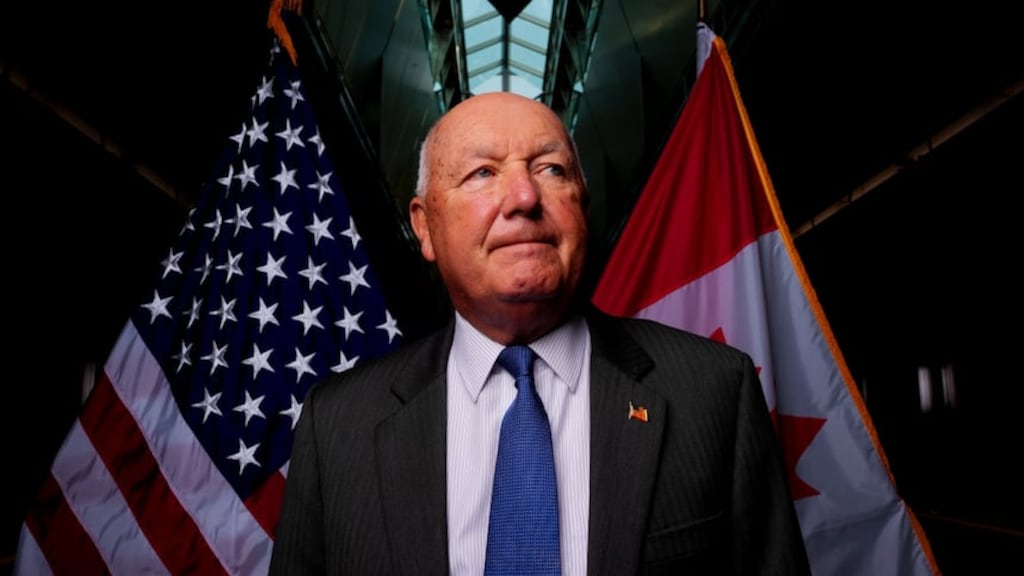
Canada is once again at the centre of a heated diplomatic storm after comments linked to U.S. President Donald Trump resurfaced and were amplified by U.S. Ambassador Pete Hoekstra, triggering backlash across Canadian political circles and public debate over sovereignty, trade, and diplomatic restraint.
The controversy began when Ambassador Hoekstra shared a social media post referencing Trump’s suggestion that Canada could become the “51st U.S. state,” a remark long considered provocative and politically sensitive in Canadian discourse.
The repost immediately drew criticism from Canadian lawmakers, commentators, and citizens who viewed it as a violation of diplomatic norms and an unnecessary escalation during a delicate period in North American relations.

Public reaction intensified within hours, with a petition demanding Hoekstra’s expulsion from Canada surpassing 14,000 signatures, reflecting widespread frustration among those who viewed the ambassador’s action as disrespectful to Canadian sovereignty.
At the centre of the political response is Prime Minister Mark Carney, who offered a notably restrained stance when asked whether the ambassador should be removed from his post.
Carney responded with a brief “No,” a statement that quickly became the focal point of national debate, interpreted by supporters as pragmatic diplomacy and by critics as political caution bordering on inaction.
Observers note that Carney’s response comes at a strategically sensitive time, as Canada, the United States, and Mexico prepare for a major review of the CUSMA trade agreement, known formally as the Canada–United States–Mexico Agreement.
CUSMA governs hundreds of billions of dollars in annual trade across North America, making stability in diplomatic relations a priority for all three governments.
The agreement’s upcoming review has heightened sensitivity around political messaging, with officials wary that symbolic confrontations could spill over into economic consequences.
Critics argue that Hoekstra’s repost undermines longstanding diplomatic etiquette between allied nations and sends an unnecessary political signal during negotiations that require trust and stability.
Others, however, argue that the incident reflects broader tensions in North American politics, where populist rhetoric and national identity debates have increasingly intersected with trade and foreign policy.
Supporters of Carney’s approach say the Prime Minister is prioritizing economic continuity over symbolic confrontation, especially given Canada’s deep reliance on integrated supply chains with the United States.
They argue that expelling a sitting ambassador could trigger retaliatory measures, complicating negotiations and potentially affecting tariffs, exports, and cross-border investment flows.
However, opponents within Canada’s political landscape warn that restraint may be interpreted as weakness, particularly when national sovereignty is perceived to be challenged in public discourse.
Several analysts suggest that the situation reflects a broader dilemma in modern diplomacy: balancing public sentiment with behind-the-scenes economic strategy.
The controversy has also reignited debate about the role of ambassadors in the digital age, where social media activity can rapidly escalate into international incidents.
Diplomatic experts note that while ambassadors are expected to represent their governments, reposting politically charged content can blur lines between official policy and personal endorsement.

Within Canada, public opinion remains divided, with some citizens urging a firm response to defend national dignity, while others caution against overreacting to rhetorical provocations.
The petition calling for Hoekstra’s removal continues to circulate online, symbolizing growing public engagement in foreign policy debates that were once largely confined to government and diplomatic circles.
Political commentators emphasize that the timing of the incident is particularly sensitive given global economic uncertainty and ongoing discussions about trade resilience in North America.
Some analysts argue that the controversy may ultimately have limited long-term impact, provided that formal diplomatic channels remain stable and trade negotiations proceed without disruption.
Others warn that repeated rhetorical provocations, even if symbolic, can gradually erode trust between allies and complicate cooperation on broader issues such as energy, security, and migration.


At present, both Canadian and U.S. officials appear focused on containing the fallout, with neither side signaling an escalation beyond public statements and political commentary.
The Prime Minister’s decision to retain the ambassador suggests a calculated effort to avoid destabilizing negotiations ahead of the CUSMA review.
However, opposition voices in Canada argue that the government risks setting a precedent where diplomatic boundaries are tested without consequences.
As the situation develops, attention is turning toward whether the United States will issue any clarification or adjustment regarding Ambassador Hoekstra’s conduct or the amplification of Trump’s earlier remarks.
The coming weeks are expected to be critical, as trade negotiations progress and political pressure builds on both sides of the border.
Ultimately, the controversy underscores the fragile balance between diplomacy and domestic politics in a deeply interconnected North America, where words—whether spoken in official meetings or shared online—can carry significant geopolitical weight.






