The Long Shadow Of Don Jr.
For nearly a decade, Donald Trump Jr. has occupied a peculiar space in American public life: not an elected official, not merely a private citizen, but a permanent supporting character in the political drama surrounding his father. He is everywhere and nowhere at once—on television, online, in courtrooms—insisting on relevance while embodying a kind of inherited authority that has come to define the modern era of political celebrity.
In recent years, that tension has sharpened. As legal pressure has mounted on the Trump Organization, Don Jr. has been called upon to play a role he seems profoundly uncomfortable inhabiting: the responsible executive. During testimony in the New York civil fraud trial, where the state accused the Trump Organization of systematically inflating asset values, his defense was disarmingly consistent. He did not recall. He relied on accountants. He signed documents prepared by others. It was a portrait not of criminal mastery, but of managerial emptiness—an heir present in name, absent in substance.

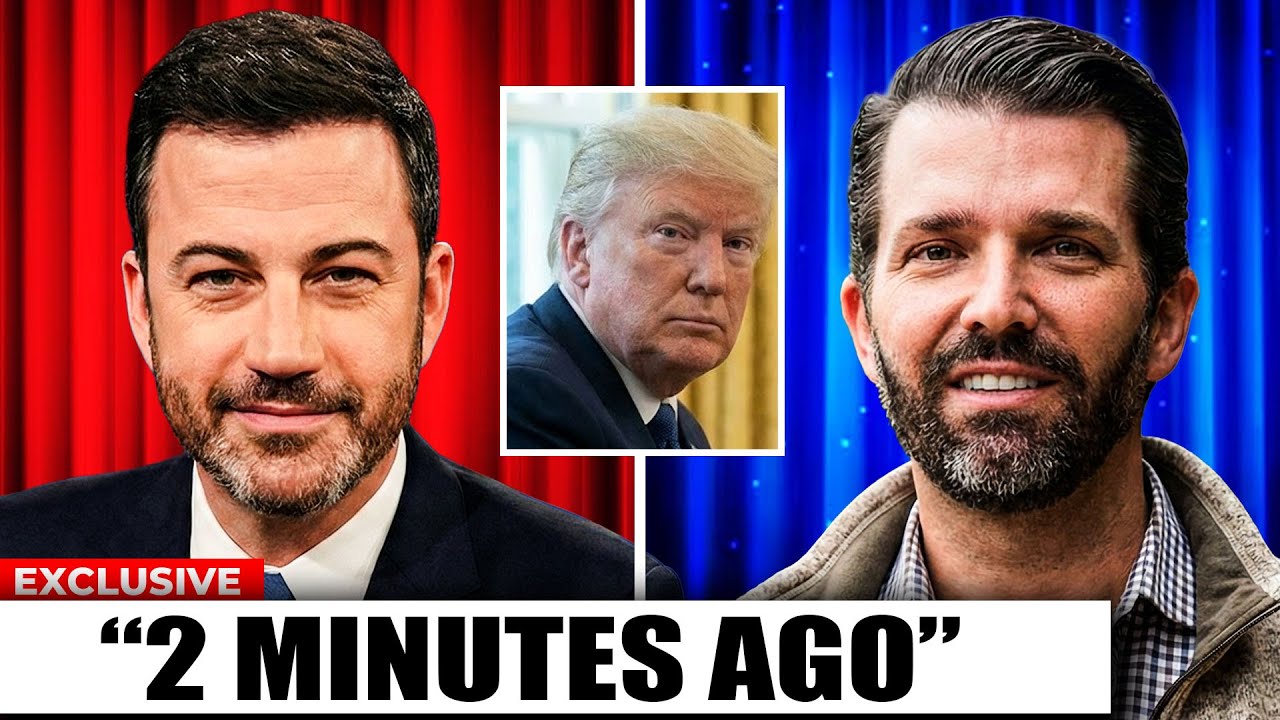
Late‑night television seized on that contradiction. Jimmy Kimmel, in particular, has returned to Don Jr. again and again, treating him as a case study in elite entitlement rather than a serious political actor. The jokes have landed not because they are cruel, but because they are precise. Don Jr. is mocked not for his ideology, but for his performance: the man who speaks like a boardroom alpha while pleading helplessness under oath. The gap between image and reality has proven irresistible.
That gap widened further as congressional Republicans, at Donald Trump’s urging, attempted to turn the tables by subpoenaing Special Counsel Jack Smith. The plan, critics argued, was to stage a perjury trap—forcing Smith to answer questions while restricting what he could say about ongoing investigations. Instead, the effort collapsed under its own contradictions. Smith, a veteran prosecutor, calmly offered to testify publicly, for as long as necessary. Republicans declined. The deposition was pushed into private, released quietly, and ultimately did more to underscore Smith’s command than to expose weakness. It was another example of theatrical aggression meeting institutional competence.
Throughout it all, Don Jr. positioned himself as both victim and surrogate warrior. He blamed the media for threats against his father. He framed criticism as persecution. He spoke with the certainty of someone convinced that power, once inherited, can never truly be lost. Yet the moments that resonated most with the public were not his speeches, but the unscripted slips: viral clips, awkward gestures, overwrought social media posts that suggested a man straining to live up to a role he never quite earned.
The family dynamic beneath the spectacle has been hard to ignore. Donald Trump’s absence from court during his sons’ testimony did not go unnoticed. Commentators compared it to a parent skipping a school play—a small but telling metaphor. The Trump children, now middle‑aged, continue to seek validation from a patriarch who measures loyalty more than competence. In that sense, the Trump saga is not only political, but deeply personal, shaped by a transactional model of affection.
Even moments of genuine gravity have been overshadowed by this dysfunction. When Trump’s older sister, Maryanne Trump Barry, a former federal judge, died at 86, the public response from her brother was muted, quickly overtaken by posts attacking prosecutors and promoting merchandise. It was a reminder that, in the Trump universe, grievance always outranks reflection.
Don Jr.’s defenders argue that he is unfairly caricatured, that he has become a stand‑in for elite disdain toward conservative voters. But the critique aimed at him is less about ideology than accountability. Power without responsibility, confidence without competence—these are not partisan complaints. They are civic ones.
As the country barrels toward another election cycle, Don Jr. remains a familiar presence, hovering at rallies, on podcasts, in headlines. Yet his story feels less like one of ascent than of exposure. In a media ecosystem that rewards outrage and performance, he has mastered visibility. What he has not mastered is persuasion.
In the end, Donald Trump Jr. may be remembered not for what he built, but for what he revealed: how thoroughly American politics has blurred the line between inheritance and merit, spectacle and substance. And how, under sustained scrutiny, even the loudest confidence can sound remarkably hollow.






