America’s Financial Dominance Faces a Quiet Challenge From Its Closest Allies
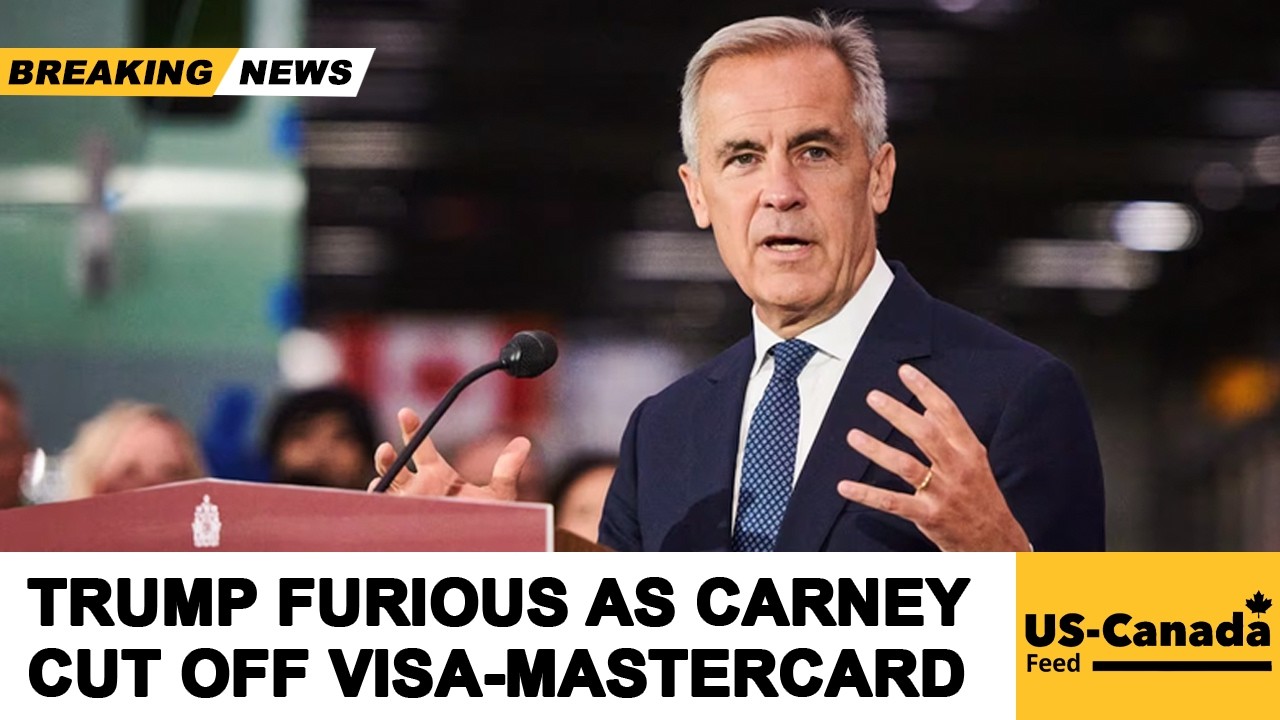
For decades, the United States occupied a position few nations in history have ever achieved. It was not merely the world’s largest economy; it controlled much of the infrastructure that allowed the global economy to function.
From international banking networks to credit card systems, American institutions became the invisible foundation of global commerce.
That foundation is now facing an unexpected challenge.
The pressure is not coming from geopolitical rivals such as China or Russia. Instead, it is emerging from some of Washington’s closest allies, including Europe and Canada.
Across both sides of the Atlantic, governments and financial regulators are accelerating efforts to build independent payment systems capable of operating without reliance on American-controlled networks.
The motivation is rooted in a growing concern about financial sovereignty.
For years, the United States has demonstrated an extraordinary ability to use its financial infrastructure as a tool of foreign policy. Economic sanctions, restrictions on payment access, and financial enforcement measures have become central instruments of American geopolitical influence.
The effectiveness of those tools is undeniable.
The suspension of Visa and Mastercard operations in Russia following the invasion of Ukraine illustrated how quickly access to the global financial system can be restricted when political circumstances demand it.
For many policymakers, however, the episode also revealed a broader vulnerability.
If financial infrastructure can be weaponized against adversaries, it can theoretically be leveraged against any nation that remains dependent on it.

That realization has gained increasing attention within European institutions.
Officials at the European Central Bank have repeatedly argued that Europe remains excessively reliant on payment networks operating under American jurisdiction.
The concern is not necessarily that Washington intends to target its allies.
Rather, the concern is that the capability exists.
In an era marked by geopolitical uncertainty, strategic dependence itself is increasingly viewed as a risk.
As a result, Europe has begun constructing what may become the most significant alternative payments ecosystem developed outside the United States in decades.
The centerpiece of that strategy is Wero, a pan-European digital payments platform supported by major banking institutions across the continent.
Designed to facilitate transactions within a European-controlled framework, the system aims to reduce reliance on Visa and Mastercard while strengthening financial autonomy.
Its expansion has been faster than many analysts initially anticipated.
Millions of users have already adopted the platform, while partnerships between national payment systems are gradually creating an interconnected European network capable of supporting cross-border transactions on a large scale.
The significance extends far beyond consumer convenience.
At stake is control over the digital infrastructure that increasingly underpins modern economic activity.
Alongside Wero, European policymakers continue advancing plans for a digital euro issued directly under the authority of the European Central Bank.
Supporters argue that such a currency would provide an additional layer of resilience while reducing exposure to foreign-controlled payment systems.
Canada is pursuing a similar strategy.

Although domestic debit transactions are largely handled through the Interac network, the overwhelming majority of Canadian credit card activity still relies on American financial infrastructure.
Many Canadian analysts now view that dependence as a strategic vulnerability.
To address the issue, Canadian authorities are developing the Real-Time Rail system, a national payments platform designed to facilitate instant transfers between bank accounts without requiring traditional card networks.
The project represents more than a technological upgrade.
It reflects a broader shift in thinking about economic security.
Increasingly, governments are treating payment systems with the same strategic importance once reserved for energy infrastructure, telecommunications networks, and transportation corridors.
The underlying question is simple: should a nation’s critical economic functions depend on infrastructure ultimately controlled by another government?
For much of the post-Cold War era, few policymakers seriously challenged that assumption.
Today, the geopolitical environment has changed dramatically.
Political polarization in Washington, disputes over sanctions policy, and uncertainty surrounding future American administrations have encouraged allies to reconsider long-standing dependencies.
Trust remains strong, but confidence in permanence has weakened.
That distinction matters.
Europe and Canada are not attempting to replace the United States as a financial power.
Nor are they seeking confrontation with American institutions.
Instead, they are pursuing insurance against future uncertainty.
The broader implications could be substantial.
If alternative payment networks continue expanding, American firms may face increased competition, reduced pricing power, and a gradual erosion of the dominance they have enjoyed for decades.
More importantly, Washington could find that one of its most effective instruments of geopolitical influence becomes less potent over time.
History suggests that infrastructure creates power.
For decades, American financial networks generated influence precisely because the world depended upon them.
Now, that dependence is slowly being reassessed.
The transformation remains in its early stages, and American financial institutions continue to dominate global markets.
Yet the direction of travel is becoming increasingly clear.
Europe and Canada are quietly building alternatives, not because they expect a crisis tomorrow, but because they no longer believe strategic dependence is a risk worth accepting indefinitely.
The result may be the emergence of a more decentralized financial order—one in which influence is distributed across multiple centers of power rather than concentrated in a single capital.
If that trend continues, the most important shift in global finance during the coming decade may not be a technological breakthrough or a market crash.
It may be the gradual end of an era in which the world’s financial system depended overwhelmingly on the United States.