Trump vs. Late-Night Icons: The High-Stakes War of Words Ignites National Debate
The landscape of American political discourse has shifted from the podium to the late-night stage, where a fierce war of words is currently unfolding. President Donald Trump has once again found himself at the center of a media firestorm, following a series of scathing segments by late-night titans Jimmy Kimmel and Stephen Colbert. This isn’t just a clash of personalities; it is a high-stakes battle for public perception that has left the former Commander-in-Chief visibly incensed, sparking a digital counter-offensive that has captivated the nation.

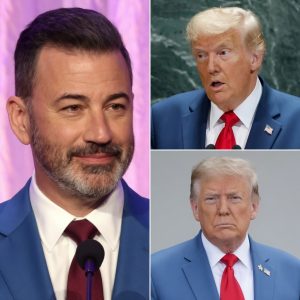
For years, the late-night circuit has served as a relentless critic of Trump’s administration and personal conduct, but the intensity has reached a fever pitch in 2026. Jimmy Kimmel, known for his sharp-tongued monologues, recently dedicated a significant portion of his show to “exposing” what he calls the inconsistencies in Trump’s latest public statements. By blending humor with pointed political critique, Kimmel has managed to pierce through the political noise, reaching millions of viewers and drawing a direct line between comedy and civic accountability.
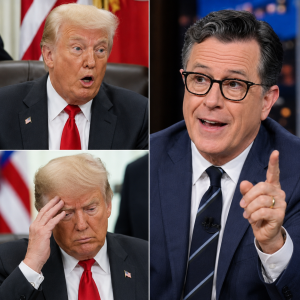
Not to be outdone, Stephen Colbert has utilized his platform to dissect the former President’s legal strategies and campaign rhetoric with surgical precision. Colbert’s segments often go beyond mere jokes, offering a sophisticated analysis that portrays Trump as a figure increasingly out of touch with the evolving political reality. This intellectualized brand of satire has proven particularly galling for Trump, who views these broadcasts not as entertainment, but as coordinated character assassination attempts orchestrated by the “mainstream media.”
The reaction from the Trump camp was swift and characteristically blunt. Taking to Truth Social, the former President launched a blistering tirade against both hosts, labeling their shows as “boring,” “unwatchable,” and “dying.” This “losing it” moment, as described by many media observers, highlights a deep-seated frustration with how late-night television shapes the narrative for independent voters. Trump’s counter-narrative focuses on the idea that these hosts are elitist mouthpieces who are disconnected from the “real” struggles of the American people.

Seamlessly weaving between legal updates and personal jabs, the late-night duo has mastered the art of making complex political developments digestible and viral. Kimmel’s focus on Trump’s courtroom demeanor and Colbert’s deconstruction of his policy shifts create a multi-pronged attack that keeps the former President on the defensive. This constant barrage ensures that Trump’s controversies remain fresh in the collective memory of the electorate, hindering his efforts to pivot toward a more structured campaign message.
Psychologically, this dynamic reveals a fascinating struggle for dominance. Trump, a master of media manipulation himself, thrives on controlling the news cycle. However, when Kimmel and Colbert use their platforms to mock his authority, they effectively strip away the “invincible” persona he carefully curates. By laughing at the very things Trump wants taken seriously, they challenge his power in a way that traditional news reporting often fails to do, leading to the explosive outbursts seen recently.
The broader implications for the upcoming election cycle cannot be overstated. As late-night clips go viral on TikTok and YouTube, the influence of these comedians extends far beyond the traditional 11:30 PM time slot. They are effectively setting the “vibe” for a generation of voters who consume news through the lens of satire. For Trump, this represents a significant obstacle; for his critics, it is a necessary check on power that utilizes the most potent weapon available in a democracy: ridicule.
In conclusion, the escalating feud between Donald Trump and the kings of late-night television serves as a microcosm of the divided American psyche. As Kimmel and Colbert continue to push the boundaries of political satire, and as Trump continues to fight back with digital fury, the line between entertainment and news continues to blur. Whether this strategy will ultimately sway the electorate or simply entrench existing biases remains to be seen, but one thing is certain: the war for the American airwaves is far from over.