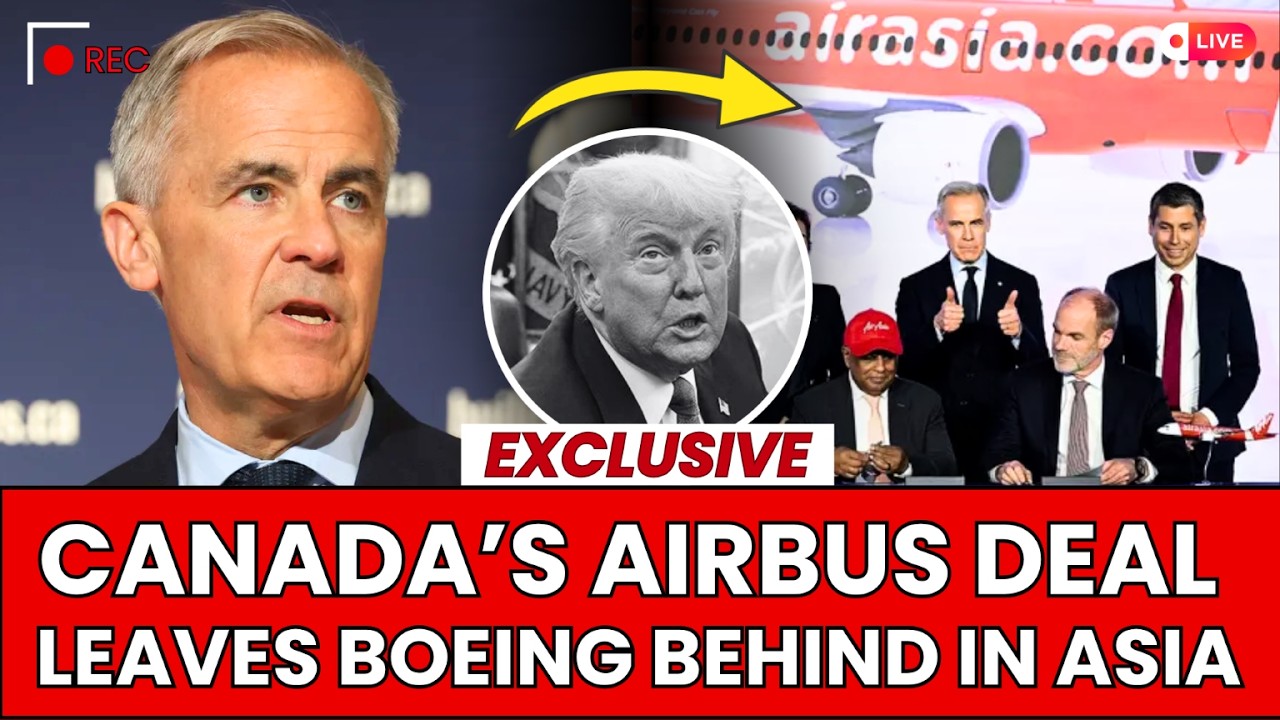
Prime Minister Mark Carney has placed Canada’s aerospace sector at the centre of a wider economic narrative following the announcement of a historic AirAsia order for 150 Airbus A220 aircraft, a deal closely connected to production facilities in Mirabel, Quebec. The agreement has attracted significant attention across Canada because it arrives at a moment when global trade relationships are facing renewed uncertainty and governments are reassessing long-term industrial priorities.
The announcement comes as Ottawa continues pursuing a strategy focused on economic resilience, diversified trade relationships, and investment attraction. Within Canadian political circles, the deal has prompted renewed debate across Canada’s political landscape about how the country should position itself amid shifting geopolitical and economic conditions.
At Airbus facilities in Mirabel, Carney highlighted the significance of the agreement for Canadian workers and advanced manufacturing. The A220 program, originally developed as Bombardier’s C Series before Airbus assumed control in 2018, remains deeply integrated into Canada’s aerospace ecosystem and supports thousands of highly skilled jobs.
For many observers, the scale of the AirAsia agreement extends well beyond aviation. Aircraft manufacturing involves engineering, software development, advanced materials, avionics, logistics, and highly specialized industrial processes. As a result, the transaction is widely viewed as a major endorsement of Canada’s advanced manufacturing capabilities.
The federal government has increasingly emphasized sectors that combine economic growth with long-term strategic value. Aerospace, critical minerals, energy development, advanced technology, and industrial innovation have all featured prominently in Ottawa’s economic messaging over recent months.
Critics of previous industrial strategies have argued that Canada risked losing competitiveness in advanced manufacturing. Supporters of the current approach contend that the Airbus announcement demonstrates continued confidence in Canadian production capacity and the country’s ability to compete in high-value global industries.
At the same time, Carney used the occasion to underscore themes that have become increasingly common in federal economic policy discussions. He stressed the importance of reliable partnerships, stable regulatory environments, and the diversification of trade opportunities beyond traditional markets.
The Prime Minister also referenced federal support measures designed to assist Canadian sectors affected by what he described as unjustified American tariffs. Those remarks reflected broader concerns within Ottawa regarding the impact of trade disputes and policy uncertainty on long-term investment decisions.
For investors and manufacturers, predictability often carries significant value. Aerospace projects require planning horizons measured in decades rather than months, making political stability and regulatory consistency important factors in determining where capital is deployed.
While opposition voices have questioned whether Canada can fully shield itself from external economic pressures, government officials argue that strengthening domestic industrial capacity is essential to maintaining competitiveness in an increasingly complex international environment.
The Airbus agreement has also been discussed within the broader context of Canada’s efforts to expand commercial engagement across Asia. AirAsia operates within one of the fastest-growing aviation markets in the world, providing Canadian industry with exposure to expanding demand throughout Southeast Asia.
That international dimension aligns with the federal government’s stated objective of reducing excessive reliance on any single market while preserving strong economic ties with long-standing partners. Officials have repeatedly emphasized that diversification is intended to complement existing relationships rather than replace them.
Political attention intensified as the announcement coincided with continuing debates surrounding American tariff policies and comments from U.S. President Donald Trump regarding Canada’s relationship with the United States. Those developments have faced growing scrutiny in Ottawa and have contributed to broader discussions about economic sovereignty.
Carney has consistently framed diversification as a practical economic objective rather than a political confrontation. His public remarks have generally focused on reducing vulnerability to external shocks while maintaining productive cooperation with international partners.
The transcript also highlighted renewed discussion surrounding Trump’s recurring references to Canada as a potential “51st state.” Canadian officials have continued to reject such suggestions, while emphasizing the importance of an independent and mutually respectful bilateral relationship.
Several commentators noted that these exchanges have raised broader concerns about government accountability and long-term economic planning. Questions surrounding trade stability, industrial strategy, and continental integration have increasingly become part of national political debate.
At international forums, Carney has argued that countries must adapt to a world characterized by geopolitical competition, supply-chain realignment, and evolving alliances. His message has centred on the view that resilience, preparation, and diversification are becoming essential elements of economic policy.
Supporters of the government’s approach contend that the Airbus deal validates efforts to position Canada as a reliable destination for investment. They point to growing interest from global firms seeking stable jurisdictions capable of supporting long-term industrial development.
Whether those expectations translate into sustained economic gains will depend on future outcomes, including investment levels, productivity growth, workforce development, and the successful implementation of industrial policies currently being advanced by Ottawa.
In political terms, the Airbus announcement represents more than a major commercial agreement. It has become part of a larger conversation about Canada’s place in the global economy, the management of relations with the United States, and the federal government’s strategy for strengthening economic independence while preserving international partnerships. As those debates continue, the issue remains politically contentious and continues to evolve.






