By XAMXAM
Late-night television has long served as a cultural pressure valve, a place where politics is reduced to punchlines and public figures are flattened into caricature. But every so often, a segment cuts deeper—not because it is louder, but because it is precise. That is what unfolded this week when Jimmy Kimmel trained his monologue not on Donald Trump himself, but on the figure who increasingly functions as both heir and shield: Donald Trump Jr..
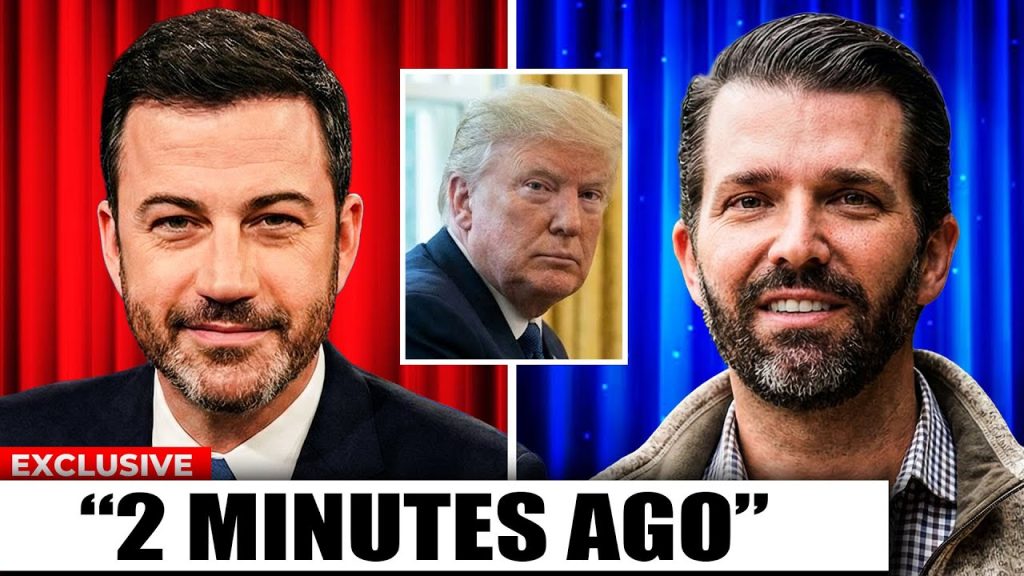
The result was not a single joke, but a cumulative dismantling—one that reportedly triggered another familiar response from the former president: outrage, denial, and a public insistence that none of it mattered.
Kimmel’s segment drew from a long, messy public record. Court testimony from the Trump Organization’s civil fraud trial. Televised interviews. Social media posts that veered from grievance to bravado. None of it was secret. That, in many ways, was the point. Kimmel did not present new allegations. He replayed old ones and let the repetition do the work.
At the center of the monologue was a contrast Kimmel has returned to repeatedly over the years: the gap between inheritance and competence. Donald Trump Jr., he suggested, speaks like a consigliere but performs like a witness unprepared for his own deposition. The line landed because it echoed what viewers had already seen—hours of testimony marked by selective amnesia, responsibility passed to accountants, and a studied vagueness about documents bearing his signature.
The audience laughed at first, then grew quieter as the clips stacked up. The humor sharpened not through insult, but through accumulation. A man who presents himself as a rugged culture warrior reacting online like a personally betrayed customer when a restaurant chain tweaks its logo. A self-styled executive praising his father as a visionary “artist” while disclaiming knowledge of the financial statements that underpinned that art. The jokes were barbed, but the structure was almost prosecutorial.
Kimmel’s most effective move was restraint. He did not accuse Donald Trump Jr. of crimes. He did not speculate about motives. He framed the performance instead—how power behaves when it is inherited rather than earned, how proximity to authority can substitute for accountability. In doing so, he turned the camera slightly away from the individual and toward the system that produced him.
The reaction from Trump was predictable, and therefore revealing. Within hours, the former president was reportedly lashing out online, denouncing Kimmel, the network, and the broader media ecosystem he insists is aligned against his family. It was the same reflex that has defined Trump’s relationship with comedy for nearly a decade: counterattack not the argument, but the platform. Demand punishment. Assert dominance.
Yet the fury underscored the very dynamic Kimmel was highlighting. If Donald Trump Jr. were irrelevant, there would be no need to defend him so aggressively. If the jokes were harmless, there would be no need to answer them at all. The volume of the response became part of the punchline.
:max_bytes(150000):strip_icc():focal(750x247:752x249)/jimmy-kimmel-live-091825-7a3491d46712499eaa40b1323dc5345a.jpg)
What made the moment resonate beyond partisan lines was its familiarity. Americans have watched versions of this story play out in boardrooms, politics, and family businesses for generations: a powerful patriarch, children elevated by name, and the quiet tension between loyalty and competence. Late-night television rarely addresses that tension so directly. This time, it did—without disguising it as outrage.
The segment also illustrated a shift in the mechanics of satire. For years, Trump thrived on conflict, turning mockery into fuel. But mockery that refuses escalation behaves differently. Kimmel did not chase Trump’s anger. He did not attempt to “win” the exchange. He presented a pattern and stepped aside.
That pattern—deflect, blame, demand loyalty, repeat—has become so familiar that it now reads as background noise. By slowing it down, Kimmel made it visible again. The laughter in the studio gave way to recognition, the sense that the joke was not just about one man, but about a broader culture of impunity.
None of this will meaningfully alter the political landscape on its own. Donald Trump Jr. will continue to campaign, post, and position himself as a surrogate for his father’s grievances. Donald Trump will continue to treat criticism as an existential threat. Late-night television will move on to the next monologue.
But moments like this linger because they expose something structural. Power that relies on loyalty over competence is brittle. It demands constant reinforcement. It reacts badly to mirrors.
In the end, Kimmel did not “destroy” Donald Trump Jr. in the way viral headlines promise. He did something quieter and more unsettling. He showed how little destruction was required. When the record is played back slowly, when bravado is measured against performance, the contradiction speaks for itself.
That, perhaps, is why the response from Trump was so intense. Not because the jokes were cruel, but because they were accurate enough to land without exaggeration. In a media environment addicted to spectacle, accuracy can feel like an ambush.
Late-night comedy rarely claims the mantle of accountability. Yet in this case, it functioned as a kind of civic annotation—footnotes delivered with a laugh track. The audience did not leave with new information. They left with a clearer sense of what they had been watching all along.
And sometimes, that clarity is what provokes the loudest reaction of all.







