Canada’s First ASEAN Trade Deal Could Reshape Its Economic Future
While much of the world’s attention has been focused on conflicts in the Middle East, rising energy prices, and intensifying geopolitical competition, an important diplomatic development involving Canada has received far less international attention.
Yet for Prime Minister Mark Carney, the move may prove to be one of the most strategically significant economic initiatives of his government.
The reason is simple.
It involves access to one of the fastest-growing regions in the world.
And it could fundamentally change how Canada approaches global trade in the decades ahead.
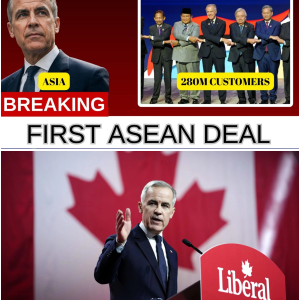
On June 6, Carney held discussions with Indonesian President Prabowo Subianto aimed at strengthening economic cooperation between their two countries.
At the center of those talks was the Canada–Indonesia Comprehensive Economic Partnership Agreement, a deal that represents a major milestone in Canadian trade policy.
If fully implemented, it would become Canada’s first bilateral trade agreement with a member of the Association of Southeast Asian Nations, commonly known as ASEAN.
That achievement alone would be significant.
But the potential implications extend much further.
For years, Canadian policymakers have worried about excessive dependence on a limited number of export markets.
The United States remains Canada’s largest trading partner by an enormous margin.
While that relationship has delivered substantial economic benefits, it has also created vulnerabilities.
Every political dispute, tariff threat, or policy shift in Washington carries consequences for Canadian businesses.
As global uncertainty has increased, so too has the desire to diversify.
The agreement with Indonesia reflects that broader strategic objective.
Rather than relying overwhelmingly on North American trade, Canada is seeking stronger footholds in regions where economic growth is accelerating.
Few regions fit that description better than Southeast Asia.


Indonesia occupies a particularly important position within ASEAN.
With a population exceeding 280 million people, it is one of the world’s largest consumer markets.
Its economy continues expanding.
Its middle class is growing.
Its infrastructure needs remain substantial.
And its strategic importance has increased as global supply chains shift throughout the Indo-Pacific region.
For Canadian exporters, those trends create significant opportunities.
The proposed agreement would reportedly reduce or eliminate tariffs on more than 95 percent of current Canadian exports entering Indonesia.
That change could make Canadian products substantially more competitive.
Agricultural goods, natural resources, advanced manufacturing products, and specialized services could all benefit from improved market access.
For Canadian companies seeking growth opportunities beyond North America, the agreement offers a potentially valuable pathway.
The timing is particularly notable.
The global economy is undergoing profound transformation.
Supply chains are being restructured.
Countries are seeking greater resilience.
And businesses increasingly want access to multiple markets rather than depending heavily on a single destination.
This environment rewards diversification.
It also rewards countries capable of establishing trade relationships across multiple regions.
Canada appears increasingly committed to that strategy.
The agreement with Indonesia can therefore be viewed as part of a much larger economic repositioning effort.
Rather than reacting solely to short-term challenges, Ottawa is attempting to build long-term flexibility into Canada’s trade architecture.
That flexibility may prove increasingly valuable as geopolitical competition intensifies.
The benefits extend beyond simple tariff reductions.
Trade agreements often create frameworks for broader economic cooperation.
Investment flows increase.
Business relationships deepen.
Regulatory cooperation expands.
And governments gain new channels for strategic engagement.
These secondary effects frequently become as important as the trade provisions themselves.


The discussions between Carney and Subianto reportedly covered several sectors that are becoming increasingly important to both countries.
Critical minerals were among them.
These resources have emerged as essential components of modern industrial strategy.
Electric vehicles, renewable energy systems, advanced electronics, and defense technologies all depend heavily on secure access to critical minerals.
Canada possesses significant reserves.
Indonesia possesses substantial resources as well.
Cooperation in this area could therefore generate mutual benefits.
Clean energy was another major topic.
Both governments recognize that energy systems are evolving rapidly.
Demand for electricity continues increasing.
Countries are investing heavily in new technologies.
Partnerships involving energy infrastructure, renewable power generation, and related industries could become increasingly important over time.
Agriculture also remains central.
Canada is one of the world’s major agricultural exporters.
Indonesia’s growing population creates expanding demand for food imports and agricultural products.
Improved market access could therefore strengthen commercial relationships across this sector.
Infrastructure development represents another area of potential cooperation.
Indonesia continues investing heavily in transportation, urban development, logistics, and industrial capacity.
Canadian expertise and investment could play a role in some of those projects.
Taken together, these opportunities illustrate why the agreement is attracting attention among economists and business leaders.
Yet the most significant aspect of the initiative may be what comes next.
The Canada–Indonesia agreement is not necessarily the final destination.
It may instead be the beginning of a much larger process.
Carney and Subianto also discussed efforts to accelerate negotiations toward a broader Canada–ASEAN free trade agreement.
That possibility carries enormous implications.
ASEAN collectively represents a market of more than 650 million people.
Its combined economy ranks among the largest in the world.
Its growth rates consistently outperform many advanced economies.
Securing improved access to that market would represent a major achievement for Canadian trade policy.


The geopolitical dimension should not be overlooked.
Trade agreements are rarely just about economics.
They also shape strategic relationships.
As competition between major powers intensifies, middle powers increasingly seek to strengthen networks of partnerships.
Canada’s engagement with ASEAN reflects this reality.
Southeast Asia has become one of the most important regions in global geopolitics.
The region sits at the intersection of major trade routes.
It plays a critical role in manufacturing supply chains.
And it occupies a central position within broader Indo-Pacific strategies pursued by countries around the world.
Strengthening relationships there therefore serves both economic and strategic objectives.
For Canada, these developments align with a larger vision of reducing vulnerability through diversification.
Rather than becoming overly dependent on any single partner, the goal is to expand options.
More markets mean more resilience.
More partnerships mean more flexibility.
More economic connections mean greater ability to adapt to changing global conditions.
This approach has become increasingly attractive following years of trade disputes, geopolitical uncertainty, and supply-chain disruptions.
The agreement with Indonesia represents one step in that direction.
Whether it ultimately becomes the foundation for deeper engagement with ASEAN remains to be seen.
But its significance is already clear.
Canada is looking beyond traditional trade relationships and positioning itself within one of the world’s most dynamic economic regions.
The immediate benefits may involve tariffs and market access.
The longer-term impact could be far larger.
If successful, the strategy could help reshape Canada’s role in the global economy for decades to come.
And in a world where economic influence increasingly depends on diverse international partnerships, that may prove to be one of the most important investments Canada can make in its future.