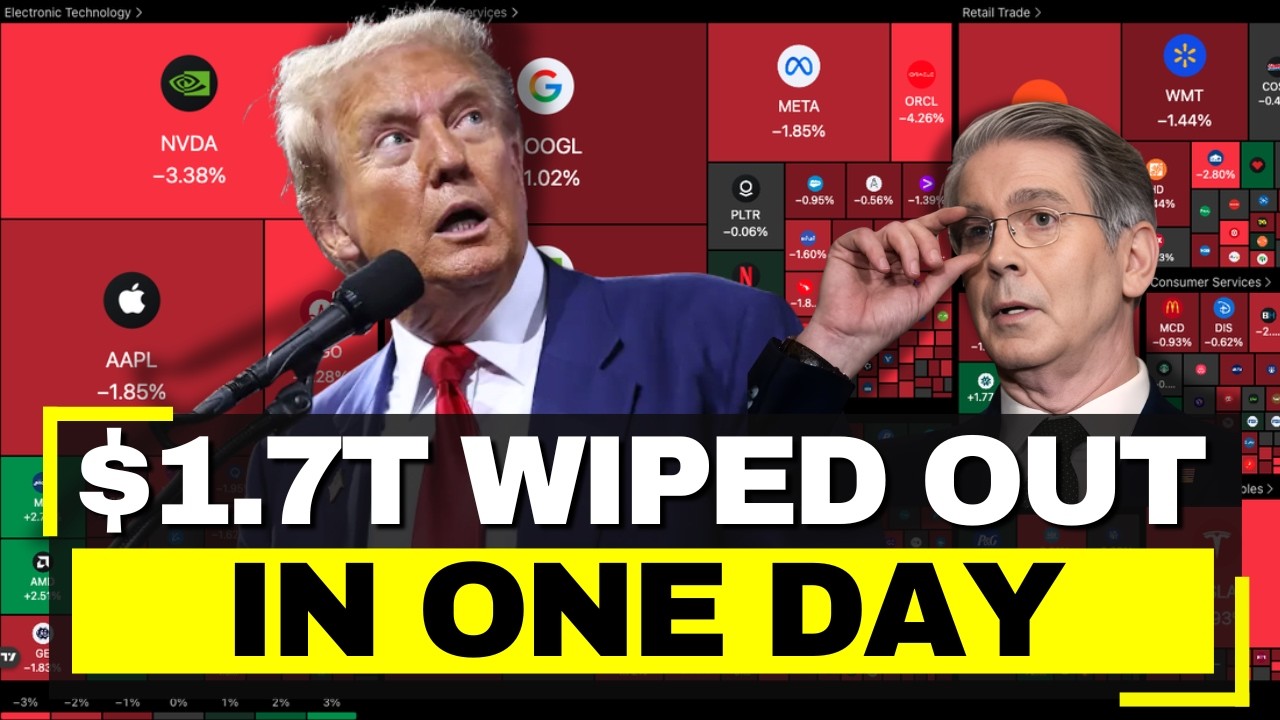
The United States delivered what should have been a celebration. In May, the economy added 172,000 jobs, more than double analyst expectations. Unemployment remained steady, and previous employment figures were revised higher.
Under normal circumstances, Wall Street would have rallied.
Instead, investors panicked.
The NASDAQ suffered its worst one-day decline since the tariff turmoil of 2025. The Dow plunged nearly 700 points. Trillions of dollars vanished from global markets within hours.
What happened exposed a deeper problem inside the American economy.
For years, investors believed strong economic data was always good news. But the financial system has evolved into something far more fragile. Today, positive economic reports can create fear rather than confidence.
The reason begins with inflation.
A strong labor market means businesses continue hiring. Workers continue spending. Demand remains elevated. And when demand remains strong, inflation becomes much harder to control.
That places the Federal Reserve in an uncomfortable position.
For most of 2026, markets were betting that the Fed would cut interest rates. Lower rates were expected to fuel corporate growth, support stock valuations, and extend the artificial intelligence investment boom.
Those expectations became the foundation of the market.

Friday’s employment report shattered that foundation.
Instead of anticipating rate cuts, investors suddenly began pricing in the possibility of another rate increase before the end of the year. The entire outlook changed in a matter of hours.
And when expectations change, markets reprice brutally.
Few sectors felt the impact more than technology.
Companies like NVIDIA, AMD, and Broadcom lost enormous amounts of market value as investors reassessed whether the AI boom could continue under higher borrowing costs.
The logic is straightforward.
Building advanced AI infrastructure requires hundreds of billions of dollars. Data centers, chips, networking systems, and energy supplies all depend on financing.
Higher interest rates make that financing significantly more expensive.
Suddenly, the valuations that seemed reasonable in a low-rate environment begin to look vulnerable.
At the same time, another pressure point is emerging.
Oil prices have climbed sharply amid continuing instability in the Middle East. Higher energy prices feed directly into inflation, making it even harder for central banks to justify monetary easing.

This creates a dangerous feedback loop.
Higher oil prices push inflation upward. Inflation pushes bond yields higher. Higher yields increase borrowing costs. Rising borrowing costs weaken asset prices.
The result is a system pulling against itself.
Meanwhile, Washington faces another challenge: debt.
America’s national debt has climbed toward unprecedented levels, while interest payments consume an increasingly large share of federal revenue.
Every rise in bond yields increases the government’s financing burden.
That means the Federal Reserve is trapped between competing risks.
Cut rates too early, and inflation could accelerate. Keep rates high, and economic growth could slow while financial markets continue to weaken.
Neither option is politically attractive.
The market reaction revealed something important about modern America.
Stocks are no longer responding primarily to economic strength. They are responding to expectations about liquidity, interest rates, and central bank policy.
That disconnect has been growing since the pandemic era.
Consumers have reported declining confidence even as stock indexes reached record highs. Economic reality and market performance increasingly appeared to live in separate worlds.
Now those worlds are colliding.
Investors who expected endless liquidity are being forced to confront a new environment where capital has a cost again.
That transition may prove painful.
Adding to uncertainty is a series of major financial events scheduled in the coming weeks, including critical inflation data, central bank decisions, and several high-profile technology fundraising initiatives.
Each event has the potential to amplify volatility.
For policymakers, the challenge is becoming increasingly complex.
The United States needs strong growth to sustain employment and government revenues. Yet that same growth risks keeping inflation elevated, preventing the interest-rate relief markets desperately want.
This is the contradiction at the heart of the current American economy.
Wall Street needs lower rates.
But the broader economy continues generating conditions that justify higher rates.
Both outcomes cannot coexist indefinitely.
That is why Friday’s jobs report became more than an economic statistic.
It exposed a structural tension that has been building for years beneath rising stock prices and record corporate valuations.
For now, the labor market remains strong.
But investors are beginning to ask a different question.
If good news can trigger a market crash, what happens when genuinely bad news arrives?
That question may define the next chapter of America’s economic story.






