By XAMXAM
For years, Donald Trump has treated biography as strategy. His public life is wrapped in an origin myth that emphasizes instinctive dominance, natural authority, and a sense of greatness that required no correction. It is a story he repeats with ritual precision, especially when challenged. This week, that story was tested not by an investigation or a courtroom, but by a late-night monologue delivered with deliberate calm.
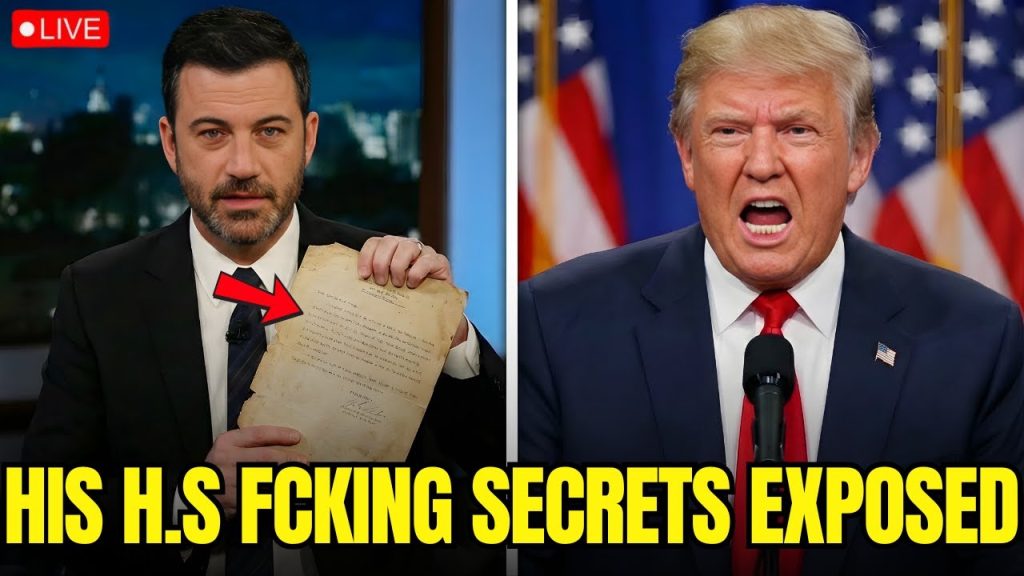
On Jimmy Kimmel Live!, Jimmy Kimmel did not announce a scandal or tease a leak. Instead, he introduced what he described as a small, often overlooked detail from Trump’s adolescence: that as a teenager, Trump was sent by his family to the New York Military Academy, a rigid, military-style boarding school.
The fact itself was hardly new. It has appeared for decades in biographies and profiles. Yet Kimmel’s framing transformed it into something sharper. He did not present the school as a mark of failure, nor did he mock a teenage Trump. He treated it as a point of contrast. Trump, he noted, often portrays himself as someone who has always been in charge, always self-directed. But the decision to send him to a highly disciplined institution suggested something else: that authority and self-control were not innate, but imposed.
The studio reaction shifted in real time. Laughter gave way to a quieter recognition. Kimmel paused, letting the timeline speak for itself. Discipline, he suggested, was not something Trump invented. It was something adults decided he needed.
That distinction mattered because it went to the heart of Trump’s political persona. Trump does not simply argue that he is strong; he insists that strength is his natural state. He mocks opponents as weak, undisciplined, or incapable of control. By highlighting an origin story in which control was externally enforced, Kimmel did not insult Trump. He destabilized the mythology.
The segment was careful, even restrained. Kimmel emphasized that sending a teenager to a structured school is not unusual and not inherently shameful. His question was not about the teenager, but about the adult narrative that followed. Why does a man who prides himself on having always been dominant leave this part of his story out? Why does toughness get marketed as instinct rather than something learned?
Kimmel called it “a quiet timeline,” a phrase that captured why the moment resonated. Loud brands depend on selective memory. Timelines, calmly laid out, can be corrosive.
Within hours, Trump’s response followed a familiar pattern. He did not engage the substance of the observation. He attacked the messenger. Posts appeared denouncing Kimmel as irrelevant, the audience as rigged, the show as dishonest. He insisted he had not watched the segment, then posted again with language that suggested he had. The contradiction became part of the story.
This reaction was not new, but its intensity underscored the vulnerability Kimmel had exposed. Trump has often absorbed criticism on policy, ideology, even scandal. What provokes sharper retaliation are challenges to identity. His public self is not just a political figure; it is a brand built on inevitability. Anything that suggests that inevitability was constructed, corrected, or supervised invites resistance.
:max_bytes(150000):strip_icc():focal(999x0:1001x2)/Jimmy-Kimmel-db432376425b4b04a35852ec4fbd70b9.jpg)
The next night, Kimmel returned to the subject briefly, again without heat. The detail, he said, was not meant as an insult but as an invitation to honesty. Mature leaders, he argued, can acknowledge formation because their authority does not depend on pretending they were born finished. Leadership, he added, is not a vibe. It is how someone behaves when rules apply to them as well.
The clip spread rapidly online. Comment sections filled with arguments about the New York Military Academy itself—whether it was beneficial, whether it was common for wealthy families, whether it “proved” anything at all. But those debates missed the point. The school was never the punchline. The gap between myth and reality was.
In American politics, origin stories matter because they signal how power understands itself. Abraham Lincoln’s log cabin, John F. Kennedy’s war heroism, Barack Obama’s community organizing—these narratives are simplified, but they are acknowledged as shaped by circumstance. Trump’s story is different. It insists on exception. He is not formed by systems; he dominates them. He is not disciplined; he imposes discipline.
That is why a modest biographical detail, delivered without accusation, landed with such force. It suggested that Trump’s relationship with authority has always been more complicated than his rhetoric allows. That suggestion did not accuse him of wrongdoing. It questioned his self-description.
The episode also illustrated a broader shift in political satire. For years, Trump thrived on confrontation. Outrage fed attention, attention fed power. But satire that refuses escalation works differently. Kimmel did not attempt to humiliate Trump. He presented a fact, framed it calmly, and stepped back. The silence that followed did the work.
By the end of the week, there was no single moment of meltdown to replay. Instead, there was a pattern: louder posts, harsher labels, repeated insistence that the conversation was unfair. The effort to redirect attention only reinforced the original point. Image, once questioned, demands constant defense.
In the end, the segment mattered not because it revealed something hidden, but because it reminded viewers of something easily forgotten. Power often depends less on what is secret than on what is omitted. And sometimes, the most destabilizing act is not exposure, but narration—placing events in order and refusing to look away.
For a public figure whose authority rests on the idea that he has always been in control, a calm timeline can feel like an attack. Not because it is dramatic, but because it is difficult to argue with.







