By XAMXAM
WASHINGTON — A sensational video circulating online this week claims that Ivanka Trump publicly confronted Barack Obama over his presidential record — and that the exchange ended in a dramatic reversal that left Ms. Trump “instantly regretting” the attack.
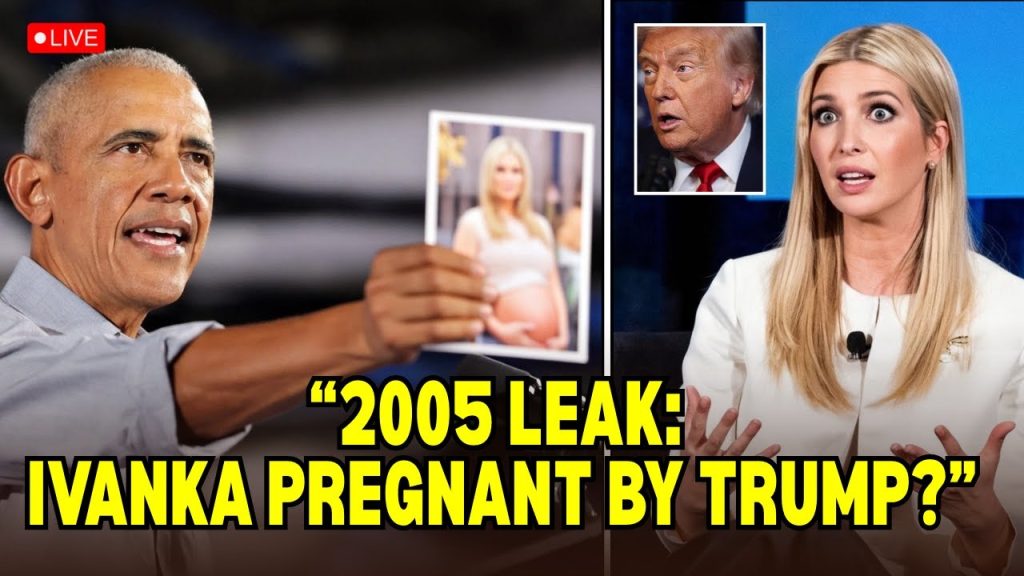
The clip, framed as footage from a high-profile charity event and promoted with breathless language, has rapidly accumulated views across multiple platforms. Yet despite its popularity, the video’s central assertions remain unsupported by independently verified evidence, according to media researchers and individuals familiar with the event calendars of both public figures.
The episode highlights a familiar dynamic in the current media ecosystem: viral political storytelling that blends real personalities with unverified claims, moving faster than fact-checking can follow.
What the Video Alleges — and What Can Be Confirmed
The video narrates a dramatic scene in which Ms. Trump is said to have criticized Mr. Obama’s leadership at a Washington charity event, prompting a calm but devastating response from the former president. It goes on to suggest that Mr. Obama later released or referenced private material that fundamentally altered public perceptions of the Trump family.
No credible news organization has confirmed that such an exchange occurred, nor that any related materials exist. Representatives for Mr. Obama declined to comment on what they described as “online speculation detached from reality.” Ms. Trump’s office did not respond to requests for comment.
“There is no record — public or private — of a confrontation of this nature,” said Jonathan Reed, a media historian who tracks political disinformation. “What we’re seeing is a narrative format designed for virality, not verification.”
Event schedules, guest lists and press coverage from major Washington charity galas in recent years do not show any documented incident matching the video’s description.
A Familiar Formula for Viral Political Content
Experts say the structure of the video follows a recognizable template: a powerful confrontation, a moment of silence, a dramatic reversal and an implied revelation. The formula is common in highly shareable political content, particularly on platforms that reward watch time and emotional engagement.
“These videos are written like short political thrillers,” said Nina Alvarez, a digital media analyst. “They borrow the language of journalism — ‘sources,’ ‘verification,’ ‘forensic review’ — without actually providing any of those things.”
The result, she said, is a story that feels authoritative to casual viewers but collapses under scrutiny.
The Risk of Reputational Harm
While public figures are accustomed to criticism, legal scholars note that narratives involving alleged private conduct cross into more sensitive territory — particularly when they lack evidence.
“There is a clear line between political critique and the circulation of unverified personal allegations,” said Mark Feldman, a professor of media law at Georgetown University. “Responsible outlets are extremely cautious because the harm can be significant and lasting.”
Mainstream news organizations, including this one, have not published any reporting supporting the claims made in the video.
Why These Stories Gain Traction
The video’s success, analysts say, reflects broader political polarization and a hunger for content that confirms existing beliefs about power, secrecy and elite behavior.
Supporters of the Trump family have dismissed the clip as fabrication. Critics, meanwhile, have shared it as symbolic rather than factual — a reflection, they say, of perceived moral contrasts between political figures.
“That ambiguity is part of the appeal,” Alvarez said. “People share it not because they know it’s true, but because it feels true to them emotionally.”

Silence, Interpreted
Both Mr. Obama and Ms. Trump have remained publicly silent about the specific video, a decision that experts say is often deliberate.
“Responding can amplify false claims,” Feldman said. “Non-engagement is frequently the advised strategy unless there’s a legal or safety concern.”
Silence, however, can also be interpreted by online audiences as confirmation — a phenomenon researchers call “absence bias,” in which lack of response is read as meaningful.
A Broader Pattern
The episode fits into a wider trend of AI-assisted or script-driven political videos that blur the boundary between commentary and fabrication. While some are clearly labeled as opinion or satire, others are not, leaving viewers to infer credibility.
Platforms have taken uneven approaches to moderation. Some attach context labels to disputed content; others allow it to circulate freely unless it violates explicit rules.
“This is the new information battleground,” Reed said. “The question isn’t just what’s true, but how fast a story can travel before truth has time to catch up.”
What Is Known — and What Is Not
What can be stated with confidence is limited:
-
There is no verified record of the confrontation described.
-
There is no corroborated evidence supporting the video’s implied revelations.
-
The claims have not been reported or confirmed by reputable news organizations.
Beyond that, the story exists primarily as a piece of viral political fiction — compelling to some, rejected by others, and unresolved by design.
The Enduring Appeal of the “Backfire” Narrative
Stories in which a powerful figure overreaches and is swiftly humbled have long held appeal in American political culture. In the digital era, those narratives are no longer confined to satire or opinion columns; they are packaged as quasi-news and distributed at scale.
“The ‘instant regret’ trope is irresistible,” Alvarez said. “It promises moral clarity in a world that feels chaotic.”
Whether that promise outweighs the responsibility to distinguish fact from fiction remains an open question — one that continues to shape the modern political media landscape.
For now, the Ivanka Trump–Obama video stands as a case study in how quickly a story can dominate feeds without ever clearing the basic threshold of verification.
And as with many such moments online, its influence may ultimately say more about the audience consuming it than about the figures it portrays.