When Silence Becomes the Sharpest Punchline
Donald Trump has never treated late-night comedy as background noise. To him, a joke is not merely a cultural aside but a challenge to authority — a reminder, broadcast nightly, that control of the national narrative is never complete. When that control slips, his response has long been predictable: escalation. Louder insults. Sharper labels. More attention.
What made the recent back-to-back segments by Jimmy Kimmel and Stephen Colbert notable was not their ferocity, but their restraint.
Across two nights, the hosts declined the familiar rhythm of provocation and punchline. There were no nicknames, no shouted monologues, no effort to “win” the moment by force. Instead, they adopted a posture that has increasingly unsettled Trump more than open mockery ever could: calm inquiry.

Kimmel went first. He walked onto his brightly lit stage not with a barrage of jokes, but with a stack of cue cards and an unusually steady tone. Rather than mocking Trump directly, he read one of the former president’s recent insults slowly, as if reviewing a flawed argument. The laughter arrived early — reflexive, almost automatic — and then receded as Kimmel paused.
He asked a question that landed with quiet force: What, exactly, are these insults supposed to accomplish? Do they lower grocery prices? Improve schools? Help anyone sleep better at night?
The studio audience laughed again, but differently this time — less at the joke, more at the recognition embedded within it. Kimmel did not rush to fill the silence. He let the idea linger. Confidence, he suggested, often appears as clarity, not as the constant humiliation of others.
His final line traveled quickly online: “If a leader’s best argument is calling everyone ‘low IQ,’ then that leader is admitting he doesn’t trust his ideas to survive a question.”
Then he moved on, refusing to feed the outrage machine any further oxygen.
The following night, Colbert approached the same target using a different instrument: documentation. He played brief clips of Trump praising a policy one week and attacking it the next, narrating the sequence not with anger but with precision. The effect was less a roast than a timeline — an invitation for viewers to notice the pattern themselves.
“Some politicians don’t flip-flop because they’re complex,” Colbert observed evenly. “They flip-flop because they’re auditioning.”
The audience roared. Colbert waved off the band, allowing the laughter — and then the silence — to do the work. His point was not that Trump was inconsistent, but that accountability itself seemed to trigger the shift. When scrutiny appears, the story changes.
By the time both clips circulated widely online, the focus was no longer on who had delivered the sharpest insult. It was on who looked composed.
Trump’s public response followed a familiar arc: rapid posts, harsher labels, declarations that the hosts were irrelevant — followed, inevitably, by more attention that contradicted the claim. He did not rebut the substance of the critiques. He attacked the messengers. Attacking the messengers, after all, is faster than explaining.
This is the paradox at the heart of Trump’s relationship with late-night comedy. If the shows do not matter, why chase them? If the jokes are weak, why respond as if they pose a threat?
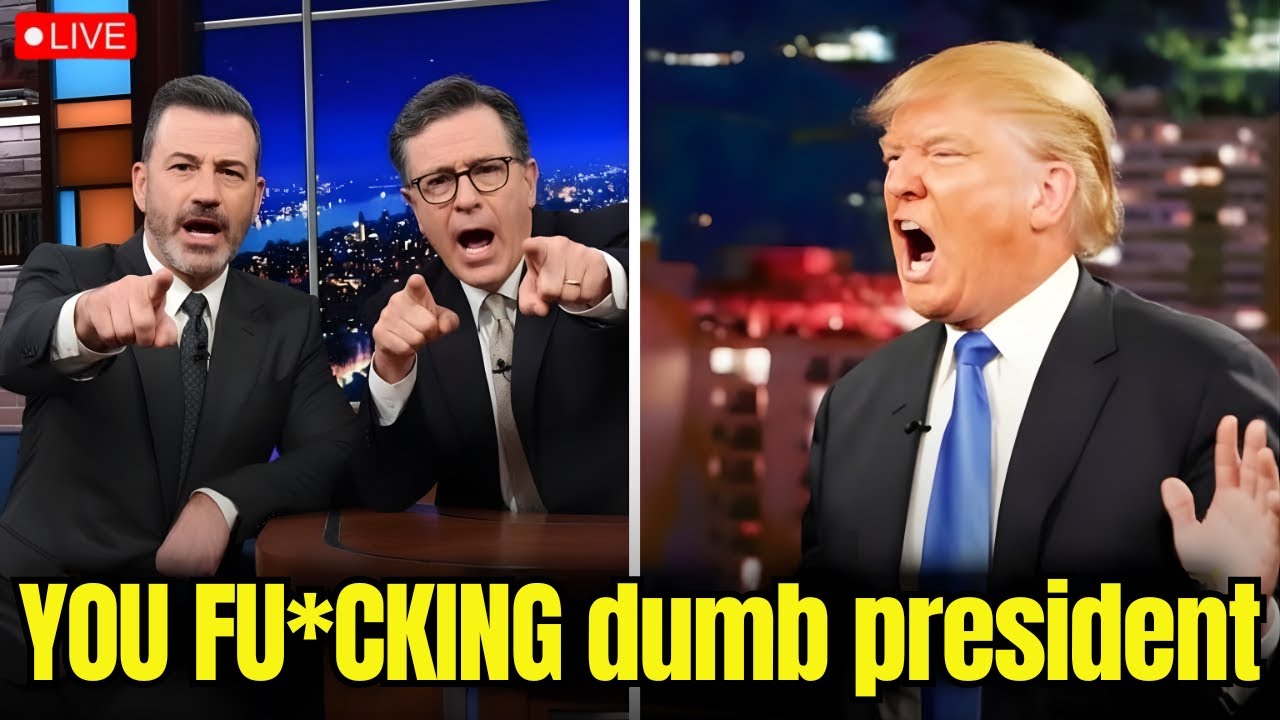
The edits that spread across social media told the story more clearly than any commentary could. Kimmel’s pauses. Colbert’s clipped delivery. Audiences reacting not with hysteria, but with the quiet satisfaction of watching someone stop shouting.
Even viewers who dislike both hosts acknowledged something unusual: the segments felt clean. They criticized conduct, not bodies. They stayed on one question rather than chasing ten distractions. They did not escalate. They waited.
Trump’s political brand has long thrived on escalation — pulling opponents into a shouting match where everything becomes heat and nothing remains long enough to be examined. Kimmel and Colbert declined the brawl. They treated the provocation like paperwork: read it, question it, set it down.
They did not humiliate Trump with secret revelations or viral stunts. They did it with restraint.
In an era addicted to outrage, the calmest people in the room can still flip the script. Not by answering noise with more noise, but by exposing why the noise exists in the first place.
Silence, it turns out, can be the sharpest punchline of all.






