Clintons Seek Public Testimony as Epstein Inquiry Collides With Partisan Strategy in Congress
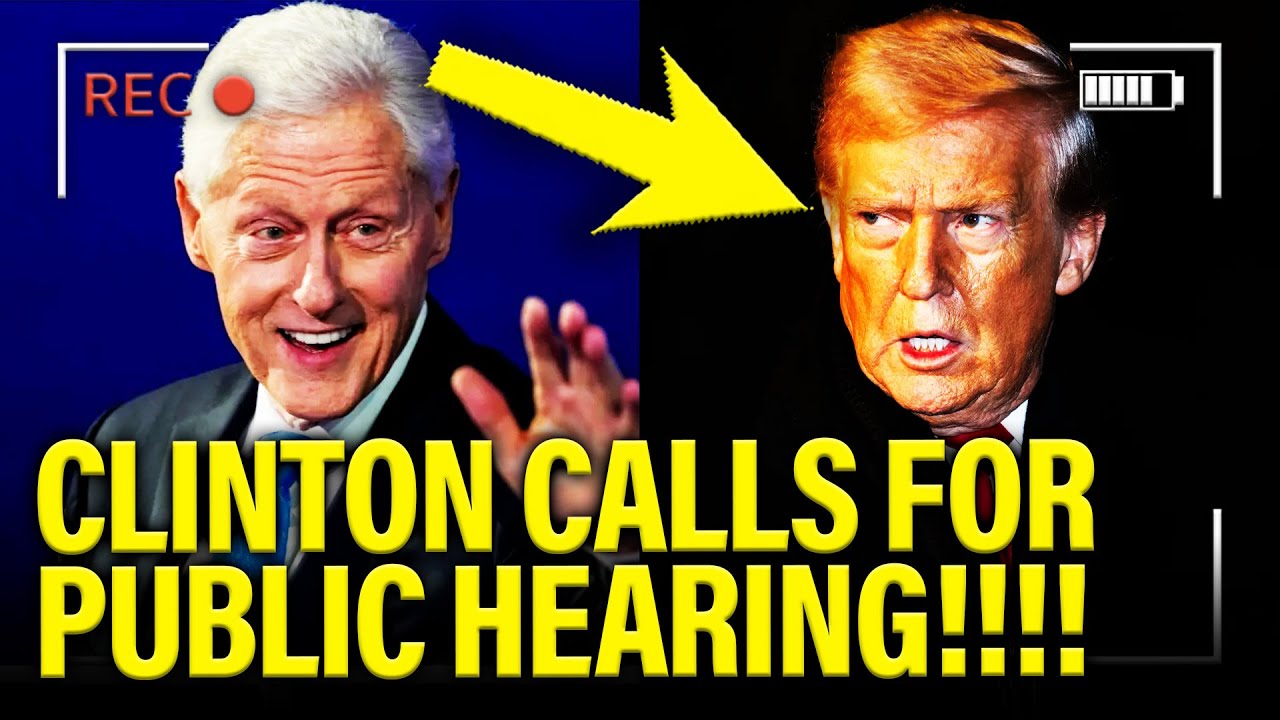
Former President Bill Clinton and former Secretary of State Hillary Clinton have taken an unusual step in Washington’s long-running battles over transparency and political accountability: they have formally agreed to testify before Congress—and have asked that it be done publicly.
The request, conveyed in a letter to the House Oversight Committee, comes as Republicans aligned with Donald Trump have moved to subpoena high-profile Democrats in what critics describe as a counteroffensive following the partial release of long-sealed documents related to the late financier Jeffrey Epstein.
The Clintons’ response reframes that confrontation. Rather than resisting congressional scrutiny, they have embraced it—on the condition that it occur in open hearings, not behind closed doors.
A Public Challenge to Congress
In their letter, attorneys for the Clintons proposed specific dates in late February for testimony and said public hearings would “best suit concerns about fairness and transparency.” The letter noted that the Oversight Committee, chaired by James Comer, had not previously requested open testimony.
The move places the committee in a bind. Republicans have argued that private depositions are standard practice for sensitive investigations. Democrats counter that private sessions allow selective leaks and political spin, particularly in matters as charged as Epstein’s social and political connections.
“Sunlight is the best disinfectant,” said Representative Raja Krishnamoorthi, a senior Democrat on the Oversight Committee, in an interview following the announcement. “If this inquiry is truly about facts, then it should be conducted where the public can see it.”
The Epstein Files and Competing Narratives
The dispute is rooted in the recent release of a portion of the Epstein files by the Department of Justice, following passage of the Epstein File Transparency Act. The release—estimated by experts to represent only a fraction of the total archive—has renewed scrutiny of Epstein’s relationships with political, business, and cultural elites across decades.
Republicans have emphasized Epstein’s past association with Bill Clinton, citing travel records showing Clinton flew on Epstein’s private plane multiple times in the early 2000s. Clinton has long acknowledged those trips, saying they were related to philanthropic work and that he was unaware of Epstein’s criminal conduct at the time.
Democrats and independent watchdogs, meanwhile, have pointed to numerous references to Donald Trump in the same materials, as well as photographs and contemporaneous media reports documenting Trump and Epstein socializing in the 1990s and early 2000s. Trump has denied wrongdoing and said he severed ties with Epstein years before Epstein’s first criminal case.
The partial nature of the document release has fueled mistrust on both sides. Transparency advocates argue that millions of pages remain unreleased or heavily redacted, raising questions about whose interests are being protected.
In a statement issued earlier this month, Bill Clinton called on the Justice Department to release “any and all materials referring to, mentioning, or containing photographs” of him, adding, “We need no such protection.”
Oversight or Political Theater?
Chairman Comer has defended the committee’s actions as legitimate oversight, saying Congress has a duty to question public figures who had close contact with Epstein. He has also criticized the pace of document production by the Justice Department, though he has said the department is cooperating.
But Democrats see a different motive. They argue the focus on subpoenaing the Clintons serves to divert attention from unanswered questions surrounding Trump’s own history with Epstein and from broader concerns about the handling of the files by the current administration.
“This risks becoming a distraction exercise rather than a truth-seeking one,” said a former House counsel who advised previous oversight investigations. “The question is whether Congress wants clarity—or spectacle.”
The Stakes for Congress
The Clintons’ demand for public testimony raises the political cost of proceeding otherwise. If Republicans decline, they risk appearing to avoid transparency. If they agree, they would place two of the most scrutinized figures in modern American politics under oath in front of cameras—an event likely to dominate headlines and overshadow other legislative priorities.
Public hearings could also set a precedent. Other figures named in the Epstein materials, including business leaders and former officials, could face renewed calls to testify openly. That prospect has made some lawmakers cautious.
“There’s a reason depositions are often private,” said a Republican aide familiar with the committee’s strategy. “They allow investigators to gather facts without turning hearings into media circuses.”
A Broader Accountability Gap
The controversy also highlights a broader debate over congressional oversight in an era of intense polarization. Democrats have complained that Republican-led committees have been aggressive in pursuing investigations of political opponents while showing limited appetite for scrutinizing Trump administration officials.
Krishnamoorthi and others have called for public testimony from senior officials at the Department of Homeland Security and the Justice Department on unrelated issues, including immigration enforcement and use-of-force incidents. Those hearings have not materialized.
“Accountability can’t be selective,” Krishnamoorthi said. “If we’re going to investigate, it should apply across the board.”
What Comes Next
For now, the ball is in the Oversight Committee’s court. Comer has not publicly responded to the Clintons’ request for open hearings, and it remains unclear whether the committee will proceed with subpoenas, negotiate terms, or shift focus.
What is clear is that the Clintons’ gambit has altered the dynamics of the Epstein inquiry. By volunteering to testify publicly, they have turned a defensive posture into an offensive one—challenging Congress to match rhetoric with transparency.
As one longtime congressional observer put it, “If the goal was to put the Clintons on the spot, they’ve just flipped the spotlight back onto the investigators.”
Whether Congress embraces that challenge may determine not only the credibility of this inquiry, but also how future investigations into elite misconduct are conducted in an increasingly skeptical public arena.






