By XAMXAM
Late-night television has long trafficked in exaggeration, but on a recent broadcast from the Ed Sullivan Theater, exaggeration was not the point. What unfolded instead was a reframing—measured, deliberate, and devastating in its restraint. In a monologue that eschewed punchlines for posture, Stephen Colbert argued that the enduring myth of Donald Trump as mastermind was not merely overstated, but fundamentally mistaken.
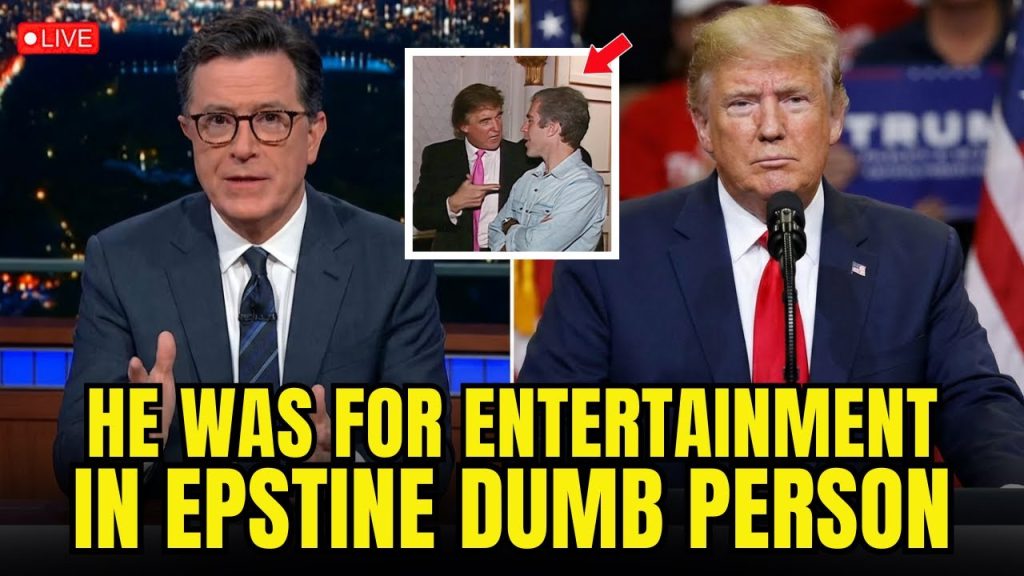
The segment arrived with none of the show’s usual flourishes. No band sting. No warm-up applause. Colbert walked onstage carrying documents—props within the language of satire—and spoke in a register closer to an essay than a joke. The effect was immediate: the room leaned forward. The laughs, when they came at all, were nervous.
For years, Colbert noted, public discussion had oscillated between two extremes when it came to Trump’s proximity to power: either Trump as omnipotent schemer or Trump as hapless outsider. Both, Colbert suggested, granted him too much agency. What if the more accurate description was simpler—and more humiliating? What if Trump was present not because he was directing events, but because he was entertaining the people who did?
To make the case, Colbert employed a familiar late-night device—reading aloud purported excerpts from correspondence associated with Jeffrey Epstein—but he was careful to frame the exercise as commentary, not proof. The letters, as Colbert presented them, functioned as satire’s mirror: not evidence to be litigated, but a narrative lens meant to puncture an illusion Trump himself had cultivated.
In Colbert’s telling, Trump appears not as an insider whispering strategy, but as a noisy presence placed at the margins of elite gatherings. The language was intentionally absurd, even cartoonish—Trump as the man invited to “make noise,” to keep a room amused, to perform confidence without comprehension. The punch did not come from accusation, but from inversion. The alpha figure, recast as ornament.
What stunned the audience was not cruelty, but coherence. Colbert did not rant. He did not stack jokes for applause. He walked viewers through a single thesis and then stopped. The silence that followed was not the silence of shock television, but the quiet that signals recognition.
Trump’s political persona has always depended on proximity to power as validation. He speaks of tables he sits at, rooms he commands, people who respect him. Colbert’s argument attacked that foundation without touching policy or ideology. If Trump’s access was transactional—if he was valued as spectacle rather than strategist—then the self-mythology collapses under its own weight.

This approach distinguished the segment from the usual late-night barrage. Instead of cataloging contradictions or replaying gaffes, Colbert questioned the premise that Trump was ever the author of the rooms he occupied. The joke, as Colbert framed it, was not that Trump failed at mastery, but that mastery was never expected of him in the first place.
The audience reaction reflected the shift. There were gasps, then a low ripple of laughter, then applause that arrived late and lingered. It was not the roar of partisan approval, but something closer to acknowledgment. The studio understood that the target was not a scandal to be proved, but an image to be punctured.
In a media environment saturated with claims of “exposure,” Colbert’s restraint stood out. He did not declare victory. He did not call for consequences. He ended the segment by stepping back, glasses off, leaving the thesis to sit with the viewer. Trump, he concluded, had mistaken attention for authority. The people Trump admired, Colbert suggested, had granted him a stage, not a seat.
That distinction matters. To be the entertainment is not to be irrelevant; entertainers can wield enormous influence. But it is a different kind of power—conditional, precarious, dependent on novelty. Colbert’s reframing implied that Trump’s greatest fear is not being opposed, but being laughed at without being admired.
The broader resonance of the segment lies in what it says about contemporary politics. In an era where performance often substitutes for governance, the line between actor and author blurs. Colbert’s monologue insisted on redrawing it. Trump, he argued, is most dangerous not because he is a mastermind, but because he mistakes the applause for authorship.
Whether viewers accept Colbert’s thesis in full is almost beside the point. What made the moment travel was its discipline. By refusing spectacle, the segment became spectacle. By lowering his voice, Colbert forced the audience to listen.
Late-night television rarely aspires to this register. When it does, the result can feel jarring—less like comedy than commentary, less like attack than diagnosis. On this night, the diagnosis landed. Trump was not exposed as a villain in a shadowy plot. He was reframed as something more cutting: the act that thought it ran the show.
In a culture obsessed with masterminds, that may be the most unsettling punchline of all.