By XAMXAM
A clip titled with the promise of implosion—Donald Trump “going nuts” after being “destroyed” on live television—began circulating online with familiar velocity. At its center was Samuel L. Jackson, speaking casually about a long-running, mostly trivial feud with Donald Trump—golf games, tweets, unpaid club dues, and the peculiar rituals of celebrity proximity to power. The packaging was incendiary; the substance, more revealing in a quieter way.
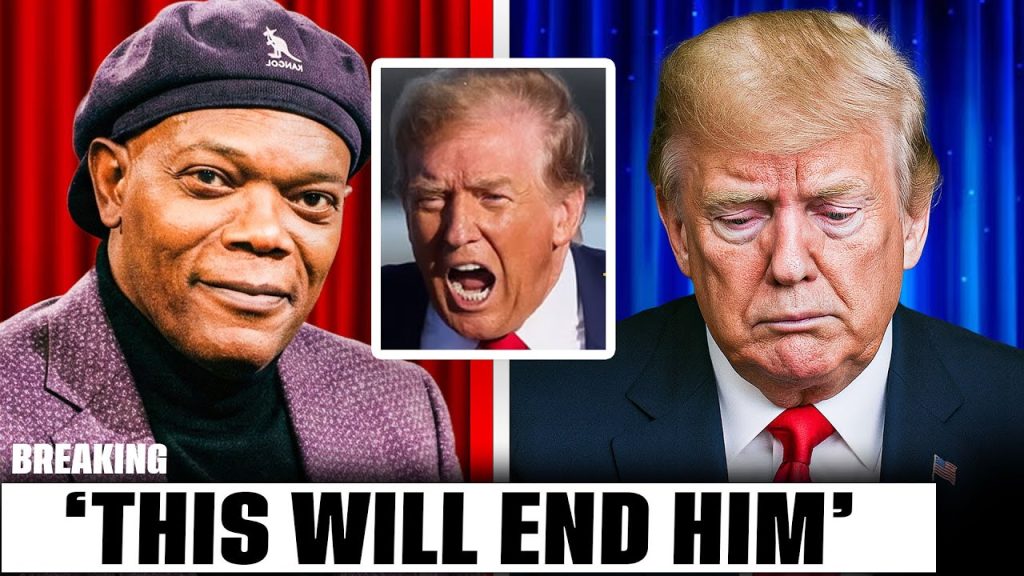
The exchange did not unfold as a dramatic confrontation in the traditional sense. There was no raised voice, no shouted insult, no theatrical crescendo. Instead, Jackson did what he has done for years in interviews: he told stories, corrected the record as he saw it, and allowed Trump’s own public statements to sit beside his recollections. The humor came from contrast rather than cruelty. The “takedown,” if there was one, arrived through accumulation.
That distinction matters. Viral framing thrives on absolutes—obliteration, meltdown, chaos—because nuance does not travel as well. But the Jackson segment gained traction precisely because it avoided the expected posture of outrage. He appeared amused, not angry. When reminded that Trump had claimed not to know him, Jackson shrugged it off, recounting phone calls, golf outings, and invoices that suggested otherwise. The laughter followed not from mockery but from the absurdity of contradiction.
This is a familiar dynamic in Trump-era media. The former president’s relationship with celebrity has always been transactional, performative, and public. He built his brand by borrowing glamour, proximity, and validation from famous names, then disavowing them when they became inconvenient. Jackson’s stories, told without apparent malice, illuminated that pattern more effectively than a polemic might have.
What the clip also demonstrates is the changing role of celebrities in political discourse. Jackson was not presenting himself as a policy expert or moral authority. He was a witness to a small, telling slice of Trump’s behavior—how power presents itself in informal settings, how denial operates reflexively, how bravado coexists with petty scorekeeping. In that sense, his commentary functioned less as an attack and more as an anecdotal record.
The reaction cycle that followed was predictable. Supporters of Trump dismissed the segment as irrelevant celebrity chatter. Critics amplified it as proof of dishonesty or insecurity. Algorithms did the rest, stripping context and amplifying emotion. Somewhere in that churn, the original exchange was transformed into a narrative of humiliation and rage.
Yet the most striking element of the moment is how little Jackson seemed to care about winning. He did not demand retraction or apology. He did not escalate. He simply declined to participate in the drama on Trump’s terms. That refusal—calm, unbothered, almost bored—proved more disarming than a sharper jab might have been.

This approach echoes a broader shift in how Trump is engaged by cultural figures. Early opposition often relied on satire or shock, attempting to match volume with volume. Increasingly, the most effective critiques are quieter, grounded in specificity, and resistant to spectacle. They let the contradictions speak for themselves.
The viral caption promises a meltdown. What viewers actually see is something subtler: the erosion of a myth. Trump’s self-mythology depends on dominance and control of narrative. When someone like Jackson treats him as neither villain nor titan—just another man prone to exaggeration—the mythology weakens. There is no explosion, only deflation.
This is why the clip resonated. It offered a release from the constant escalation of political media. There were no allegations to adjudicate, no policies to litigate. There was simply a famous actor, unhurried, recounting experiences that contradicted a famous politician’s claims. The audience was invited to draw its own conclusions.
Of course, none of this settles anything of consequence. It does not alter an election, resolve a legal dispute, or clarify a policy debate. Its importance lies elsewhere—in illustrating how power looks when it is not being courted. Jackson did not seek Trump’s approval, nor did he fear his disapproval. That posture, rare in a culture that rewards deference, proved contagious.
The danger, as always, is mistaking viral satisfaction for civic progress. Clips like this can entertain and puncture ego, but they can also distract from substantive accountability. The laughter fades; the systems remain. Celebrity anecdotes do not replace reporting, nor should they.
Still, moments like this endure because they capture something true about the age: that credibility is increasingly tested not in grand speeches but in offhand recollections, not in formal debates but in casual contradictions. Trump did not need to “go nuts” for the clip to land. He only needed to be treated as ordinary.
In a media environment addicted to extremes, that may be the sharpest cut of all.