🔥 BREAKING: TRUMP ERUPTS After JIMMY KIMMEL & WHOOPI GOLDBERG EXPOSE Him LIVE ON TV — BRUTAL ON-AIR TAKEDOWN SENDS STUDIO INTO TOTAL CHAOS ⚡
In late September 2025, a familiar tension in American public life resurfaced in an unexpected place: the studios of late-night television and daytime talk shows. What began as a temporary suspension of Jimmy Kimmel Live! quickly escalated into a broader debate over political pressure, media independence and the boundaries of free expression, drawing in figures from across the entertainment and political spectrum — most prominently Jimmy Kimmel and Whoopi Goldberg.
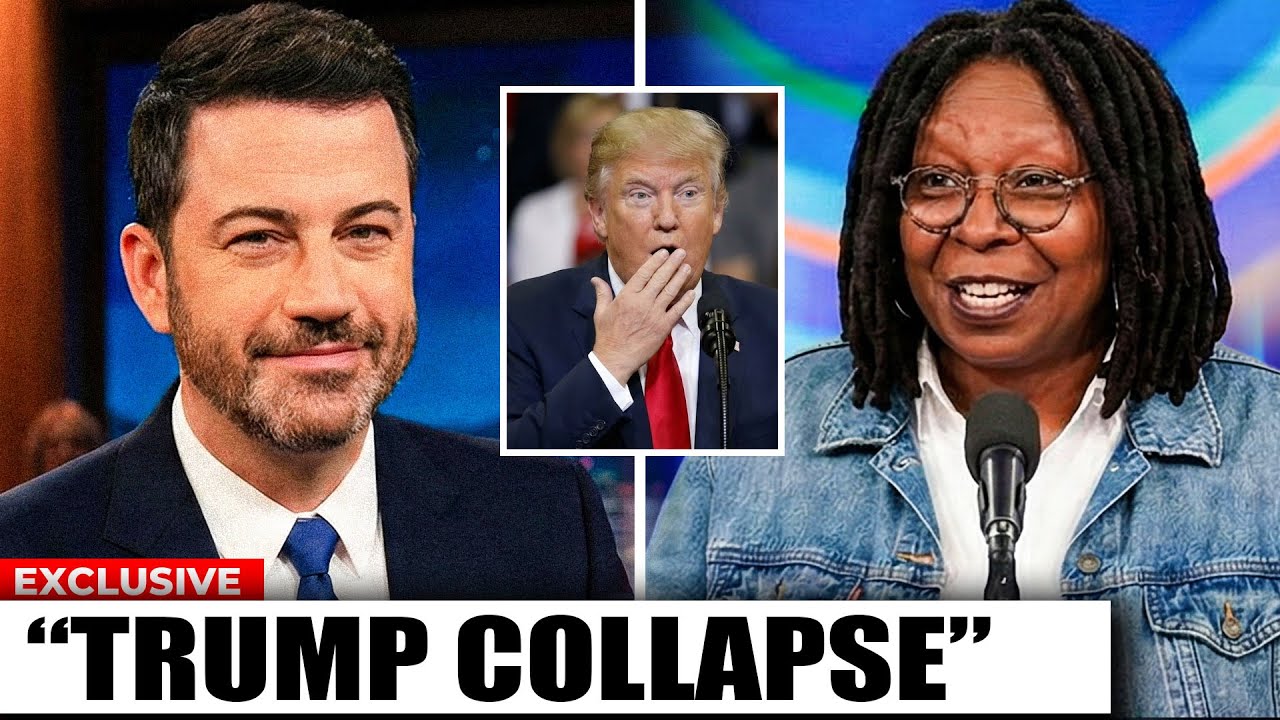
The controversy followed a monologue in which Mr. Kimmel criticized right-wing political rhetoric and the politicization of a recent act of violence. Within hours, the Federal Communications Commission chairman, a Trump appointee, publicly suggested that ABC’s broadcast licenses could face scrutiny. Shortly afterward, ABC announced that Jimmy Kimmel Live! would be suspended. The network cited internal review processes, but the timing raised immediate questions among media watchdogs and civil-liberties advocates.
For several days, ABC’s daytime flagship The View remained silent on the matter, prompting speculation that corporate pressure was discouraging public discussion. That silence ended abruptly on September 22, when Ms. Goldberg opened the show with a blunt declaration. “Did you really think we weren’t going to talk about Jimmy Kimmel?” she asked, drawing sustained applause from the studio audience.
Ms. Goldberg’s remarks were notable not for their theatricality, but for their clarity. She drew a distinction between editorial judgment and government coercion, emphasizing that while networks may cancel or criticize shows, “the government cannot apply pressure to force someone to be silenced.” Coming from a host on the same network that had suspended Mr. Kimmel, the statement carried particular weight.
The segment quickly expanded beyond one program. Co-hosts Sunny Hostin and Ana Navarro framed the issue as a constitutional concern rather than a partisan dispute. Ms. Navarro, who has spoken frequently about growing up under authoritarian regimes in Latin America, warned that the use of tragedy as justification for silencing critics followed a pattern familiar from less democratic societies. Even several Republican lawmakers, including Senators Ted Cruz and Rand Paul, publicly criticized the FCC chairman’s comments, calling them inconsistent with First Amendment principles.
When Mr. Kimmel returned to the air the following evening, he avoided self-pity. Instead, he broadened the lens, pointing to what he described as an atmosphere of intimidation facing journalists, entertainers and critics of the administration. “This isn’t about me,” he told viewers. “It’s about whether people in power get to decide who’s allowed to speak.”
Former President Donald J. Trump responded on social media with characteristic aggression, celebrating what he claimed were declining ratings and attacking both Mr. Kimmel and Ms. Goldberg personally. He denied threatening ABC, even as his posts reiterated that the network had previously paid settlements after his criticism — comments that critics said undermined his own argument.

The exchange highlighted a recurring feature of Mr. Trump’s relationship with media institutions. Rather than disputing specific claims, he often frames criticism itself as illegitimate, casting journalists and entertainers as enemies rather than participants in public debate. That strategy has proven effective with his supporters, but it also tends to amplify the very attention he seeks to suppress.
What made this episode different was the alignment of voices across formats and ideologies. Late-night comedy, daytime television, conservative senators and civil-liberties advocates all converged on the same concern: the appearance of government pressure on speech. The argument was not that Mr. Kimmel’s monologue was beyond criticism, but that regulatory power should never be used — or threatened — to punish dissent.
For ABC and its parent company, Disney, the incident underscored the difficulty of navigating political polarization while maintaining journalistic credibility. The network has not acknowledged any coordination with federal officials, but the perception of vulnerability to political influence proved damaging enough to provoke a public reckoning on its own airwaves.
In the end, the episode served as a reminder of why entertainment platforms still matter in civic life. They reach audiences that traditional political programming does not, and they can surface constitutional questions in accessible, human terms. When Ms. Goldberg closed her remarks by telling viewers that speaking out was “your birthright as an American,” she was not issuing a partisan call to action. She was restating a principle that transcends party affiliation.
The confrontation did not resolve the underlying tensions between power and speech. But it did make one thing clear: attempts to intimidate critics can still backfire, particularly when those critics respond not with outrage alone, but with persistence, solidarity and an insistence on the rules that govern a democratic society.






