By XAMXAM
Late-night comedy rarely breaks political news. Its power lies elsewhere—in timing, restraint, and the quiet confidence to let an audience finish the thought. That is what made Jimmy Kimmel’s recent monologue notable. By shifting attention away from Donald Trump and toward Melania Trump, Kimmel triggered a reaction that became the story. The punchline did not shout. The response did.
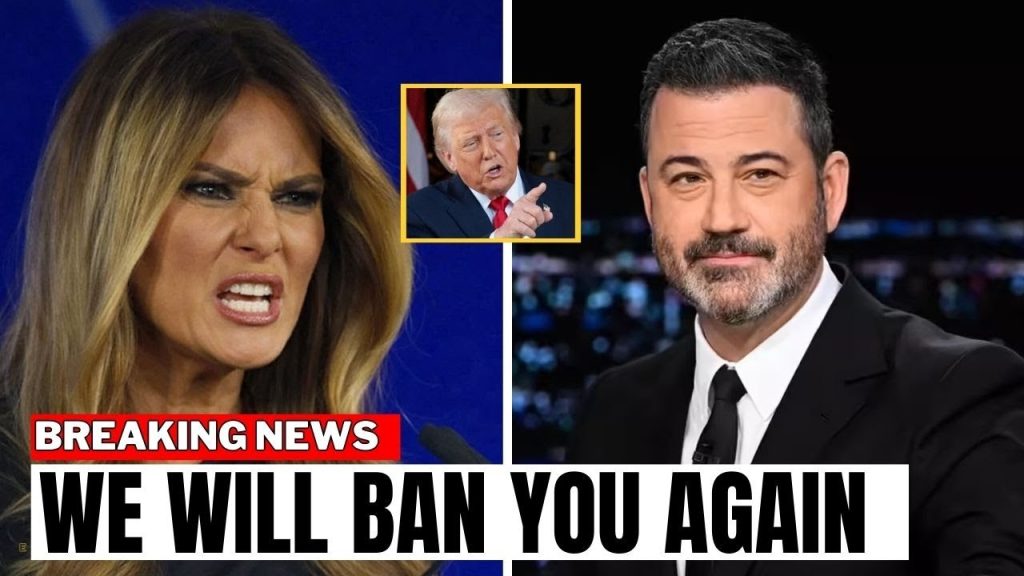
The segment began with a familiar rhythm—archival clips, a raised eyebrow, a line delivered as if it might drift past unnoticed. Kimmel’s focus was not accusation but observation: the contrast between noise and stillness, between an omnipresent voice and a meticulously curated silence. Melania Trump has long occupied a peculiar place in American political theater, visible yet distant, impeccably styled yet emotionally opaque. Comedy, drawn to paradox, cannot resist that terrain.
Kimmel did not present her as villain or victim. He treated her as an image—polished, controlled, and persistently unreadable—and asked, gently, what that image does in a culture addicted to confession. The jokes worked precisely because they declined to explain. A fashion detail here, a public absence there, a reminder that silence can be a strategy as much as a shield. The laughter came not from revelation but from recognition.
Then came the reaction. As the clip traveled, Trump’s counterattack followed the familiar arc: denunciation of the host’s talent, complaints about ratings, the suggestion of retaliation. The response was louder than the provocation. And in that imbalance—one man reacting to everything, one woman reacting to nothing—the monologue found its second life.
Late-night satire thrives on contrast. Kimmel understands that escalation dulls the blade. He slowed down instead. He let the audience notice how Melania’s composure resists the gravitational pull of scandal, how her public persona absorbs scrutiny without acknowledging it. In a political era that prizes performance, her refusal to perform becomes the point.
There is a temptation to read such moments as cruelty aimed at a private individual. But Melania Trump is not private in the ordinary sense. She has authored books, promoted causes, and appeared on the world stage. What Kimmel examined was not her interior life but the architecture of her public one—the careful choices that produce distance. The humor did not speculate about motives; it marveled at the effect.
Trump’s meltdown, reported and reposted, did more than defend a spouse. It underscored the asymmetry the jokes had outlined. Where he fills every silence, she preserves it. Where he litigates every slight, she lets them pass. The louder his response grew, the more persuasive the original observation seemed.

This is the paradox of contemporary media politics: outrage amplifies what it seeks to suppress. Kimmel’s segment did not need repetition or reinforcement. The counterattack supplied both. By insisting the moment mattered enough to punish, Trump elevated it from monologue to headline.
Comedy’s civic function is often misunderstood. It is not to prosecute but to frame—to show how power behaves under light pressure. In this case, the pressure was minimal. A handful of jokes, paced deliberately, produced a reaction that told the audience more than any accusation could. When a figure accustomed to control cannot tolerate indirection, indirection becomes effective.
Melania Trump’s role in the exchange remained unchanged. She did not respond. That non-response, long a feature of her public presence, acted as a mirror. Viewers projected onto it admiration, curiosity, skepticism. The ambiguity held. Kimmel respected that ambiguity by refusing to collapse it into explanation.
Critics will argue that satire aimed at spouses crosses a line. The counterpoint is that public narratives do not maintain themselves. They are curated, reinforced, and defended. Kimmel addressed the narrative, not the person—how an image functions when placed beside relentless commentary. The joke was about proximity to noise, not personal conduct.
What lingered after the laughter was a question about strength. Is it found in constant rebuttal, or in selective silence? The segment did not answer. It did not need to. Trump’s reaction volunteered a comparison.
In an era of maximalism, minimalism can feel subversive. Kimmel’s restraint—his refusal to overstate—allowed the audience to do the work. The joke landed because it trusted viewers to recognize a pattern they already knew. The meltdown confirmed it.
Late-night television did not expose a secret. It exposed a dynamic. One side amplified; the other did not. And in that difference, a familiar truth reappeared: power that cannot abide humor often reveals more in its response than any critic could hope to show.







