By XAMXAM
Late-night television rarely changes political outcomes. What it does change—often decisively—is perception. In a recent segment on Jimmy Kimmel Live!, Jimmy Kimmel delivered a moment of comedy so restrained, so surgically calm, that it triggered an outsized response from Donald Trump. The subject was not Trump himself, but Melania Trump—and the reaction exposed far more than the joke ever stated aloud.
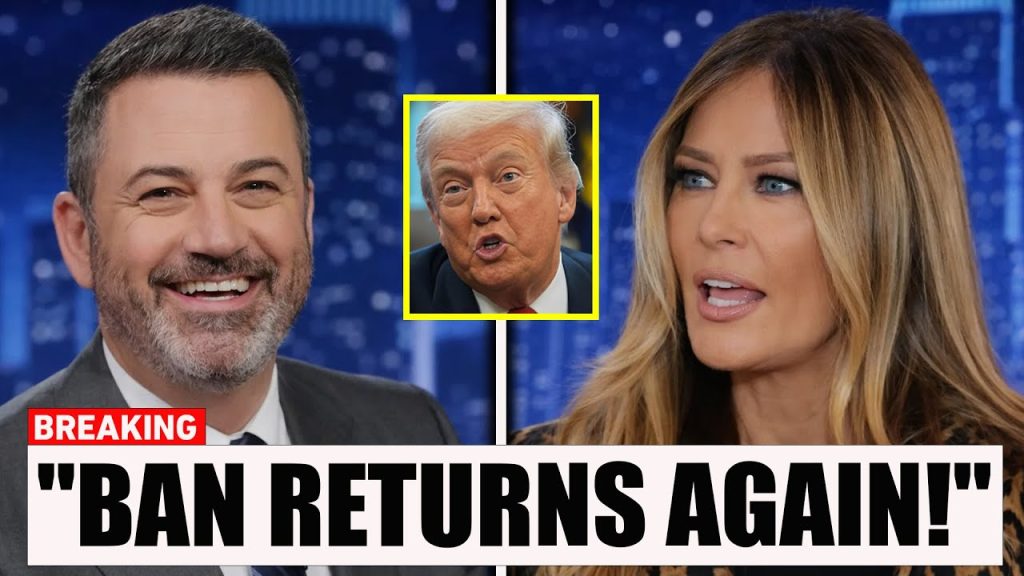
The segment did not arrive with fanfare. There was no accusation, no raised voice, no overt condemnation. Instead, Kimmel did what seasoned satirists do best: he observed. He let clips roll. He allowed pauses to linger. He trusted the audience to notice what has long been hiding in plain sight—the peculiar stillness of Melania Trump’s public presence and the way it contrasts with the chaos that surrounds her husband.
That contrast was the joke.
For years, Melania Trump has occupied a singular place in American political culture. She is omnipresent yet opaque, impeccably styled yet emotionally distant, a figure of ceremonial precision who rarely reveals interior life. Kimmel’s monologue did not ridicule her appearance or question her intelligence. It framed her as a symbol—of elegance, detachment, and a kind of disciplined silence that defies the expectations placed on public figures, especially first ladies.
The laughter came not from cruelty, but from recognition.
Kimmel lingered on her immobility at public events, her unreadable expressions during long speeches, her ability to remain untouched by scandal without visibly defending herself. He treated this not as a failing, but as an anomaly worthy of examination. In a political ecosystem addicted to outrage, Melania’s refusal to perform emotion reads almost as a rebuke.
The sharper edge of the segment, however, emerged only afterward—when Trump reacted.
Within hours, Trump unleashed a familiar barrage: insults about ratings, attacks on Kimmel’s talent, accusations of disrespect. It was, in form and substance, a replay of countless past responses. Yet this time, the imbalance was impossible to miss. Kimmel had already moved on. Melania had not responded at all. Only Trump was shouting into the void.
That asymmetry became the story.
In modern politics, reaction often matters more than action. The initial joke did not “expose” Melania in any conventional sense. It exposed something else: the fragility of narrative control. Trump’s brand has always relied on volume—on the belief that the loudest voice defines reality. But when confronted with satire that refuses to escalate, that strategy collapses under its own weight.

Silence, it turns out, is difficult to fight.
Kimmel’s restraint was not accidental. By refusing to overplay his hand, he denied Trump the confrontation he thrives on. There was no villain to battle, no insult to avenge. The humor worked precisely because it did not demand a response. Trump supplied one anyway, transforming a late-night aside into a national talking point.
The irony is stark. Melania Trump’s defining public trait—her composure, her distance, her refusal to engage—has functioned as a kind of armor. She survives news cycles by offering nothing for them to grip. Trump, by contrast, survives by feeding them continuously. In this episode, the armor held. The noise backfired.
This dynamic touches on a deeper cultural tension. American politics increasingly rewards emotional display: anger, grievance, vulnerability, performative sincerity. Melania Trump violates that norm. She appears transactional rather than expressive, present without seeming invested. Kimmel’s segment did not condemn this posture. It asked, implicitly, whether detachment might itself be a form of power.
Trump’s reaction suggested he does not believe so.
For him, any commentary—no matter how mild—registers as an attack. His inability to let the joke pass transformed a subtle observation into a referendum on control. In trying to reassert dominance, he only amplified the very contrast the segment had highlighted: one figure absorbing attention without reacting, the other unable to tolerate even the suggestion of scrutiny.
The audience understood this intuitively. The laughter that followed Kimmel’s monologue was not explosive; it was knowing. It carried the recognition that sometimes the most revealing moments in public life are the quietest ones, and that overreaction is itself a confession.
Late-night comedy does not convict or acquit. It reframes. In this case, the frame was devastatingly simple. One person did nothing—and looked stronger for it. Another did everything—and looked weaker with each word.
Trump’s eruption did not undermine the joke. It completed it.
In a media environment saturated with outrage, the segment offered an alternative lesson: power does not always announce itself. Sometimes it stands still, says nothing, and lets others unravel around it.







