By XAMXAM
Comedy has always had a complicated relationship with power. At its best, it punctures pretension; at its worst, it merely flatters the crowd. In recent days, that tension resurfaced sharply when Ricky Gervais turned his attention once again to Donald Trump, triggering a familiar cycle of ridicule, reaction, and escalation that now feels almost ritualized.
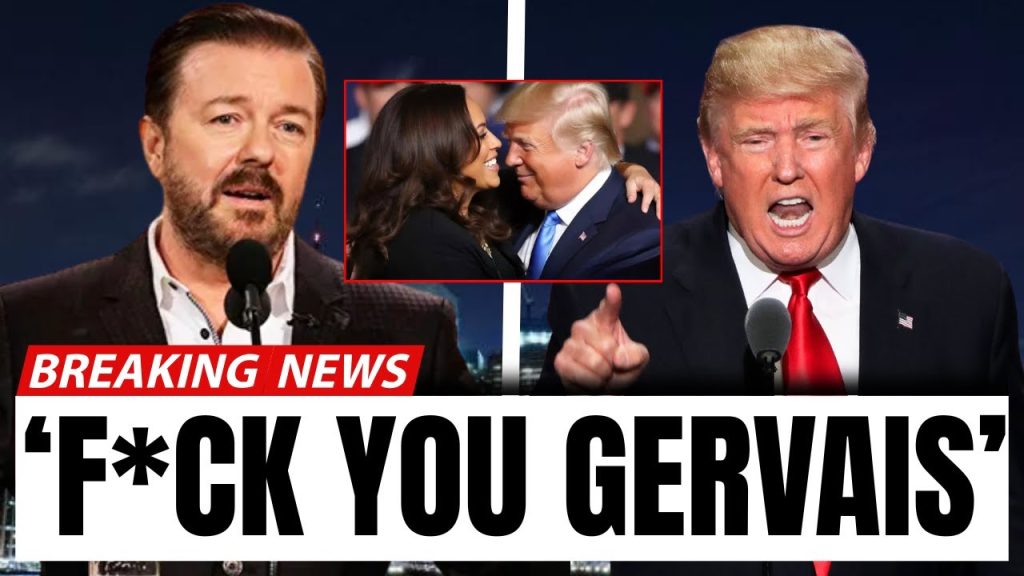
The moment itself was not unprecedented. Gervais has made a career out of ignoring the social contract that asks comedians to soften their blows when powerful people are involved. He is known for lingering on a joke long after politeness would suggest moving on, for returning to the same target until discomfort replaces laughter. This time, his target was Trump’s self-image: the mythology of toughness, wealth, and dominance that Trump has spent decades cultivating.
Gervais did not focus on policy or ideology. Instead, he did what he often does—reduce a public persona to its most brittle components. Trump, in Gervais’s telling, emerged not as a fearsome strongman but as a figure defined by exaggeration and contradiction: bravado paired with hypersensitivity, claims of fearlessness shadowed by visible insecurity. The audience recognized the outline immediately. The laughter came not from surprise, but from recognition.
That recognition is what makes such moments dangerous for Trump. His political style relies on control of the narrative environment. Rallies are choreographed. Interviews are often combative but predictable. Social media posts, though impulsive, still place him at the center of attention. Comedy, particularly Gervais’s brand, disrupts that control. It does not argue with Trump’s claims; it reframes them as material.
The response followed a well-worn script. Trump lashed out publicly, dismissing Gervais as irrelevant, untalented, and unsuccessful—charges he has leveled at critics from across the cultural spectrum. The irony, of course, is that such responses only amplify the original insult. In comedy, indignation is oxygen. The louder the objection, the clearer the wound.
What distinguishes this episode from countless others is not the insult itself but the asymmetry of the exchange. Gervais has little to lose. He does not seek political power in the United States, does not depend on American voters, and has built his reputation precisely on refusing to accommodate the sensitivities of elites. Trump, by contrast, is deeply invested in being perceived as dominant. Laughter at his expense undermines that investment in a way that criticism rarely does.
This is why comedians have proven so effective at provoking Trump over the years. Figures like Stephen Colbert, Jimmy Kimmel, and John Oliver have repeatedly drawn reactions that appear disproportionate to the original jokes. Gervais operates in the same ecosystem but with fewer constraints. He does not pretend to balance satire with civility. He is uninterested in bipartisan approval. That indifference sharpens the blade.
The substance of Gervais’s remarks mattered less than their tone. He did not shout. He did not moralize. He described Trump in a way that made his own reactions seem childish by comparison. In doing so, he shifted the frame. Trump was no longer the aggressor in a culture war but the object of observation, a character being examined rather than feared.
Trump’s subsequent behavior reinforced the portrait. Multiple posts, escalating language, and repeated references to the comedian suggested preoccupation rather than confidence. Each denial became evidence of fixation. Each insult invited further mockery. The cycle fed itself.

From a distance, the episode offers a lesson about modern power and performance. Authority today is sustained not only by institutions but by image. When that image depends on constant affirmation, mockery becomes destabilizing. Comedy, especially when delivered without apology, exposes how fragile certain performances can be.
It also highlights the peculiar vulnerability of leaders who cannot laugh at themselves. Self-deprecation is a form of insulation; it absorbs criticism before it can wound. Trump has never practiced it. Every joke, therefore, lands as an attack. Every laugh sounds like a threat.
Gervais understands this instinctively. His comedy often revolves around forcing audiences—and targets—to sit with discomfort. He does not offer release through reconciliation or moral clarity. He leaves the tension unresolved. In this case, that unresolved tension migrated online, where Trump’s reactions extended the lifespan of the joke far beyond the original performance.
The broader cultural response followed predictably. Clips circulated. Memes multiplied. Other comedians joined in, less to add new insights than to marvel at the predictability of Trump’s reaction. What could have been a fleeting exchange hardened into a narrative: comedian strikes, former president erupts, internet laughs.
There is a temptation to see this as trivial, another skirmish in the endless churn of outrage and entertainment. But it reveals something durable. Trump’s authority, such as it is, depends on never appearing ridiculous. Comedy threatens that by its very nature. It strips away the solemnity that power requires and replaces it with play.
In the end, Gervais did not “win” an argument. He did not need to. He demonstrated that Trump’s greatest weakness remains unchanged: the inability to ignore an insult. As long as that remains true, comedians will continue to find him irresistible, not because they oppose him politically, but because he reacts exactly as comedy demands.
Power resists critique. It rarely survives mockery.