When Brilliance Becomes a Performance
Donald Trump has long cultivated a singular idea about himself: that he is not merely successful or confident, but innately smarter than everyone else. Intelligence, in this narrative, is not demonstrated so much as declared. It is why he sprinkles the word “genius” into speeches like a title, and why education is treated as a punchline unless it flatters him. In recent days, that fixation collided with late-night television in a way that revealed less about test scores than about the fragility of a public myth.
The episode began as these moments often do, with a post. Trump mocked critics as “low IQ,” praised his own brain and dared anyone to test him. The language was loud and absolute, calibrated to dominate the timeline rather than invite discussion. And because it was Trump, the internet did what it always does: it turned the boast into a dare.
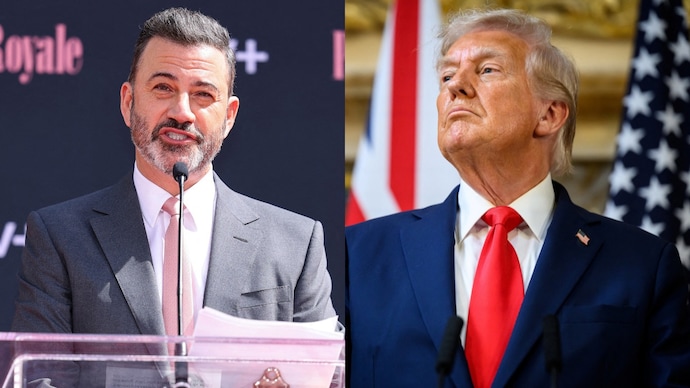
On Jimmy Kimmel Live, Kimmel responded with restraint. He appeared holding a thin envelope and an uncharacteristically sober tone. There was no grin, no tease. He framed the subject narrowly—not Trump’s intelligence, but Trump’s obsession with proving it. “Truly smart people don’t demand trophies for thinking,” Kimmel said. “They show their work. They answer questions.” The line drew nervous laughter, then quiet.
What followed was presented not as exposé but as mirror. Kimmel spoke about records Trump has long alluded to but rarely shared, emphasizing limits and context. Numbers, he reminded viewers, do not define a life. They do, however, puncture performances built on constant self-assertion. When he described a score as ordinary—“not disastrous, not genius”—the room erupted. The laughter was not cruel; it was recognitional. The sentence did not attack Trump’s mind. It challenged the act.
That distinction mattered. The segment’s power lay in what it refused to do. It did not claim secret knowledge or diagnose. It traced a pattern: a leader who demands transparency from others—birth certificates, grades, medical reports—while treating his own history as proprietary. “Transparency isn’t something you demand only from others,” Kimmel said. “It’s something you model when you’re asking for power.”
Trump’s response followed a familiar rhythm. He attacked the messenger, called the show rigged, insisted he never watches—and then posted again, confirming that he did. The contradiction became the story: a man insisting something doesn’t matter while behaving as if it matters above all else. Noise replaced answer; volume replaced explanation.
By morning, the clip had traveled well beyond comedy. Commentators argued—correctly—that scores are blunt instruments and poor proxies for leadership. But that wasn’t what made the moment stick. It was the calm clarity of the question beneath the joke: if confidence is real, why must it be announced so often? Why do ordinary questions feel like censorship? Why does a self-styled champion of free speech respond to scrutiny with attacks on speech itself?
This dynamic is not new. Trump has long equated strength with volume and certainty with repetition. Critics are dismissed as weak; inquiries reframed as hostility. The tactic can command a room. It falters when the room stops rewarding noise. In that sense, the late-night exchange functioned less as satire than as a lesson in media literacy. It asked viewers to distinguish between answering and performing, between evidence and assertion.
The aftermath underscored the point. Kimmel did not escalate. He did not trend-chase. He let the outrage burn itself out. That restraint altered the temperature. Without a counter-volley, the insult had nowhere to land. Attention drifted back to the unanswered questions.
What lingered was not an envelope or a number, but a pattern familiar far beyond politics. In offices and classrooms alike, the loudest voice is often mistaken for the most informed. Confidence substitutes for competence until someone quietly asks to see the work. When that happens, bravado collapses under the weight of the ordinary.
Trump’s fixation on intelligence is revealing precisely because it is so insistent. Leaders secure in their judgment rarely need to announce it. They demonstrate it in decisions, in patience, in the ability to stay on topic and accept accountability without turning every challenge into a feud. The insistence on being called a genius, repeated week after week, reads less like strength than anxiety.
Late-night television did not settle a debate about intelligence. It reframed one about power. What is America supposed to do with an IQ boast? Are families safer? Are bills cheaper? Are schools better because a powerful man demanded applause for his brain? Those questions drew no answers—only noise. And that, perhaps, was the most telling response.
Power does not collapse when it is mocked. It collapses when it is calmly examined—when claims are replayed, when answers are expected, when confidence is asked to show its work. The most destabilizing force in such moments is not ridicule, but attention that refuses to be steered.