By XAMXAM
When Donald Trump decided that Stephen Colbert was an enemy worth destroying, the confrontation followed a familiar Trumpian script. Public insults. Demands for termination. Celebration of regulatory scrutiny. The full weight of presidential outrage was aimed at a late-night comedian whose greatest crime was refusing to soften his satire.
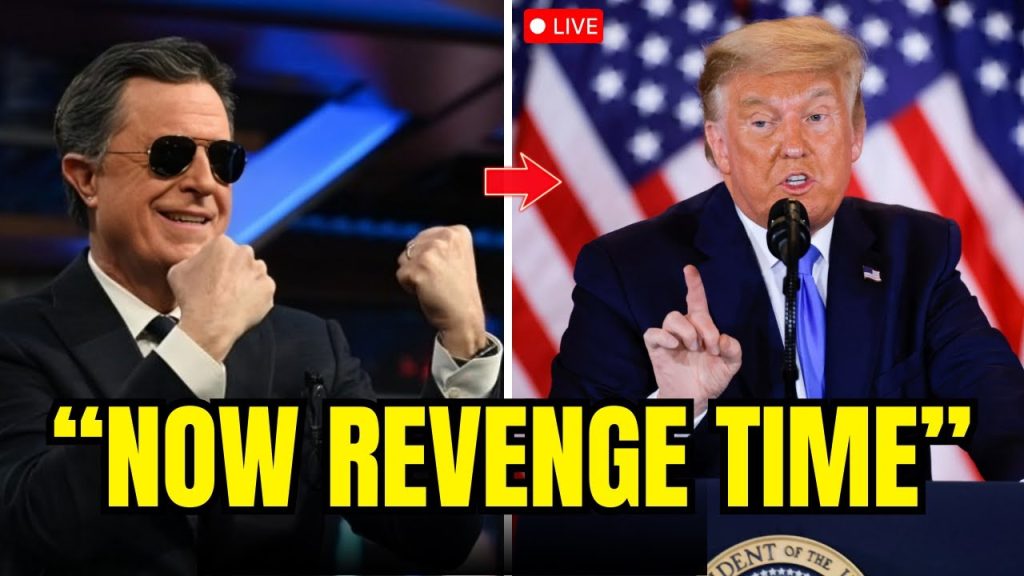
Trump did not want a debate. He wanted disappearance.
Colbert, at the time, was not an obvious victor waiting in the wings. The Late Show was respected but not dominant. Jimmy Fallon still controlled the late-night ratings conversation, and industry observers often framed Colbert as struggling to fully claim David Letterman’s old throne. In that context, Trump’s attacks carried real risk. Advertisers grew skittish. Supporters mobilized boycotts. When federal regulators began examining Colbert’s language in 2017, Trump publicly celebrated, signaling that pressure would continue.
Most performers, confronted with that level of attention from the presidency, would have adjusted course. They might have toned things down, pivoted toward safer material, or waited quietly for the storm to pass. Colbert chose a different path entirely.
He turned the attack into content.
Trump’s insults were not ignored or rebutted. They were displayed, quoted, and repurposed. Colbert read them aloud. He printed them on props. He drank from a coffee mug emblazoned with Trump’s words and declared that it “tasted like freedom of speech.” Night after night, Trump’s rage became a recurring segment rather than a threat. The audience quickly grasped what was happening: the power dynamic had inverted.
This was not defiance built on anger. It was defiance built on fluency in attention.
Trump’s central miscalculation lay in assuming that intimidation functions the same way in entertainment as it does in politics. In politics, dominating the narrative can neutralize critics. In comedy, dominance is meaningless without audience engagement. Attention—especially hostile attention—is currency. Trump provided it in bulk.
As the attacks escalated, so did Colbert’s reach. Ratings began to climb. Viewers who had never watched The Late Show tuned in to see how the comedian would respond to the president’s latest outburst. By September 2017, Colbert overtook Fallon to become the most-watched host in late-night television. The shift was not temporary. It held.
Awards followed. Emmy nominations accumulated. Colbert’s cultural relevance expanded beyond the confines of late night into broader political discourse. Trump’s efforts to silence him had achieved the opposite result: they made him unavoidable.
The genius of Colbert’s response was not simply that it was funny. It was that it stripped Trump of his preferred battleground. Trump thrives on escalation. He relies on opponents responding with outrage or submission. Colbert offered neither. Instead, he offered repetition and irony. Each new insult sounded less shocking than the last. Predictability replaced menace. Once that happened, the intimidation lost its force.

Colbert even acknowledged the dynamic openly. Looking into the camera, he thanked the president for watching and announced he was “honored to live rent-free” in Trump’s head. The line landed not because it was cruel, but because it was accurate. Trump could not stop responding. And every response fed the machine.
Media analysts eventually said the quiet part out loud. Trump had become Colbert’s most effective promoter. Every tweet functioned as free advertising. Every insult generated headlines worth millions in exposure. Conservative commentators who disliked Colbert’s politics nonetheless admitted the strategy worked. Attention had been converted into dominance with ruthless efficiency.
What made the episode linger long after Trump left office was its clarity. Trump believed hierarchy would win the day: president above comedian. Colbert understood systems: audiences, incentives, repetition. In an attention economy, authority does not guarantee control. Understanding the medium does.
When Trump’s presidency ended, the asymmetry became unmistakable. Trump’s megaphone diminished. Colbert’s platform did not. The Late Show continued. The audience stayed. The satirical machinery remained intact.
This was not revenge in the cinematic sense. There was no single climactic moment, no dramatic takedown speech. It was revenge as process. Trump attacked. Colbert absorbed. Trump escalated. Colbert monetized. Over time, the outcome hardened into fact.
Trump did not destroy Colbert. He built him.
The lesson extends beyond late-night television. Power that fails to understand how attention operates will often end up strengthening the very voices it seeks to silence. Trump believed ridicule would weaken his critic. Instead, it trained him, sharpened him, and expanded his reach.
Colbert did not defeat Trump by matching his aggression. He defeated him by refusing to play the same game. Comedy, deployed consistently and without fear, did what outrage never could: it made dominance look ordinary and authority look fragile.
That is the kind of revenge that does not announce itself. It simply endures.