By XAMXAM
Late-night television has long served as a pressure valve for American politics, a place where satire translates frustration into laughter. On a recent night, however, that role expanded. A coordinated crossover between Jimmy Kimmel and Stephen Colbert did more than entertain. It reframed a growing confrontation between political power and media scrutiny — and provoked an unusually public reaction from Donald Trump.
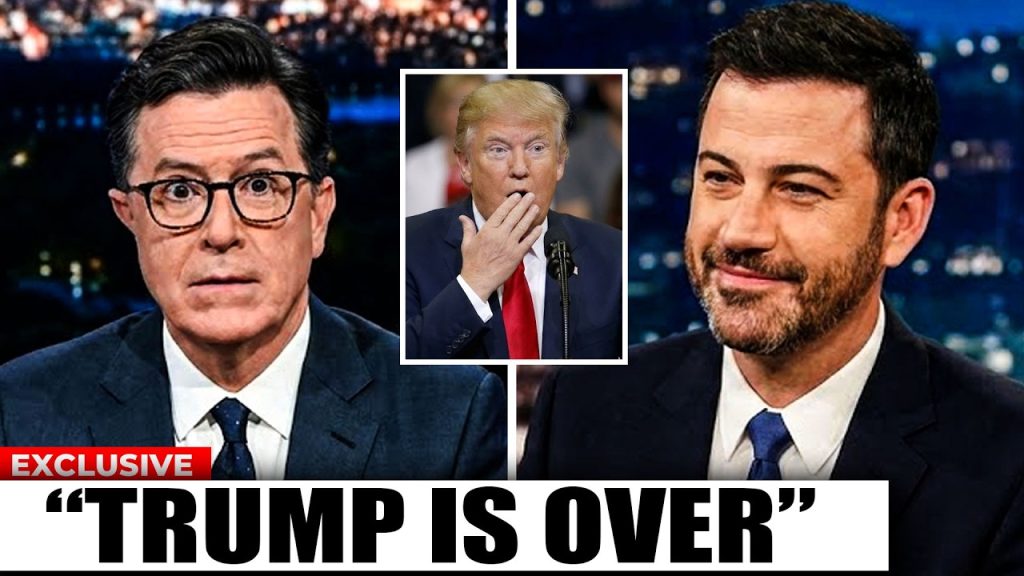
The exchange unfolded across two studios, miles apart but carefully synchronized. Kimmel appeared on Colbert’s show in New York; Colbert returned the favor from Los Angeles. The stunt was unprecedented in the modern late-night landscape, a genre that typically thrives on rivalry and network silos rather than collaboration. The target of the collaboration, however, was clear.
Both hosts revisited Trump’s public record — his confrontations with journalists, his lawsuits against media companies, and his repeated attempts to discredit critics as dishonest or malicious. The humor was sharp, but the structure was deliberate. Rather than rely on a single punchline, the segments stacked examples, creating a cumulative effect that emphasized pattern over insult.
For Trump, who has long treated media attention as both adversary and fuel, the moment struck a nerve. In recent weeks, he had already been engaged in legal disputes with major networks and openly celebrated the cancellation or suspension of programs critical of him. The crossover, broadcast live and amplified almost instantly online, shifted that dynamic. It was no longer a single host responding to a single grievance, but a coordinated display of solidarity.
The immediate aftermath was telling. Trump lashed out publicly, condemning the hosts, questioning their relevance, and renewing calls for networks to rein them in. He framed the segments as evidence of bias and conspiracy, echoing familiar themes from his years in office and on the campaign trail. Yet the intensity of the response suggested something more than routine indignation.
Late-night television occupies an unusual space in American culture. It is not journalism in the traditional sense, but it often performs a journalistic function, replaying clips, contextualizing statements, and highlighting inconsistencies. For audiences fatigued by formal political coverage, it can serve as an accessible entry point into complex debates. That reach has made it a recurring target for politicians who view ridicule as a threat to authority.
The Kimmel–Colbert crossover leaned into that tension. Rather than mock Trump’s personality alone, the hosts focused on behavior: his treatment of reporters, his reaction to lawsuits and settlements, and his apparent desire to punish institutions that challenge him. The laughter in the studio was real, but so was the unease beneath it. The segments implicitly asked whether criticism itself was becoming a liability in a political climate increasingly hostile to dissent.
Media analysts noted that Trump’s anger may have stemmed less from the jokes themselves than from what they represented. By appearing together, Kimmel and Colbert signaled that individual hosts could be replaced, but the broader culture of scrutiny would persist. Attempts to silence one voice might only amplify others.

Network executives, for their part, have insisted that programming decisions remain driven by financial and strategic considerations, not political pressure. Still, the timing of recent cancellations and suspensions has fueled skepticism. When Trump publicly praises those outcomes, critics argue, it blurs the line between coincidence and influence.
The reaction among viewers was swift. Clips circulated widely on social media, often stripped of context but heavy with implication. Supporters of the hosts framed the moment as a defense of free expression, a reminder that humor has historically played a role in challenging power. Trump’s supporters dismissed it as coordinated elitism, proof that entertainment and politics have merged in ways that alienate large segments of the country.
That divide reflects a deeper question about the role of satire in a polarized era. Can comedy still function as a shared language when audiences no longer agree on basic facts? Or has it become another front in an ongoing cultural struggle, reinforcing divisions rather than bridging them?
What made this episode distinct was not the sharpness of the jokes, but the visible stakes. Trump has demonstrated a willingness to weaponize regulatory bodies, lawsuits, and public pressure against perceived enemies. In that context, a late-night monologue is no longer just a punchline; it is a test of how much dissent a system will tolerate.
The crossover ended without a definitive resolution. There was no final blow, no dramatic concession. Instead, it left behind an image: two comedians, standing in separate studios, using humor to draw attention to a pattern they argue is dangerous. Trump’s reaction, immediate and furious, became part of the story itself.
In a media environment saturated with outrage, the episode stood out precisely because it was coordinated and controlled. It suggested that satire, when deployed collectively, can still unsettle even the most media-savvy political figures. Whether that unease translates into accountability remains uncertain.
What is clear is that the boundaries between entertainment, journalism, and politics continue to blur. Late-night television is no longer merely reflecting the news; it is shaping how audiences interpret power, credibility, and resistance. And as long as that remains true, moments like this will continue to provoke reactions far beyond the studio lights.







