As pressure mounts in Washington to release the full Jeffrey Epstein files, one question is growing louder by the day: Why won’t Donald Trump raise his hand and testify under oath?
The answer may lie in a long, uncomfortable, and increasingly well-documented history — one that Trump himself has acknowledged, denied, contradicted, and avoided for years.
The connection between Donald Trump and Jeffrey Epstein is not speculation. It is not new. And it is not confined to rumor.
Trump’s Own Words on Epstein
Donald Trump has publicly admitted that he knew Jeffrey Epstein for more than 15 years. In a now-infamous quote, Trump once said Epstein “liked beautiful women as much as I do,” adding that “many of them are on the younger side.”
At the time, the comment raised eyebrows. In hindsight, it reads as a warning sign.
Trump later attempted to distance himself from Epstein, claiming they were not close and denying certain forms of contact. But court records and sworn testimony have complicated that narrative.
Flight Records and Contradictions
During the 2021 trial of Ghislaine Maxwell, evidence emerged showing that Trump had flown on Epstein’s private jet seven times, contradicting his earlier denials.
Flight logs are not opinions. They are records.
While Trump has insisted that he never traveled on Epstein’s plane, the documented evidence presented under oath tells a different story — one that undermines his credibility and raises questions about what else he may be concealing.
The Katie Johnson Allegations
Perhaps the most disturbing chapter involves a lawsuit filed by a woman using the pseudonym Katie Johnson, who alleged that she was raped by Donald Trump at an Epstein residence when she was 13 years old.
The case was ultimately withdrawn amid reported threats and intimidation, but the allegations remain part of the public record. Trump has denied the claims. No criminal conviction followed.
Still, the existence of the lawsuit — combined with Epstein’s proven pattern of trafficking underage girls — continues to fuel scrutiny.
Clintons Agree to Testify — In Public
This week, the political stakes escalated.
Former Secretary of State Hillary Clinton publicly stated that she and former President Bill Clinton are willing to testify before Congress about the Epstein files — in a fully public hearing.
Her message to House Oversight Chairman James Comer was blunt:
“Let’s stop the games. You talk about transparency. There is nothing more transparent than a public hearing. Cameras on. We will be there.”
The subtext was unmistakable: If others are willing to testify under oath in public, why isn’t Donald Trump?
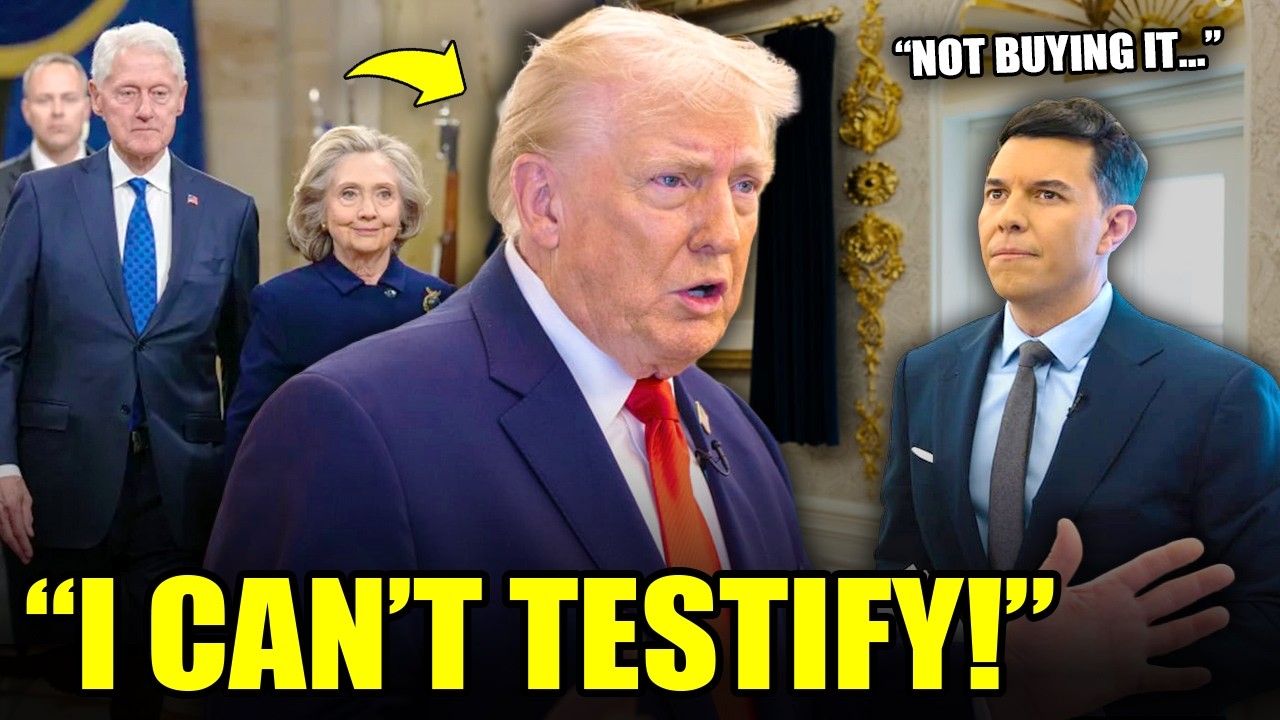
Why Trump Avoids Oath-Bound Testimony
Trump’s history under oath offers clues.
In the deposition related to writer E. Jean Carroll, whom a jury later found Trump liable for sexually abusing, Trump infamously defended himself by saying Carroll was “not my type.”
The statement stunned observers — not only for its cruelty, but for its logic. Trump has used the same defense repeatedly when accused of inappropriate conduct, including allegations involving women on airplanes.
Under oath, Trump also repeatedly invoked his Fifth Amendment rights in civil and criminal matters — a sharp contrast to his past attacks on others for doing the same.
A Pattern, Not an Isolated Incident
Trump has been accused by more than two dozen women of sexual misconduct over several decades. These accusations span from groping to assault and include claims from women with no connection to one another.
In contrast, while Bill Clinton’s personal history is deeply flawed — including the Monica Lewinsky scandal and Paula Jones lawsuit — Clinton was never found civilly liable for rape, nor accused by dozens of women across generations.
That distinction matters in legal and historical terms.
Epstein Files and the Fight Over Transparency
Democrats have now stated publicly that if Bill Clinton is compelled to testify, Donald Trump must also be called.
Even some Republicans have broken ranks. Representative Marjorie Taylor Greene, in a rare moment of alignment with Democrats, has openly demanded the full release of the Epstein files, asking:
“If President Trump is not implicated, what exactly is being protected here?”
Her question echoes what many Americans are now asking.
Why the Files Matter

The Epstein case is not about partisan politics. It is about power, abuse, and accountability.
Epstein was convicted of sex trafficking minors. His network included billionaires, politicians, royalty, and celebrities. Victims have repeatedly stated that powerful men were protected — while they were silenced.
If Donald Trump has nothing to hide, public testimony would offer clarity. Instead, his refusal fuels suspicion.
The Fifth Amendment Irony
Trump has spent years attacking constitutional protections when they inconvenience him — criticizing the First, Fourth, and Fourteenth Amendments.
Yet when scrutiny turns personal, he embraces the Fifth Amendment with remarkable enthusiasm.
That contradiction has not gone unnoticed.
The Bigger Picture
This moment is about more than Epstein.
It is about whether a former president — and potential future one — is willing to submit to the same legal and moral standards as everyone else.
Refusing to testify does not prove guilt. But avoiding transparency in the face of overwhelming public interest raises serious questions.
As the Epstein files continue to surface and congressional pressure builds, one truth becomes harder to ignore:
Silence is not innocence — especially when the record already speaks.






