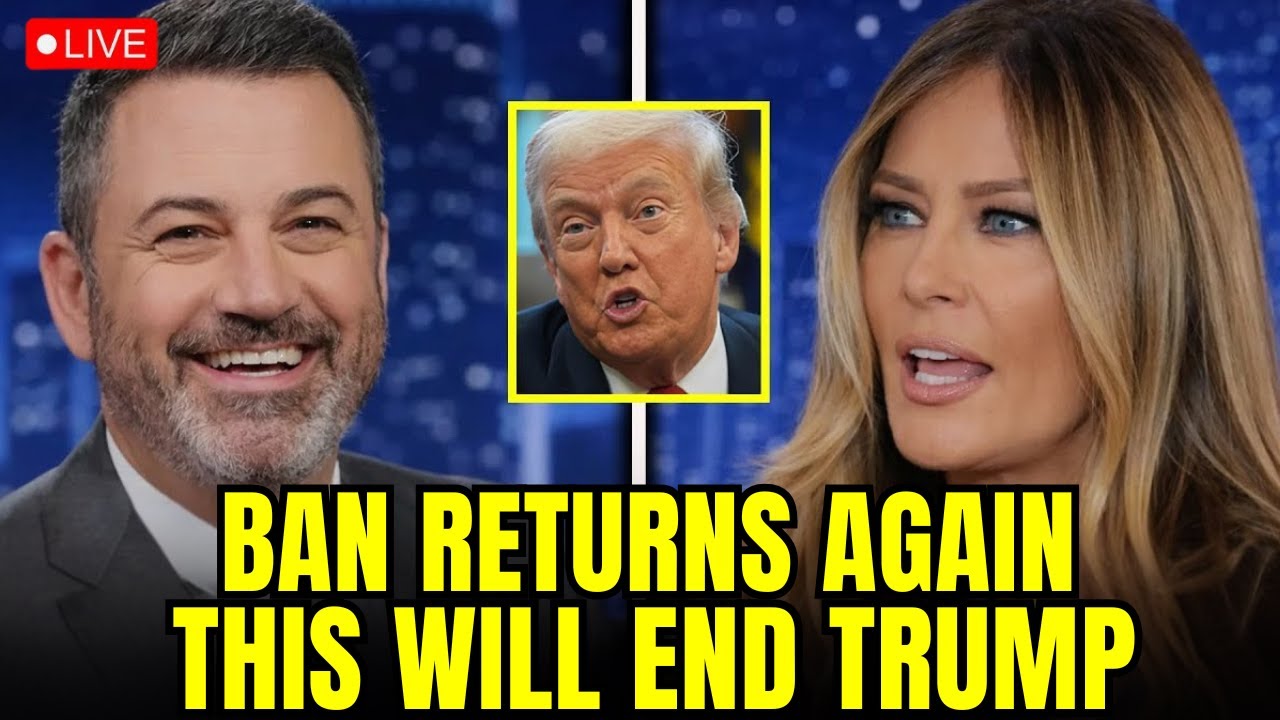
A Frame, a Pause, and a Reaction: How a Jimmy Kimmel Segment Sparked a Trump Backlash
Late-night television has long functioned as a pressure valve for American politics, translating the day’s anxieties into humor before the morning news cycle begins again. But occasionally, a segment does more than entertain. It reframes. And when that happens, the reaction can be louder than the joke itself.
That appeared to be the case following a recent episode of Jimmy Kimmel Live, in which Jimmy Kimmel focused briefly on a public appearance by Donald Trump and Melania Trump—and then moved on. The moment lasted only minutes. The response, however, did not.
The segment began unremarkably. Kimmel, flipping through his cards, introduced what he described as a “small detail” from footage surrounding Melania Trump’s recent documentary promotion. He emphasized that the clip did not reveal anything private or hidden, only something visible but easily overlooked without replay.
What followed was not framed as a punchline, but as observation.
The footage showed Donald and Melania Trump walking toward cameras at a formal event, smiling as expected. Kimmel paused the video at a single second, zooming in slightly—not to expose scandal, but to slow the moment down. A half-step of distance. A glance that did not quite connect. A hand that nearly touched, then didn’t.
Crucially, Kimmel did not explain what it “meant.” Instead, he asked what it looked like. The studio audience responded not with immediate laughter, but with recognition—the kind that arrives when something familiar is finally named.
He replayed the clip again, this time without commentary. The silence did the work.
When Kimmel resumed speaking, he made a point of narrowing the target. “This isn’t about Melania,” he said, according to the broadcast. “She isn’t running for anything.” He added that public figures do not owe audiences a performance of intimacy. The focus, he suggested, was elsewhere: on Donald Trump’s habit of presenting every aspect of his life as branding, every relationship as proof of success.
“If your life is as perfect as your slogans,” Kimmel said, delivering the line that would later dominate headlines, “you shouldn’t need to edit the footage.”
The audience laughed, then applauded—not sharply, but steadily. Media analysts later noted that the line functioned less as an insult than as a rule, one that applied broadly to political image-making.
Kimmel followed with a question rather than a conclusion. What, he asked, is the public meant to do with carefully staged images? Do they improve policy outcomes? Do they make lives safer or more affordable? The question shifted the segment away from gossip and toward accountability. Then, just as quickly, Kimmel moved on.
By morning, clips of the segment were circulating widely. Some viewers shared it as comedy. Others framed it as commentary on political performance. Many focused not on the joke itself, but on what happened next.
Donald Trump responded forcefully on social media, attacking Kimmel personally, questioning the legitimacy of the audience, and insisting the moment was meaningless. The posts came in quick succession. He claimed not to watch the show, then returned to it repeatedly. To critics, that contradiction became part of the story.
“If it didn’t matter,” one media columnist observed, “why respond at all?”

Notably, Melania Trump made no public comment. Her silence was interpreted in different ways by different audiences, but its effect was unmistakable. In a media ecosystem driven by reaction, non-response can amplify attention rather than diminish it.
The episode underscored a recurring dynamic in modern politics: control of the camera is power—until it isn’t. Trump has built a career on dominating visual narratives, on projecting certainty through repetition and force. In this case, however, the disruption did not come from confrontation, but from stillness. A paused frame. A replay. A refusal to overexplain.
Kimmel did not accuse. He did not speculate. He did not linger. The exposure, such as it was, came from allowing viewers to see something slowly in a culture that rarely pauses.
The intensity of Trump’s response suggested, to many observers, that the discomfort lay not in the content of the clip but in the loss of control over its interpretation. When branding depends on constant motion, a freeze-frame can feel destabilizing
Late-night television often blurs the line between satire and journalism. This segment stayed carefully on one side of it. It made no claims about private relationships. It offered no hidden information. It asked a public question about public presentation—and then stepped aside.
In the end, the moment’s impact had less to do with Melania Trump than with the reaction it provoked. The joke did not shout. The response did.
And in an age when political power is exercised as much through image as through policy, that contrast may explain why a brief pause on late-night television echoed so loudly the next day.






