By XAMXAM
In American political culture, there is a long tradition of presidents being teased. The jokes are usually affectionate, sometimes sharp, and almost always fleeting. What separates Donald Trump from his predecessors is not that he has been mocked, but that he has never learned how to absorb it.
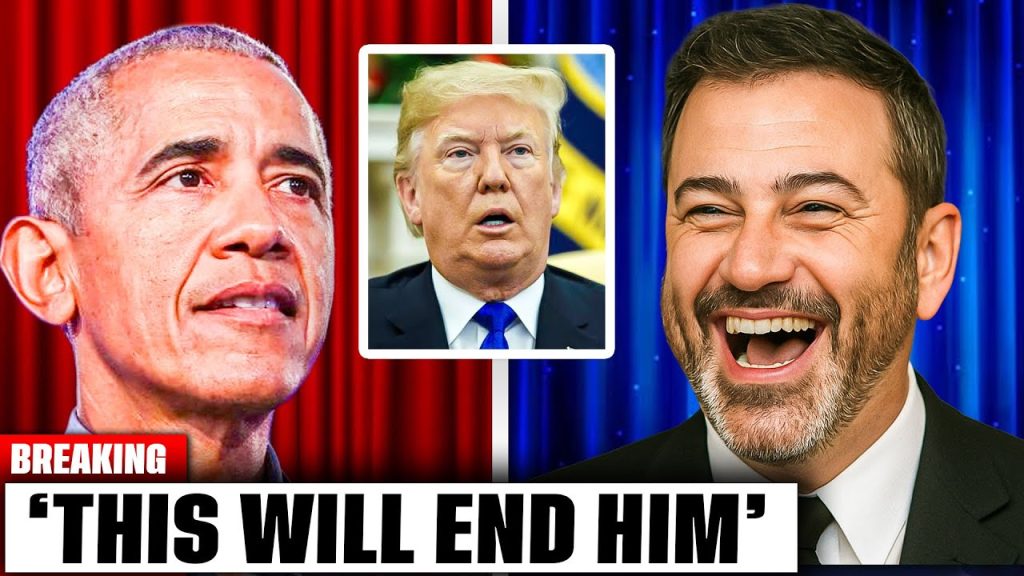
That contrast was on vivid display once again as clips of Jimmy Kimmel and Barack Obama — separated by years, stages, and styles — circulated side by side across television and social media. The effect was less a coordinated attack than a historical rhyme: two public figures using humor to expose the same vulnerability, and one former president reacting as though humor itself were a hostile act.
On late-night television and award-show stages, Jimmy Kimmel has perfected a form of crowd-aware satire. He reads the room, reads the moment, and increasingly, reads Donald Trump’s own words back to him. When Kimmel quoted a Trump social media post during the 2024 Academy Awards, the joke worked not because it was cruel, but because it was literal. The audience laughed at the familiarity of the language, then laughed again when Kimmel allowed a single pause to do the work Trump’s all-caps style usually demands.
Obama’s approach, by contrast, has always been quieter. When Barack Obama addressed Trump during the White House Correspondents’ Dinners of 2011 and 2016, he did not raise his voice. He did not exaggerate. He treated Trump’s claims — particularly the “birther” conspiracy — as curiosities best neutralized by calmly placing them under fluorescent light. The audience response built slowly, the way recognition builds, until laughter arrived almost as relief.
Placed together, the Kimmel and Obama moments form a kind of informal case study in power and temperament. Both men relied on the same raw material: Trump’s own statements, his self-mythologizing, his insistence that any attention is good attention as long as it is loud enough. Both trusted the audience to connect the dots. Neither appeared interested in humiliation for its own sake.
And yet the reaction from Donald Trump followed a familiar pattern. Public complaints. Private fury, according to those around him. Renewed calls for punishment — of networks, hosts, institutions — that failed to treat mockery as a punishable offense. The jokes, in Trump’s telling, were not jokes at all. They were acts of aggression.
This is where the story stops being about comedy and starts being about leadership. Modern presidents are not judged only by their policies, but by their capacity to coexist with scrutiny, irony, and dissent. Humor, especially when aimed upward, has long served as a pressure valve in democratic culture. It signals that no figure is above response.

Obama seemed to understand that instinctively. His jokes about Trump in 2011 landed precisely because they were framed as closure: the end of a distraction, the dismissal of a spectacle. In 2016, his final remarks at the Correspondents’ Dinner carried the same tone — not triumph, but finality. The famous “Obama out” was less a punchline than a punctuation mark.
Kimmel’s method reflects a different era, one in which reactions unfold in real time and screens multiply the moment before it has settled. By reading Trump’s words aloud, Kimmel collapses the distance between statement and consequence. The laughter is not just at Trump, but at the mismatch between how Trump sees himself and how his words actually sound when removed from their native platform.
What emerges is a recurring loop. Trump provokes. Comedy responds by quoting him. Trump reacts to the quotation as though it were distortion. The reaction becomes the next act of the joke. Volume replaces wit, and grievance replaces control.
This cycle explains why Trump’s critics often do not need to invent a “meltdown.” Description suffices. The public record fills in the rest. In that sense, the most effective lines delivered by Obama and Kimmel were the ones closest to fact, delivered with the least embellishment.
There is an old political lesson hiding in this exchange: the ability to endure laughter without demanding retribution is not a weakness. It is evidence of confidence. Leaders who possess it tend to outlast the joke. Those who do not risk becoming inseparable from it.
Comedy does not remove power. It reveals how securely someone holds it. In the encounters between Trump, Obama, and Kimmel, the laughs told a clearer story than the shouting ever could.






