Trump Faces Growing Congressional Threats as Impeachment and 25th Amendment Talk Converge

Washington — Less than a year into President Donald Trump’s second term, a development once considered unthinkable inside Washington has begun to move from the margins toward the center of congressional debate: the possibility of his removal from office.
Multiple impeachment resolutions have been formally filed in the House of Representatives. At the same time, sitting members of Congress — including a senior United States senator — have publicly invoked the 25th Amendment, the constitutional mechanism for removing a president deemed unable to carry out the duties of the office. While neither path has yet advanced far enough to pose an immediate threat to Mr. Trump’s presidency, together they reflect a level of institutional alarm not seen since the aftermath of the Jan. 6, 2021, attack on the Capitol.
Behind the scenes, according to several people familiar with the matter, Mr. Trump has responded with an aggressive campaign to shore up Republican loyalty, personally calling senators, warning of primary challenges, and pressing party leaders to keep impeachment efforts bottled up. Publicly, he has dismissed the developments as political theater. Privately, aides acknowledge that the president is increasingly focused on Senate math.
“This is not just noise anymore,” said one Republican strategist close to the White House, speaking on the condition of anonymity to discuss internal deliberations. “The president understands that once these ideas enter the congressional bloodstream, they are hard to contain.”
A New Impeachment Landscape
Three impeachment resolutions are currently on the House calendar: H. Res. 353, introduced in April 2025; H. Res. 537, filed in June; and H. Res. 939, introduced in December by Representative Al Green, Democrat of Texas. Each accuses Mr. Trump of high crimes and misdemeanors, citing abuse of executive power, violations of the First Amendment, and the usurpation of Congress’s constitutional authority over war-making.
One resolution points to Mr. Trump’s unilateral authorization of military strikes on Iranian nuclear facilities without prior congressional approval. Another alleges a pattern of retaliatory actions against political opponents and the press. Mr. Green’s most recent resolution uses unusually stark language, warning that Mr. Trump’s conduct constitutes “tyranny” and poses an “existential threat” to the constitutional order.
House Democratic leaders have so far declined to advance the resolutions, wary of forcing a politically divisive vote while Republicans retain a narrow majority. In December, Mr. Green attempted to force a vote on his impeachment measure, but it was tabled with the support of most Republicans and several Democrats.
Even so, the filings themselves are significant. Impeachment resolutions are legal documents, not symbolic protests. They lay out allegations that could form the basis of articles of impeachment should the balance of power in the House shift after the 2026 midterm elections.
“These documents are essentially placeholders,” said Pamela Karlan, a constitutional law professor at Stanford. “They are a signal that the legal groundwork is being laid, even if the political conditions are not yet ripe.”
The 25th Amendment Enters the Conversation

If impeachment represents a familiar constitutional pathway, the renewed discussion of the 25th Amendment is something else entirely.
In January, Senator Edward J. Markey, Democrat of Massachusetts, publicly called for invoking the amendment after Mr. Trump reportedly told foreign leaders that his failure to win a Nobel Peace Prize had freed him to pursue more aggressive territorial ambitions, including renewed interest in acquiring Greenland. Representative Yassamin Ansari, Democrat of Arizona, went further, calling the president “mentally unfit” and urging “immediate 25th Amendment action.”
The amendment allows the vice president and a majority of the cabinet to declare the president unable to discharge the powers of the office, immediately transferring authority to the vice president as acting president. If the president contests the declaration, Congress must vote within 21 days, with a two-thirds majority in both chambers required to keep the president sidelined.
No cabinet secretary or White House official has publicly endorsed such a move, and few lawmakers believe it is imminent. Mr. Trump has filled his cabinet almost entirely with loyalists, many of whom owe their political standing directly to him.
Still, the mere fact that elected officials are openly discussing the amendment marks a shift.
“The 25th Amendment was designed for incapacity, not misconduct,” said Jack Goldsmith, a former Justice Department official. “But history shows that once political actors start invoking it rhetorically, it reflects deep concern about a president’s judgment.”
The Senate as the Ultimate Arbiter
Both impeachment and the 25th Amendment converge on the same institutional chokepoint: the Senate. In either scenario, removal requires a two-thirds vote — 67 senators.
At present, Republicans hold 53 seats, meaning that removal would require the support of at least 20 Republicans, assuming unanimous Democratic backing. That threshold appears high, but it is not without precedent. In Mr. Trump’s second impeachment trial in 2021, seven Republican senators voted to convict him of incitement of insurrection.
What has changed since then, Democrats argue, is the cumulative weight of Mr. Trump’s actions in his second term: his expansive use of executive power, his confrontations with Congress, and his increasingly erratic public statements.
Republican senators, for their part, have largely closed ranks in public. In private, some acknowledge that they are tracking multiple scenarios, including the possibility that Democrats could gain seats in the 2026 elections, lowering the number of Republican defections needed for removal.
“The math matters,” said a Republican senator who requested anonymity. “And everyone in this building can count.”
A President Under Pressure
Mr. Trump has responded to the moment with characteristic defiance. On Truth Social, he has labeled impeachment efforts a “witch hunt” and mocked 25th Amendment discussions as “desperate fantasies.” Yet advisers say his tone has sharpened in recent weeks, reflecting a heightened sensitivity to Republican unity.
According to people familiar with the outreach, the president has personally contacted several senators to reinforce loyalty, reminding them of his influence with primary voters and conservative donors. He has also urged party leaders to frame impeachment talk as an assault on the electorate itself.
For now, those efforts appear to be working. But history suggests that congressional dynamics can shift quickly, particularly in the face of electoral pressure.
“The real question isn’t whether Trump will be removed tomorrow,” said Norm Ornstein, a senior fellow at the American Enterprise Institute. “It’s whether the conditions that make removal conceivable are becoming more normalized. And the answer to that is yes.”
A Precarious Equilibrium
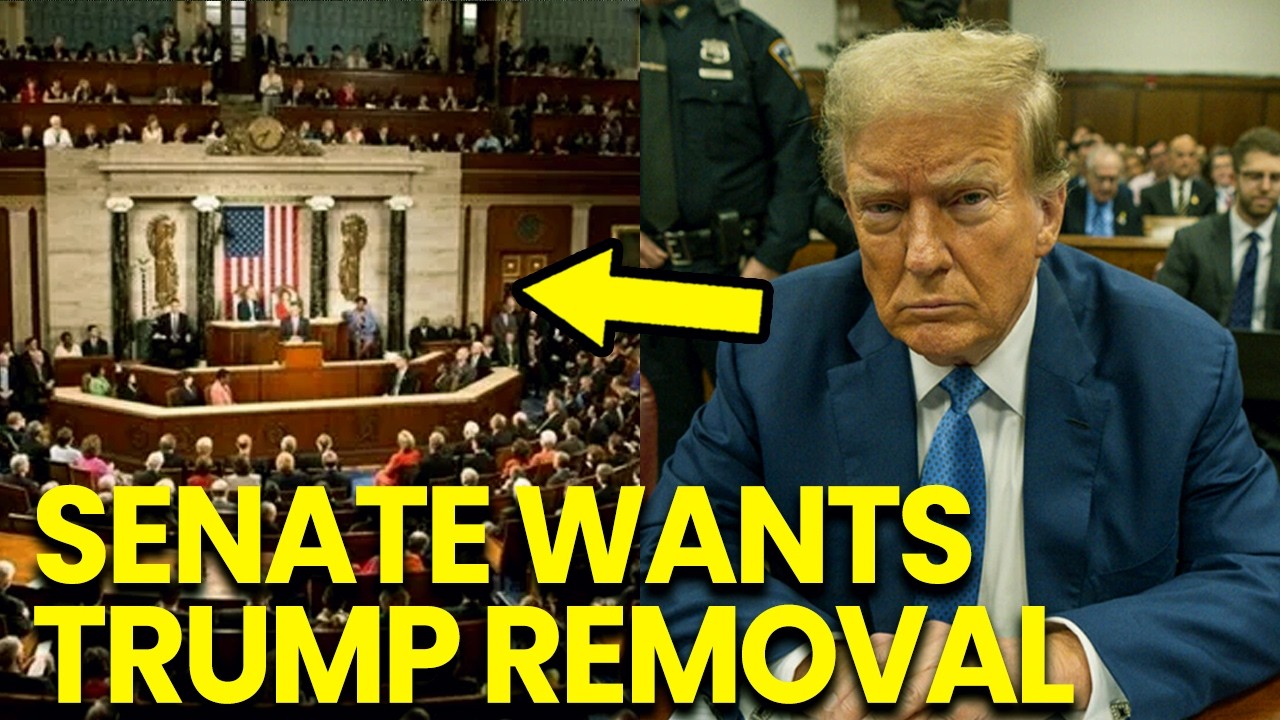
The United States has never removed a president through either impeachment conviction or the 25th Amendment. Yet the repeated invocation of both mechanisms within a single presidential term underscores the fragility of the current political equilibrium.
As the midterm elections approach, Democrats are weighing how aggressively to pursue accountability, while Republicans are calculating the risks of continued alignment with a president who remains popular with the party’s base but polarizing with the broader electorate.
For now, Mr. Trump remains firmly in office. But the architecture of removal — legal, procedural, and political — is no longer theoretical. It is being actively debated, drafted, and, in some cases, rehearsed.
Whether those debates ultimately culminate in action will depend less on constitutional text than on political will — and on whether the pressures now building inside Congress continue to intensify.