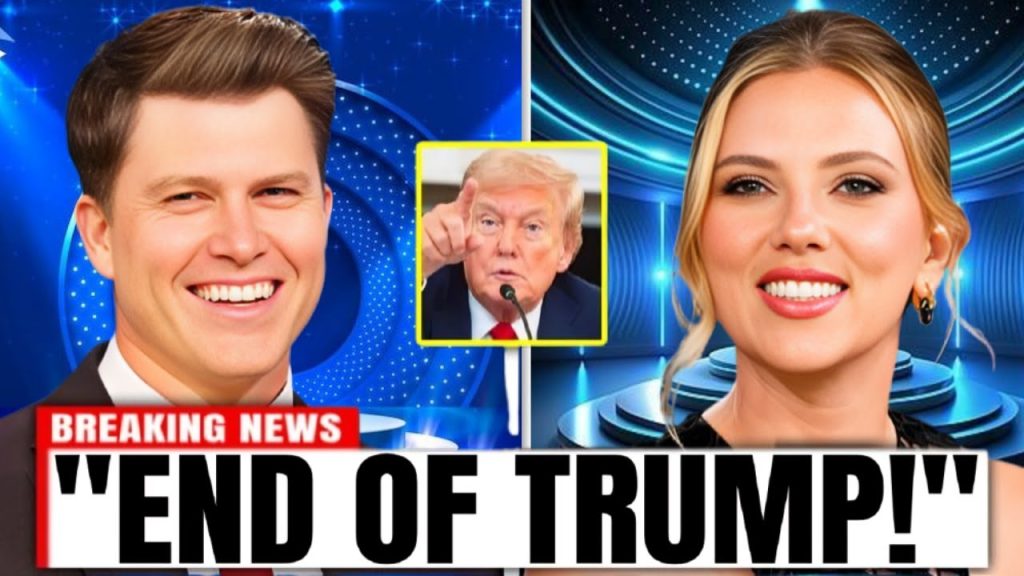
On a recent live television broadcast, what began as a familiar exercise in late-night satire took on a sharper, more revealing edge. Scarlett Johansson and Colin Jost, speaking with the rhythm and ease of seasoned performers, delivered a sequence of jokes aimed at Donald Trump that felt less like routine comedy and more like an extended critique of a political persona that has long blurred the line between governance and spectacle.
The segment did not rely on shouting or shock. Instead, its power came from accumulation. Jost opened with a barrage of observations about tariffs, repeating Trump’s own language until it collapsed under its excess. The repetition drew laughter, but it also exposed something more fundamental: a governing style that often substituted volume for clarity. Johansson followed with remarks that shifted the tone, grounding the humor in lived consequences, particularly for women and families navigating policy decisions shaped more by ideology than deliberation.
Together, they created a performance that felt unusually cohesive for live television. The jokes landed not because they were exaggerated, but because they mirrored a reality that audiences recognized. Trump’s public persona — the hyperbole, the grievance, the constant need for validation — has been so visible for so long that parody now requires only minor adjustment to feel incisive.
The studio’s reaction reflected this recognition. Laughter came quickly, but it was often followed by a brief pause, as if the audience were processing the implication beneath the punchline. That pause mattered. It suggested that the humor was doing more than entertaining; it was articulating a shared fatigue with a political style defined by chaos marketed as confidence.
Johansson’s contributions were particularly notable for their restraint. Rather than leaning into caricature, she approached Trump’s behavior as if analyzing a performance — gestures, tone, and affect — exposing insecurity beneath bravado. Her jokes carried the cadence of critique rather than mockery, turning what could have been ridicule into something closer to diagnosis.
Jost, for his part, framed Trump’s presidency as an extended improvisation, a series of decisions made with the urgency of a live broadcast and the foresight of none. He likened governance to a reality show that had lost its script but kept filming anyway, each crisis treated as a cliffhanger rather than a responsibility. The audience laughed because the metaphor felt uncomfortably apt.
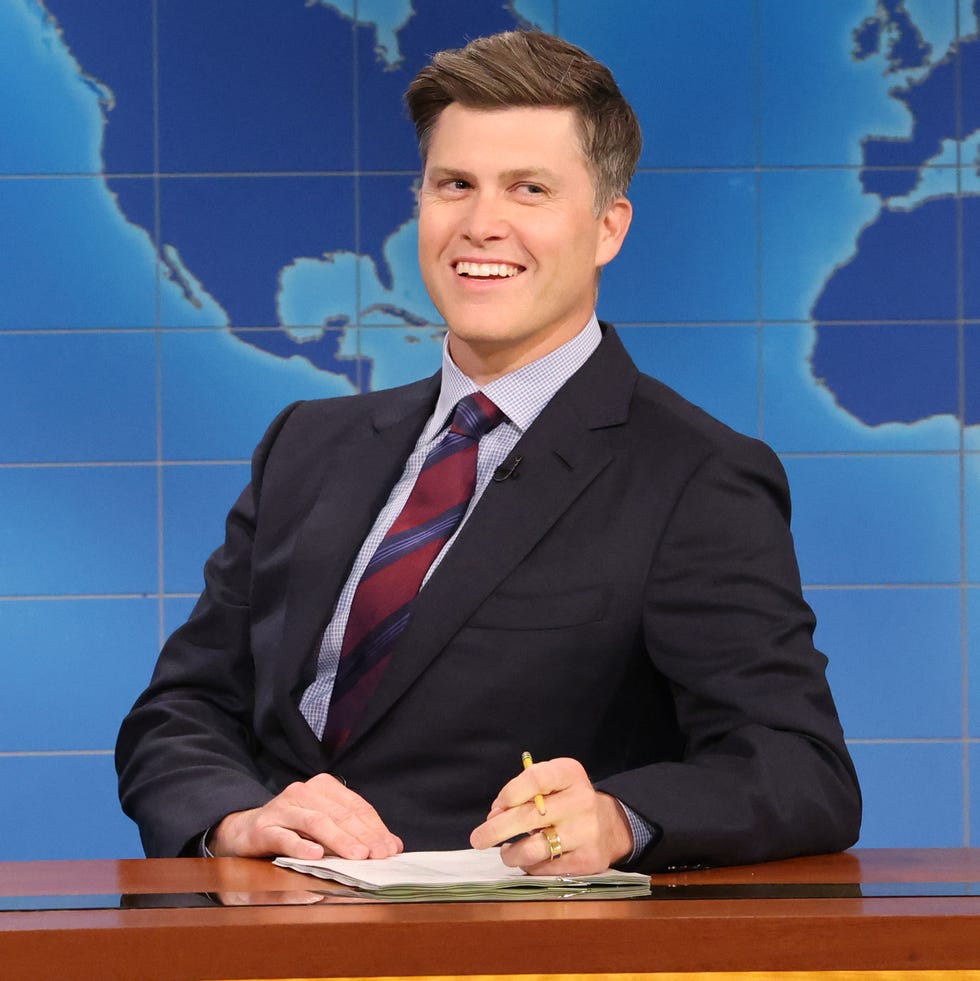
What distinguished the segment from countless other Trump parodies was its sense of proportion. Johansson and Jost did not attempt to summarize an entire presidency. Instead, they focused on patterns: the obsession with image, the transactional view of loyalty, the tendency to treat complex systems as personal branding exercises. In doing so, they avoided the trap of outrage, allowing humor to function as a lens rather than a weapon.
The jokes also touched on broader consequences. Economic policy became a recurring theme, portrayed as a high-stakes gamble driven by instinct rather than analysis. References to tariffs, market volatility, and international relations were framed not as abstract debates, but as decisions with tangible effects — on prices, stability, and public trust. The laughter these jokes elicited carried an edge, reflecting an awareness that mismanagement is rarely cost-free.
Cultural impact, too, was part of the subtext. The performers suggested that Trump’s greatest legacy may not lie in legislation, but in how he reshaped political discourse itself. Politics, under his influence, became louder, more theatrical, and increasingly detached from accountability. In that environment, comedy took on a dual role: both a release valve and a form of informal record-keeping.
Observers noted that the segment quickly gained traction online, with clips circulating widely across platforms. The appeal was not merely partisan. Even viewers fatigued by constant Trump coverage seemed drawn to the precision of the critique. It did not demand agreement so much as recognition.
Behind the scenes, such moments often provoke reaction. Trump has long demonstrated a sensitivity to televised criticism, particularly when it commands mass attention. The combination of Johansson’s cultural stature and Jost’s position within mainstream comedy made the segment difficult to dismiss as fringe commentary. It was delivered calmly, professionally, and without apology.
Yet the lasting significance of the moment may lie less in Trump’s response than in the audience’s. The applause was sustained, but it was not euphoric. It carried the tone of acknowledgment rather than celebration, as if viewers were recognizing something already understood but rarely articulated so cleanly.
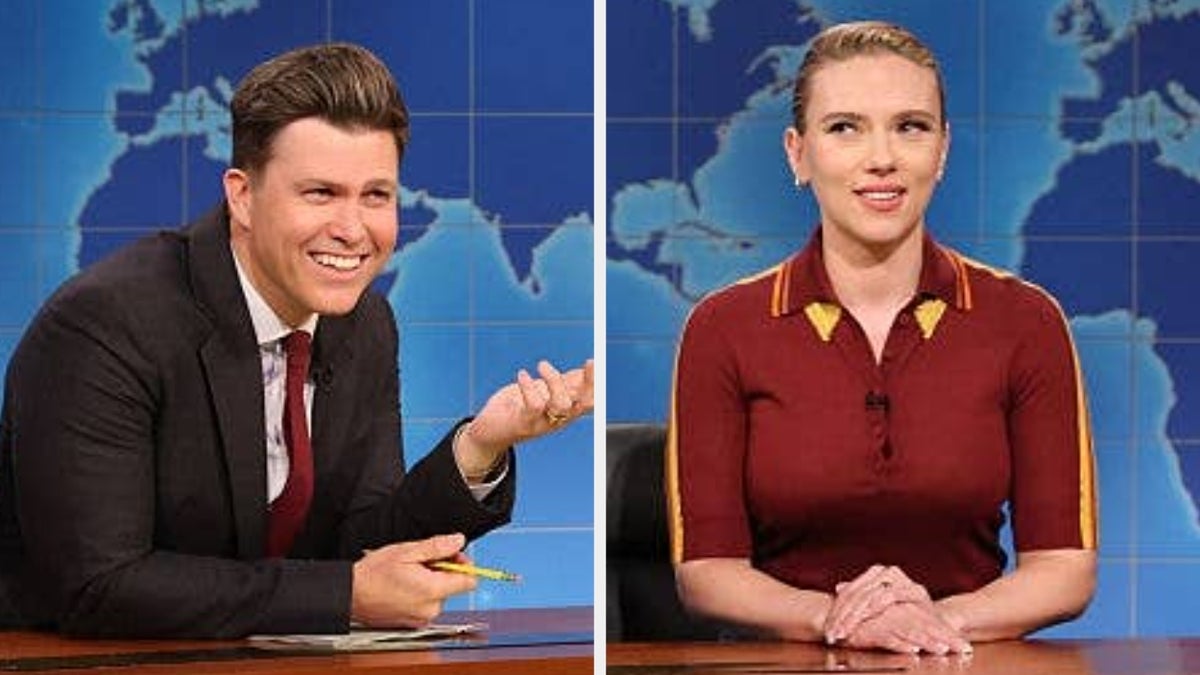
In the end, Johansson and Jost did not humiliate Trump so much as demystify him. Their performance stripped away the aura of inevitability that often surrounds powerful figures, revealing a presidency sustained as much by performance as by policy. The humor worked because it was grounded in observation, not exaggeration.
Late-night comedy has long occupied an uneasy space between entertainment and commentary. In moments like this, it leans decisively toward the latter. By turning laughter into a tool of clarity, Johansson and Jost offered more than jokes. They offered a brief, sharply lit portrait of a political era defined by spectacle — and a reminder that even the loudest performances eventually carry their own punchlines.






