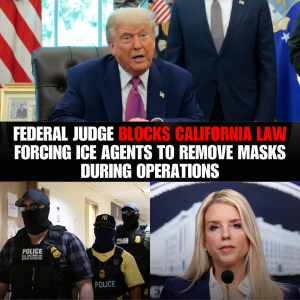
Los Angeles — A federal judge has temporarily blocked California from enforcing key portions of its controversial “No Secret Police Act,” ruling that the law, as written, likely violates the U.S. Constitution’s Supremacy Clause by improperly targeting federal law enforcement officers.
In a preliminary injunction issued by a U.S. District Judge in Los Angeles, the court barred California from enforcing the statute’s ban on federal immigration agents — including officers from U.S. Immigration and Customs Enforcement (ICE) — wearing masks during enforcement operations. The judge concluded that the law appeared to discriminate against federal officers by carving out exemptions for state and local law enforcement, raising serious constitutional concerns.

The ruling represents a significant setback for California lawmakers who championed the legislation as a transparency and civil liberties measure, while also underscoring the limits of state authority when it comes to regulating federal agencies.
Supremacy Clause at the Center
At the heart of the court’s decision is the Supremacy Clause of the U.S. Constitution, which establishes that federal law takes precedence over state law and prevents states from interfering with or discriminating against the federal government in the execution of its duties.
In the judge’s view, the No Secret Police Act crossed that line.
“The statute, as currently drafted, singles out federal officers for differential treatment,” the court wrote, noting that the mask prohibition applied to federal agents but not to California state or local police. That disparity, the judge said, created a substantial likelihood that the law would be found unconstitutional if allowed to take effect.
Federal attorneys had argued that the mask ban would endanger agents and undermine federal enforcement operations, particularly in sensitive or hostile environments. They also contended that states cannot impose operational restrictions on federal officers that do not apply to their own law enforcement personnel.
The judge appeared persuaded by those arguments, at least at this preliminary stage.
What Was Blocked — and What Wasn’t
Importantly, the court’s ruling did not strike down the entire law.
While enforcement of the mask ban against federal agents has been paused, the judge allowed a separate provision of the statute to remain in effect. That provision requires all law enforcement officers — including federal, state, and local — to display clear identification while on duty.
The court found that the identification requirement was more narrowly tailored and did not raise the same constitutional red flags, because it applied uniformly across all levels of law enforcement rather than singling out federal officers.
Civil rights advocates who supported the legislation emphasized this distinction, arguing that transparency can still be advanced through identification rules even as the mask issue remains in legal limbo.
Competing Visions of Transparency and Authority
California lawmakers who backed the No Secret Police Act said the law was designed to address public concern over masked law enforcement officers conducting operations without visible identification, which critics argue can blur accountability and fuel fear in immigrant communities.
Supporters of the legislation framed it as a response to high-profile enforcement actions that, in their view, resembled secret policing tactics inconsistent with democratic norms.
“This was about transparency and trust,” one state lawmaker said after the ruling. “Communities deserve to know who is exercising authority over them.”
Opponents, however, countered that masks are often used for officer safety, particularly in situations involving threats, harassment, or retaliation against agents and their families. Federal officials argued that the California law would have exposed agents to unnecessary risk and interfered with federal responsibilities.
The judge’s order reflects the tension between those competing concerns — transparency on one hand, and federal operational independence on the other.
Lawmakers Signal Possible Revisions
In response to the ruling, California legislators signaled they are already considering revisions to the law to address the court’s concerns. One option under discussion is rewriting the statute so that any mask-related restrictions would apply equally to all law enforcement agencies, including state and local police.
Legal experts say such a change could significantly alter the constitutional analysis.
“If California removes the discriminatory aspect and applies the rule uniformly, the Supremacy Clause problem becomes much more complicated for challengers,” said a constitutional law professor familiar with the case. “Uniformity matters a great deal in these kinds of disputes.”
However, even a revised law could face further legal challenges, particularly if federal agencies argue that any state-imposed operational rules — even neutral ones — interfere with federal authority.
What Happens Next
Because the injunction is preliminary, it does not represent a final ruling on the law’s constitutionality. The case will continue to move through the courts, where judges will more fully consider the merits of the legal arguments on both sides.
For now, federal immigration agents in California may continue to wear masks during operations, while still being required to display clear identification. State officials, meanwhile, must decide whether to revise the law, defend it as written, or pursue both strategies simultaneously.
The case highlights a broader national debate over the balance between state oversight, civil liberties, and federal power — a debate that is likely to intensify as states continue to push back against federal immigration enforcement in novel ways.
As the legal fight unfolds, one thing is clear: the boundaries between state authority and federal supremacy remain a central, and contested, feature of American constitutional law.