BY CUBUI
When Satire Becomes a Mirror: Trevor Noah, Donald Trump, and the Politics of Performance
On a late-night stage lit for laughter, Trevor Noah delivered what appeared, at first, to be a familiar roast of Donald Trump. The jokes landed quickly, the audience responded eagerly, and the cadence felt recognizably comedic. Yet beneath the humor, the performance operated as something more pointed: an examination of how spectacle has come to rival substance in modern political life.
Noah’s routine did not hinge on a single headline or controversy. Instead, it wove together years of public moments—press conferences, rallies, cultural flashpoints—to construct a portrait of a political figure whose relationship with attention has long defined his public presence. The jokes suggested that Trump moves through politics as though it were an extension of television, where volume, repetition, and confidence matter more than coherence or consistency.
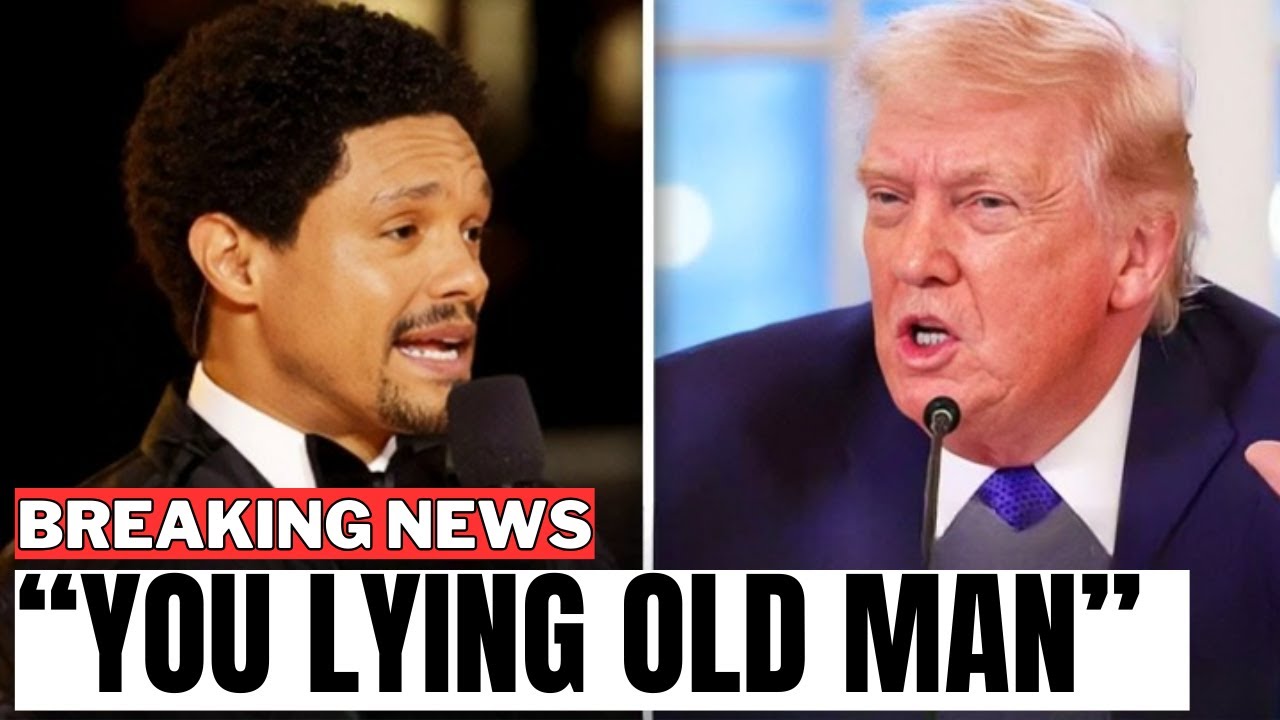
The set opened with references that blurred entertainment and geopolitics, invoking cultural moments such as the Grammy Awards alongside Trump’s past comments on international affairs. The juxtaposition was deliberate. In Noah’s telling, politics, celebrity, and global power now occupy the same stage, governed by similar rules: whoever commands attention controls the moment.
Throughout the routine, Noah returned to a recurring theme—Trump’s apparent comfort with improvisation. Facts, he suggested, are treated less as fixed points than as flexible materials, reshaped to suit the immediate audience. The humor likened political debate to a game where declaring victory matters more than demonstrating accuracy, an analogy that resonated precisely because it echoed how many viewers experience contemporary media.

Rather than depicting Trump as a traditional ideologue, Noah framed him as a performer driven by reaction. Applause, outrage, and constant visibility were portrayed as essential fuel. When praise is abundant, the performance continues smoothly. When challenged, the tone shifts—often sharply—toward confrontation. In this way, Noah’s satire echoed a broader media analysis: that conflict itself has become a governing strategy.
At several points, the routine moved from laughter toward reflection. Noah spoke about leadership not as an abstract ideal, but as a daily responsibility that demands engagement with expertise—scientists, economists, diplomats, and administrators whose work rarely fits into punchlines. In contrast, he portrayed Trump as someone who appears skeptical of such expertise, preferring instinct and assertion over consultation. The joke landed because it aligned with a widely observed pattern rather than a single disputed claim.
The audience laughter often carried an edge of recognition. Many of the moments Noah referenced—statements about international conflict, exaggerated claims of success, dismissals of criticism—are familiar to viewers across the political spectrum. Comedy, in this context, functioned less as persuasion than as translation, turning accumulated fatigue into shared understanding.
Yet Noah was careful not to present satire as harmless entertainment. He repeatedly implied that the ease with which spectacle replaces substance has consequences. When politics becomes performance, disagreement turns personal, institutions become props, and democratic norms risk being reframed as obstacles rather than safeguards. The humor, while sharp, consistently pointed back to that underlying concern.
In the final portion of the set, Noah widened the lens further, suggesting that Trump is not an isolated phenomenon but a symbol of a media environment that rewards extremity. Attention economics, he implied, encourage louder voices and simpler narratives, pushing nuance to the margins. Trump, in this view, did not invent the system but mastered it.
As the laughter faded, the routine ended not with outrage, but with a quiet recalibration. Noah suggested that comedy’s role is not merely to mock power, but to expose the assumptions that allow power to operate unchecked. By exaggerating what is already exaggerated, satire strips away the illusion that confidence alone equals competence.
The applause that followed reflected more than appreciation for jokes well told. It signaled recognition—of an era in which politics, media, and entertainment have become deeply entangled, and of the uneasy realization that laughter can coexist with serious consequence. In that space between humor and discomfort, Noah’s performance found its lasting impact.






